
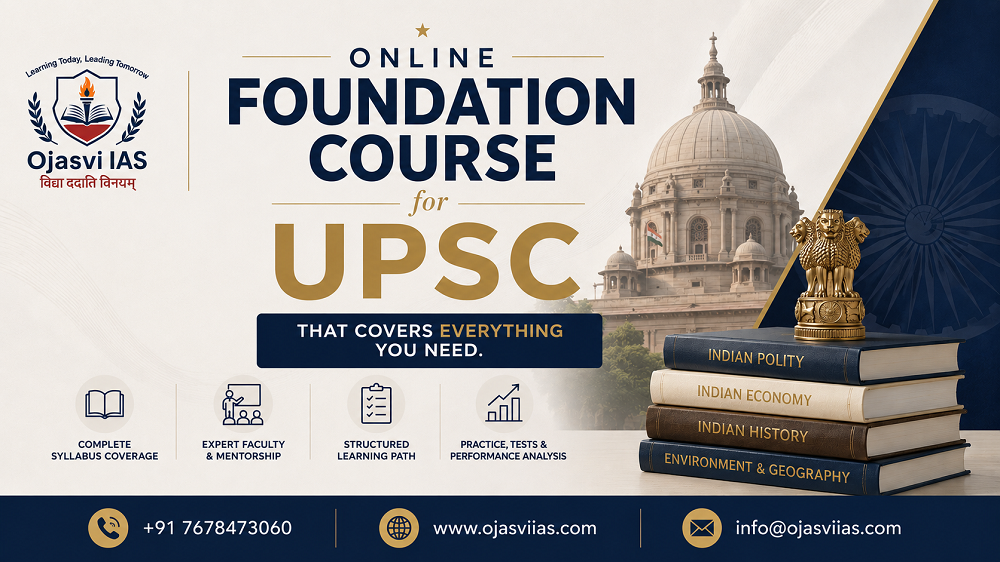
Every year thousands of aspirants sit down with a notebook, a schedule, and genuine determination to crack the Civil Services Exam. Most of them work hard. That part isn’t the problem. What trips people up is starting without a proper direction — jumping into topics randomly, covering some things twice and missing others entirely, and realizing months later that the base was never solid to begin with.
UPSC preparation is a lot like construction. You can’t rush the foundation and expect the rest to hold.
Why a Foundation Course Matters?
The syllabus is wide. The question patterns shift. And there’s no shortage of material to get lost in. An IAS Foundation course cuts through that noise by covering History, Geography, Polity, Economy, Environment, and Current Affairs in a sequence that actually makes sense — not scattered, not random, not whatever YouTube suggested that day.
That structure alone saves months. Aspirants who know what to study next spend their energy learning, not deciding.
The Advantages of Learning Online
Technology changed who gets access to good preparation and who doesn’t. A UPSC foundation course online means a student in a small town gets the same faculty, the same material, and the same depth as someone sitting in a Delhi coaching centre.
Recorded lectures you can rewatch. Flexibility to study around work or college. No relocation, no hostel, no commute. For working professionals and college students especially, that flexibility isn’t a luxury — it’s what makes consistent preparation actually possible.
What a Comprehensive UPSC Foundation Course Should Include?
Not all foundation programmes are built the same. A good online foundation course for UPSC goes beyond just covering the syllabus topics.
Concept building should go deeper than surface-level definitions. Current affairs need to connect back to static topics — otherwise they stay isolated facts that don’t show up in answers the way examiners want. Mock tests and practice questions tell you where you actually stand, not where you think you stand. And answer writing practice — often ignored until mains prep — needs to start early because it’s a skill, not something you switch on overnight.
Mentorship and doubt-clearing matter too. Preparation gets mentally heavy. Having someone to course-correct keeps aspirants from going in circles for weeks.
Developing Skills Beyond the Syllabus
Two aspirants can cover identical content and perform very differently on the exam. The difference usually comes down to analytical thinking, ability to approach a problem from multiple angles, and time management under pressure.
These aren’t things you develop by reading more. They come from engaged discussions, case studies, and the kind of structured practice that good foundation courses build in from the start.
Why Ojasvi IAS Stands Out?
There’s no shortage of coaching options. What’s rare is a programme that gives conceptual depth without becoming overwhelming. Ojasvi IAS is built around exactly that balance — structured curriculum, experienced faculty, and a learning approach that keeps students oriented without spoon-feeding them.
The goal is knowledge that sticks and thinking that’s exam-ready. Consistent, systematic progress with enough student autonomy to develop independent understanding. That combination is what keeps aspirants on track through a preparation journey that stretches over months.
Start Your Preparation with Confidence
Civil Services rewards preparation that’s fundamental, consistent, and strategic — not just intense. Starting with a proper UPSC foundation course is one of the better decisions an aspirant can make early on.
Whether you’re just beginning or need a structured path after some scattered self-study, a solid IAS foundation course gives you the grounding to move forward with clarity. The online flexibility combined with Ojasvi IAS’s approach makes that possible regardless of where you’re starting from — geographically or in terms of preparation level.
Frequently Asked Questions
1. What is a UPSC foundation course?
basically a structured starting point — covers History, Geography, Polity, Economy, Environment, and Current Affairs in a way that builds real understanding rather than just ticking syllabus boxes. most aspirants who skip it end up coming back to basics anyway, just later and under more pressure.
2. Who should enroll in an IAS foundation course?
beginners, college students, anyone who feels the syllabus is too scattered to approach alone. even aspirants who’ve been preparing for a while find it useful when their base has gaps — better to address that early than patch it during mains prep.
3. What are the benefits of a UPSC foundation course online?
flexibility, mostly. study when it suits you, rewatch what didn’t sink in, access the same faculty quality from wherever you live. for anyone outside the major coaching cities, that access used to be a real disadvantage. online removes it.
4. Does an online foundation course for UPSC include mock tests and answer-writing practice?
yes — and both matter more than most beginners realise. mock tests show you where your actual gaps are, not where you think they are. answer writing is a skill that takes months to develop, so starting it during foundation stage rather than right before mains is just smarter preparation.
5. Why should I choose Ojasvi IAS for UPSC preparation?
structured learning, faculty who know the exam pattern well, and an approach that focuses on conceptual clarity rather than just covering content fast. the mentorship side matters too — having guidance through a long preparation journey keeps you from losing direction when the syllabus feels overwhelming.