A new graduate can explain what Quality Score is, define a long-tail keyword and recite the stages of a funnel, then go quiet when a small business owner asks a plain question: where should the first few thousand rupees of ad budget go? Nothing in the vocabulary was wrong. What was missing was practice at making a decision when the answer is uncertain, and the money is real.
That gap is the central problem for anyone entering the field, and it begins with how training gets chosen. Most course pages promise practical learning and expert mentors in nearly identical language, so comparing digital marketing courses in India is more useful when you look past the promises. Check how much time each program gives to individual skills, whether students work on live accounts, and what the final certificate actually certifies.
Knowing the Terms Is Not the Same as Making the Call
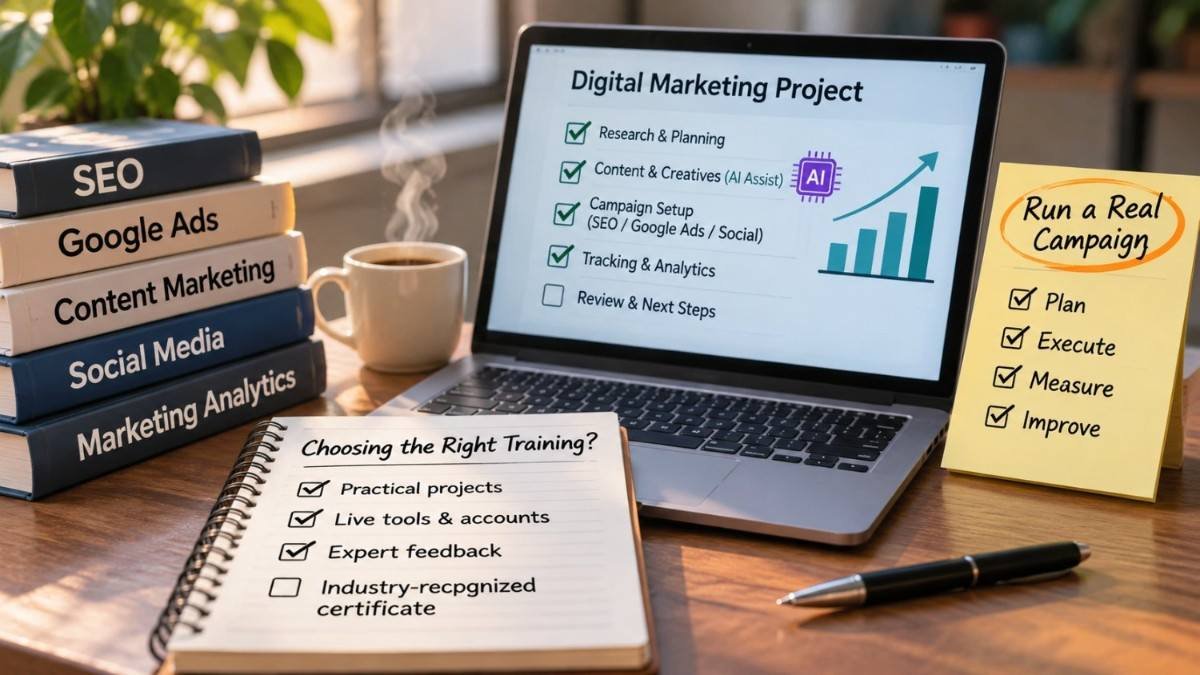
Digital marketing is several adjacent skills working together. SEO and keyword research bring people to a page, content marketing gives them a reason to stay, Google Ads and social media marketing buy or earn attention, and marketing analytics shows which of those efforts produced anything. A learner can memorise each piece separately and still be unable to connect them.
Consider a hypothetical neighbourhood bakery that wants more custom cake orders. A concept-level answer says to run search ads. A working answer starts with harder questions. Does the website make ordering easy on a phone? Are calls and form submissions being tracked? Which searches suggest someone is ready to order a cake, and which suggest they want a recipe? Is the budget large enough to learn anything from a month of data?
Each question draws on a different skill, and none has a textbook answer. That is why campaign planning is learned mostly by doing it and being corrected.
Four Ways to Test Whether Training Is Practical
Before enrolling anywhere, ask questions a landing page cannot easily dodge.
First, how deep does the coverage go? A syllabus listing forty topics at one hour each teaches less than one that covers fifteen properly. Second, will you work in a live ad account, a real website or a real analytics property, where mistakes have consequences, or only watch demonstrations? Third, who reviews your work, and how quickly? Feedback is where much of the learning happens. Fourth, what will you have at the end that someone else can inspect? A certificate issued by an institute mainly shows that you finished the course. A documented project shows what you can do.
Credentials deserve the same scrutiny. A certificate tied to a university or a major platform may carry more outside recognition than one an institute issues itself, because a third party stands behind it. Even so, neither replaces evidence of real work. Placement claims deserve a closer look too, since “placement support” can mean anything from resume feedback to a paid internship inside a working agency.
Be wary of any program that promises a specific salary or a guaranteed job. No training can honestly promise either.
Where AI Helps in a Real Project, and Where It Quietly Fails
AI tools now touch nearly every stage of campaign work. They can point out what a client brief leaves unsaid, group a few hundred search queries by intent, draft content outlines, and suggest ad copy variations. Google’s Search Central guidance says generative AI can be useful when researching a topic and adding structure to original content. That is a fair description of the job: a fast assistant for the first pass. For readers who want to see how that plays out across a whole project, a step-by-step walkthrough on using AI to complete a digital marketing project follows one campaign from brief to monthly report.
The failures are just as specific. A chatbot may call a keyword high volume and low competition without having seen any search data, and the sentence will sound as confident as a verified one. Ask it for Google Search ad headlines, and it may run past the 30-character limit, because language models are unreliable at counting. Google has also updated its guidance to advise checking AI-generated text by hand before it is published.
The remedy is a habit, not a tool. Use AI to generate options, then verify every number in Keyword Planner, Google Analytics or the ad platform itself, and leave the strategic decision to a person who understands the business.
Privacy needs the same care as accuracy. Customer names, phone numbers and order histories should not be pasted into public AI tools, and anyone handling that data should learn which privacy rules apply to the business they are working for. A sensible habit is to strip personal details from every export before asking a tool to analyse it.
Beginners should be careful here. Someone who already understands strategy can tell when an output is generic. Someone who leans on the tool in place of that understanding tends to produce work that a client notices quickly.
Proof Is Built From Decisions, Not Screenshots
Employers and clients generally want to see work: a campaign that ran, a site that improved, a report that explains results honestly. A portfolio entry should read like a short case file. State the goal and the constraints, the research behind the plan, what was launched, which numbers were tracked and why, what went wrong, and what changed afterwards. Note where AI was used and what you corrected, since that shows judgment. A short running log of what the tool suggested, what you checked and what you decided becomes useful evidence over time, and it shows you where the tool tends to mislead you.
The project does not need a paying client. A friend’s small business, a volunteer group or your own website can supply real constraints, as long as you are honest about scale and outcomes. Modest results reported accurately are worth more than impressive numbers nobody can verify.
Courses will keep multiplying, and tools will keep changing. The question that outlasts both is simple enough to ask before paying any fee, and again at the end of a program: can you take a vague business problem, build a plan you can defend, run it, measure it honestly and explain what you would do next? If so, the certificate is a footnote. If not yet, you know exactly what to practice.