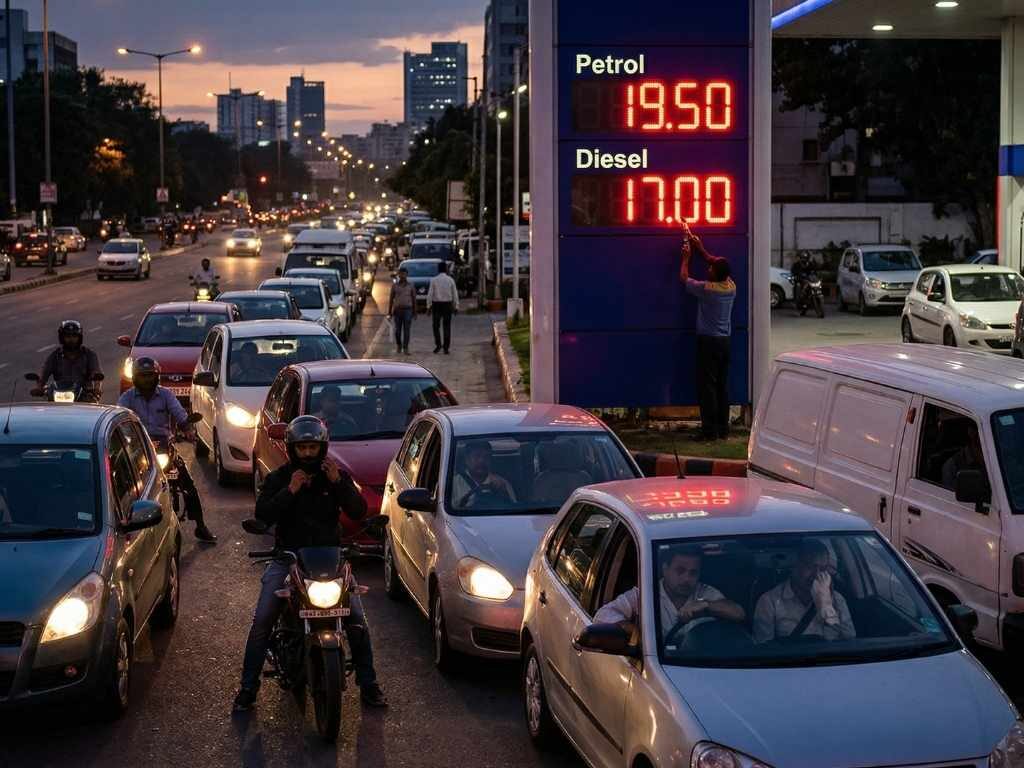
Have you recently pulled up to a gas station, stared at the numbers spinning relentlessly on the digital display, and felt a sudden urge to just walk everywhere instead? You aren’t alone. I vividly remember freezing at the pump a few days ago, genuinely shocked as it cost me a small fortune just to fill up my rather unassuming daily driver. The collective groan of motorists is echoing across continents right now, and for good reason.
Understanding the Petrol Price Today isn’t just an exercise in complaining about our commuting costs; it’s a fascinating, albeit stressful, window into a tangled web of global geopolitics, fragile supply chains, and market panic. Let’s unpack this maelstrom. We’re going to dive deep into exactly what the Petrol Price is doing right now and the myriad reasons why this essential commodity is Rising Worldwide.
The Reality at the Pump: Checking the Petrol Price Today
If you want to know the Petrol Price Today, you have to look beyond your local neighborhood. While we often casually refer to it as “gas” here in the States, petrol is a globally traded commodity, and the numbers we’re seeing right now are dizzying.
As of late March 2026, the global average cost of petrol sits at around $1.41 per liter. But averages rarely tell the whole story, do they? Depending on where you live, that number can seem like a wild underestimation or a jealous dream.
Breaking Down the Global Numbers
In the United States, the national average for a gallon of regular unleaded recently rocketed to roughly $3.98, marking a precipitous 34% hike over just a few weeks. Diesel is faring even worse, breaching the $5.35 mark.
Meanwhile, if you glance overseas, the situation is equally dire, if not worse. European countries, heavily reliant on imported energy, are seeing immediate surges, with places like Ireland hitting nearly €2.00 per liter. In Asia, where reliance on Middle Eastern shipping routes is acute, nations are scrambling. Cambodia, for instance, saw a staggering near-68% spike in just a couple of weeks, and Vietnam wasn’t far behind with a 50% jump.
So, what exactly shifted to make the Petrol Price jump so violently?
Why Is the Petrol Price Rising Worldwide?
When everyday commodities suddenly become luxuries, it’s rarely due to a single isolated event. The fact that the cost of fuel is Rising Worldwide stems from a chaotic confluence of international incidents.
The Middle Eastern Powder Keg
The primary culprit right now is the severe geopolitical imbroglio in the Middle East. Starting in late February 2026, a major conflict involving the United States, Israel, and Iran drastically destabilized the region. When war erupts in the world’s most critical energy-producing neighborhood, the ripple effects are instantaneous.
Oil markets inherently carry a “war risk” premium. When tensions simmer, traders price in the possibility of disruption. But when missiles actually fly, and energy infrastructure is targeted—like the recent strikes that severely damaged liquid natural gas export capacities in Qatar—that theoretical premium becomes a harsh reality.
The Strait of Hormuz Chokepoint
If you want to understand why the Petrol Price Today is causing global panic, look at a map and find the Strait of Hormuz. This incredibly narrow waterway sits between the Persian Gulf and the Gulf of Oman. Under normal circumstances, roughly 20% of the world’s total oil supply flows through this tight bottleneck.
Due to the ongoing conflict, traffic through the Strait has plummeted to a mere fraction of its historical average. Tankers are either stranded, rerouted, or simply refusing to sail through a high-risk combat zone. The International Energy Agency (IEA) recently flagged this as an unprecedented supply shock, noting that millions of barrels per day were essentially erased from the global market overnight. When you choke off one-fifth of the world’s oil, the Petrol Price has absolutely nowhere to go but up.
How This Supply Shock Ripples Through the Economy
It’s easy to think that a rising Petrol Price only affects you when you’re holding a fuel nozzle. Unfortunately, that’s just the tip of the iceberg. The reality of rising fuel prices worldwide bleeds into almost every facet of the global economy.
Paper Markets vs. Physical Barrels
There’s a fascinating, albeit troubling, dynamic playing out between “paper” oil (futures contracts traded on Wall Street) and the actual physical barrels of crude. While global benchmark futures like Brent crude have hovered between $100 and $110 a barrel, the physical cost of securing a cargo of oil right now is astronomically higher.
Refiners in Asia are paying massive premiums just to get their hands on crude from Africa or the Americas because Middle Eastern supplies are trapped. This disconnect means that even if the stock market tickers show a slight dip in oil futures, the Petrol Price Today at your local station remains stubbornly high. The raw material is simply too hard—and too expensive—to physically acquire.
The Unseen Toll on Everyday Goods
Think about how your groceries get to the supermarket. Or how your latest online order lands on your porch. Everything moves via trucks, ships, and planes. When diesel and aviation fuel skyrocket, logistics companies instantly slap fuel surcharges on their services.
Major transport companies in Europe and North America are already noting that fuel now makes up a massive chunk of their operating costs. Ultimately, businesses don’t absorb those costs out of the goodness of their hearts; they pass them right down to us. This creates a terrifying feedback loop of inflation. You pay more to drive to the store, and you pay more for the items once you walk through the automatic doors.
What Actually Drives the Petrol Price in Your Neighborhood?
If the global crude market is a disaster, why does the Petrol Price Today look so wildly different depending on whether you’re in Texas, London, or Mumbai?
Global crude oil is just the base ingredient. Several local variables cook up the final number you see on the sign:
- Taxes and Duties: This is the massive differentiator. Richer nations generally levy heavy excise taxes on fuel to fund infrastructure or push green initiatives. In the EU, taxes make up a huge percentage of the pump price. Conversely, the U.S. has relatively low federal gas taxes, which is why Americans historically enjoy cheaper fuel than their European counterparts.
- Currency Exchange Rates: Oil is traded in U.S. dollars. If you live in a country where the local currency is weakening against the dollar, importing oil becomes exponentially more expensive, causing the domestic Petrol Price to surge even if the global barrel price stays flat.
- Refining Capacity: You can’t put crude oil straight into a Honda Civic. It has to be refined. If regional refineries are down for maintenance—or if they’re struggling to source the specific type of crude their machinery handles best—local shortages occur, driving up the regional Petrol Price.
- Government Subsidies: Many nations heavily subsidize fuel to shield their citizens from market volatility. This keeps the pump price artificially low, though it drains national treasuries in the background.
Looking Ahead: When Can We Expect Relief?
If you’re desperately waiting for the Petrol Price to drop back to levels that don’t make you wince, you might need to practice some patience. The timeline for relief is entirely dependent on geopolitics.
Expert Forecasts and Worst-Case Scenarios
Financial heavyweights like Goldman Sachs and J.P. Morgan are watching the situation with bated breath. The consensus is that as long as the Strait of Hormuz remains restricted, the trend of costs Rising Worldwide will persist.
In optimistic scenarios—where peace talks (like the recently proposed 15-point U.S. framework) gain traction and shipping lanes reopen swiftly—we could see prices moderate later this year, potentially slipping back under the $80-a-barrel mark by late 2026.
However, the worst-case scenarios are sobering. If the conflict drags out and critical infrastructure remains offline, some analysts warn that Brent crude could shatter its 2008 historical records, potentially pushing toward $140 or $150 a barrel. Airlines are already bracing for this exact reality, trimming unprofitable routes and preparing for billions in extra fuel expenses. If that happens, the Petrol Price Today might actually look like a bargain in retrospect.
Final Thoughts on Navigating the Fuel Frenzy
We are currently navigating a deeply fragile global energy landscape. The fact that the Petrol Price is Rising Worldwide isn’t a random economic hiccup; it’s a direct reflection of real-world conflict, choked supply chains, and nervous markets.
While governments might tap into strategic reserves to try and cool things down—as the U.S. and other G7 nations have signaled they might do—these are temporary bandages on a gaping wound. Until the underlying geopolitical tensions ease and the flow of global crude normalizes, checking the Petrol Price Today will likely remain a slightly nerve-wracking part of our daily routines.
For now, carpooling, consolidating errands, and keeping a close eye on your budget are your best immediate defenses against a market that remains wildly out of our individual control. Hang in there, and drive safely.