
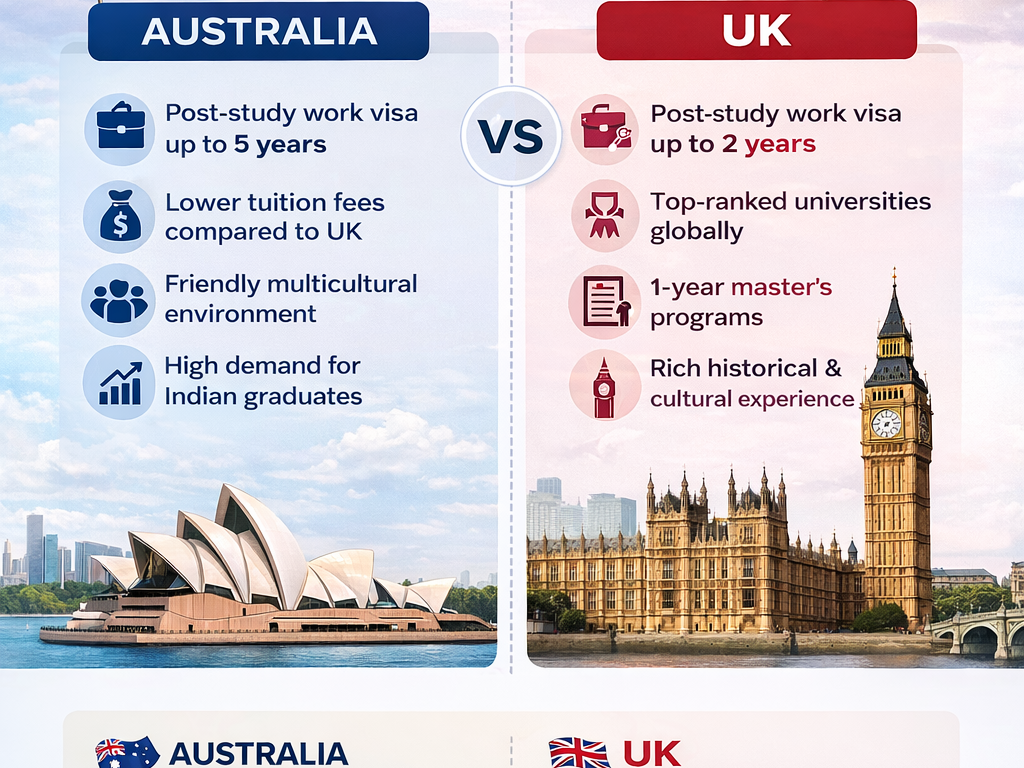
Every year, I speak to hundreds of Indian families who are torn between the UK and Australia. Both places have excellent universities, courses taught in English, and big Indian student communities that make the transition smoother. The big question that always comes up in our counselling sessions is simple: “Sir, Australia ya UK which one is actually better for us?”
The truth is, there isn’t one clear winner. It really comes down to what matters most to you and your family whether you want to finish faster and possibly spend less overall, or whether you’re thinking more about longer work rights, practical experience, and future settlement options. Let me walk you through the real differences based on what we’ve seen with students we’ve helped in 2025-26.
How the Courses Are Structured
The time difference between the two options marks their most significant difference. In the UK most bachelor degrees require three years of study while master programs typically require one year of study. The shorter duration of this program attracts students who want to finish their studies for financial savings while achieving their qualifications and entering the workforce.
Australia beats a lot on a bell-curved mean. Bachelors often consume a span of 3-4 years (averaging 3.5 years) while most master programs require 1.5-2 years to complete. Many Indian students actually like this pace because it gives more room for industry placements, projects, and hands-on training, especially in fields like engineering, IT, nursing, and business. It feels less rushed for some.
If your priority is speed and intensity from a system with centuries of prestige, the UK often suits better. If you want more practical depth and a steadier rhythm, Australia tends to feel more comfortable.
The Money Side – Tuition and Living Costs
Cost is usually the first thing families ask about. UK tuition for international students generally ranges from £10,000 to £38,000 a year (roughly ₹10.5–40 lakhs). Australian fees sit between AUD 20,000–45,000 (about ₹11–25 lakhs) for undergraduate, and similar or a bit higher for postgraduate.
Because UK master’s are shorter, the total tuition you pay for a complete degree is often lower than in Australia. That’s a real advantage for many middle-class Indian families.
Living costs tell another story. Outside London, you might spend £900–£1,400 per month in the UK. In Australian cities like Sydney or Melbourne, it’s closer to AUD 2,000–2,500 a month. Australia does allow students to work more hours up to 48 hours per fortnight during term time and unlimited during breaks which helps many students cover expenses better than the UK’s 20-hour weekly limit.
Australia has also updated its financial proof requirement to AUD 29,710 for living costs in 2026, so families need to show stronger evidence upfront. Overall, the UK can work out cheaper for the full degree, but Australia sometimes feels easier to manage month-to-month once you start earning through part-time work.
Student Visa Process in 2026
Both countries have tightened rules, but the experience is different.
For the UK, you need a Confirmation of Acceptance for Studies (CAS), proof of funds for tuition plus living expenses (currently around £1,171 per month outside London or £1,529 in London), English proficiency, and the visa fee is about £524–£558. Processing is usually quick often three to four weeks which many students appreciate.
Australia’s Subclass 500 visa requires a Confirmation of Enrolment (CoE), Overseas Student Health Cover (OSHC), a Genuine Student statement, and clear financial evidence (including the AUD 29,710 living cost threshold plus tuition and travel). The visa fee is higher (around AUD 2,000), and because India falls under a higher evidence level for some applicants, documentation needs to be thorough. Processing can take 35–60 days or longer in busy periods. The UK route generally feels lighter on paperwork for most Indian applicants.
Post-Study Work and Future Options
This is where Australia has a noticeable edge right now for many students.
In the UK, you get the Graduate Route visa currently two years of work rights after graduation (three years for PhD). However, from January 2027 onwards, this is being reduced to 18 months for bachelor’s and master’s graduates. The process of switching to a sponsored Skilled Worker visa requires two conditions to be met, which include achieving specific salary benchmarks and securing employment with a sponsoring company.
The Temporary Graduate Visa in Australia which is designated Subclass 485 allows you to stay for a period of two to three years which can extend further if you completed your studies in a regional area. The points-tested skilled migration system then offers a clearer path towards permanent residency, especially in areas like healthcare, engineering, data science, and teaching. Many students tell us the combination of decent part-time earnings during study and stronger post-study work rights helps them build savings and experience faster.
If long-term settlement or extended work experience is important, Australia currently feels more open for Indian students.
Lifestyle, Safety, and Indian Student Support
Daily life plays a big role too. The UK gives you historic cities, cultural depth, and easy access to the rest of Europe, great if you love that classic international student vibe. Weather can be cold and grey, and finding affordable housing in big cities like London is tough.
Australia offers plenty of sunshine, beaches, and a more relaxed pace that many Indian students say lowers their stress levels. Indian communities in Sydney, Melbourne, Brisbane, and even smaller cities are strong, with familiar food, festivals like Diwali, and active student groups. Both countries are generally safe for international students, though Australia’s regional campuses can feel even quieter and more secure.
Scholarships, university support services, and Indian societies are available in both places the choice often comes down to whether you prefer Europe’s energy or Australia’s outdoor, laid-back lifestyle.
Final Thoughts – It Depends on Your Goals
Neither country is universally “better.” If you’re looking for a shorter, potentially more affordable total degree, quick global recognition, and the prestige of UK universities, the United Kingdom is still an excellent choice.
If you value more practical learning, longer post-study work rights, better chances at building savings through work, and a clearer pathway to permanent residency especially in STEM, healthcare, or migration-friendly fields then Australia often makes more sense right now.
The key is to be honest about your priorities: budget, preferred course length, career plans, and how much post-study uncertainty you’re comfortable with. Many families we work with find it helpful to speak with experienced study in UK consultants for Indian students or study in Australia consultants for Indian students who can run personalised comparisons with the latest 2026 rules, do cost projections, and check eligibility properly.
Both the UK and Australia offer life-changing education and opportunities. The right one is simply the one that best matches what you want for the next five to ten years of your life.