Who should you hire? The short answer
Hire a traditional SEO firm if your site still has crawl, content or authority gaps, or if most of your buyers still start on Google. Hire an AI SEO company once those basics are solid and your buyers are asking ChatGPT, Perplexity or Google’s AI Mode for vendor shortlists. Most businesses end up needing both skill sets, from one team or from two.
The label on the proposal matters less than what the agency can show you.
Two proposals land on your desk in the same week. One promises page-one rankings. The other promises to get you “cited by AI.” Both come from nice people with decent decks, and both may be selling you mostly the same work under different names.
That’s the real trouble with this decision. Part of the gap between an AI SEO agency and a traditional SEO agency is genuine. Part of it is packaging. This guide separates the two, then maps the choice to your industry, your budget and the buyers you’re trying to reach.
Two facts that seem to contradict each other
First, clicks are leaking out of Google. Ahrefs compared 300,000 keywords and found that when an AI Overview shows up, the top-ranking page’s click-through rate runs about 58% lower than it would without one (December 2025 data). Position two loses about 51%. Pew Research’s browsing study of 900 U.S. adults points the same way: in March 2025, people clicked a regular result in 8% of visits to pages with an AI summary versus 15% without, and clicked a link inside the summary itself in only 1%.
Second, AI platforms still send very little traffic. SE Ranking put AI referrals at 0.32% of website visits across more than 100,000 sites in early 2026. Conductor’s benchmark, built on a different set of 13,770 domains, found 1.08%. Different samples, different numbers, same message: it’s a small slice of visits.
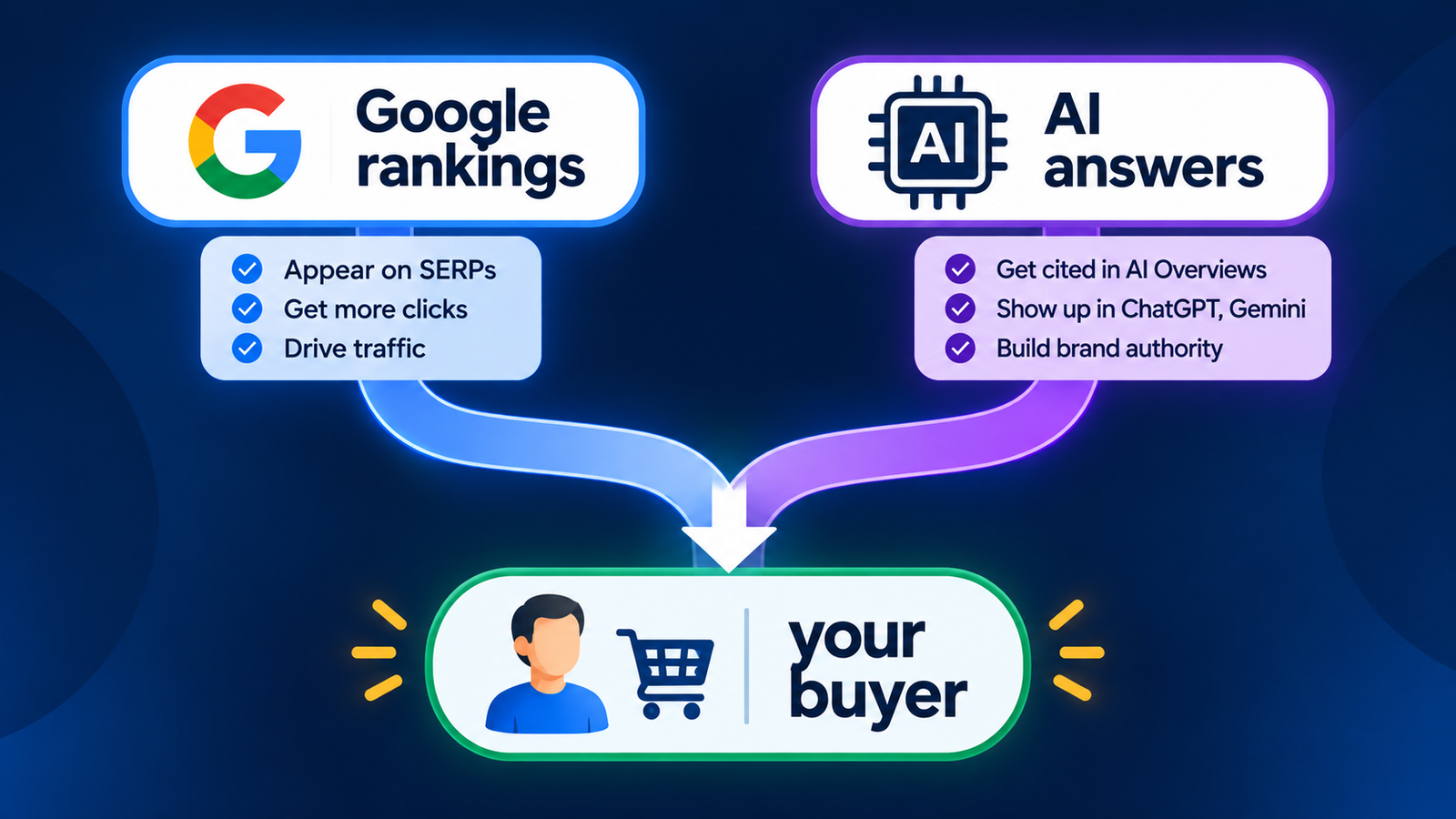
Both things are true at once, and that tells you something. Visibility is moving faster than traffic. Your buyers are getting answers, and forming opinions about vendors, inside AI products long before those products send many visitors. So the useful question isn’t “AI or traditional?” It’s “which of my buyers’ questions is my brand missing from, and what’s the cheapest honest way to fix that?”
What each type of agency actually does
Strip away the pitch decks and both agencies do the same three jobs: keep your site crawlable and fast, publish pages worth ranking or quoting, and earn mentions from other credible places. What changes is the scoreboard, and where each team goes looking for opportunity.
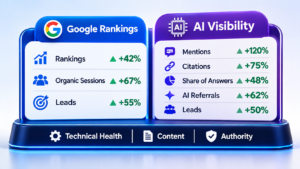
What is a traditional SEO firm? A traditional SEO firm improves how your pages rank in search results, mainly on Google and Bing, through technical fixes, keyword and intent research, content and link building. It reports on rankings, organic traffic and the leads that come from organic sessions.
What is an AI SEO company? An AI SEO company works to get your brand named, quoted or linked inside AI-generated answers in tools like ChatGPT, Perplexity, Gemini and Google’s AI Overviews and AI Mode. Its reporting adds mentions, citations and your share of answers on a set of buyer questions.
One warning before you compare proposals. “AI SEO company” is used for three different things: a firm that optimizes for AI answers, a firm that simply uses AI tools to work faster, and a vendor selling autonomous agent software. They’re not interchangeable. Ask which one is in front of you.
What genuinely differs
- Prompt-level tracking. Instead of (or alongside) keyword rank, the team checks a fixed set of real buyer questions across several AI products on a schedule and records who gets named. A few dozen questions is a workable start.
- Off-site presence. AI answers lean on sources beyond your own site. Pew found that Wikipedia, YouTube and Reddit together made up 15% of the sources listed in the Google AI summaries it examined. An AI-focused team spends real time on reviews, comparison pages, industry publications, community threads and video.
- Original, quotable substance. Google’s own guidance puts unique, non-commodity content first. A good AI-focused writer builds pages around claims, data and definitions that another site can’t simply copy.
- Multi-engine monitoring. Google, ChatGPT, Perplexity, Gemini and Claude each retrieve and cite differently. Watching one tells you little about the others.
What is mostly relabeling
When Google published its first official guide to generative AI features in May 2026, it said those features are rooted in its core ranking and quality systems. Coverage of the guide, including Search Engine Land’s summary, notes that you don’t need llms.txt files, special AI markup or pages chopped into tiny chunks to appear in Google’s AI Overviews or AI Mode.
Two honest caveats. Google speaks only for Google. ChatGPT and Perplexity run their own retrieval, and nobody outside those companies can promise what moves them. But if the headline deliverables in a proposal are an llms.txt file, “AI schema” and rewritten duplicates of your pages, you’re probably paying for ritual rather than results.
AI SEO company vs. traditional SEO firm, side by side
The two differ most in what they measure, where they look for gains and what they’re likely to miss.
| What to compare | Traditional SEO firm | AI SEO company |
|---|---|---|
| Main goal | Rank in search results and win the click | Be named or cited inside AI answers |
| Scoreboard | Rankings, organic sessions, leads from organic | Mentions, citations, share of answers on buyer questions, AI referral visits, leads |
| Where it looks for gains | Your site: technical health, content, links | Your site plus the third-party sources AI draws on |
| Content style | Built around keywords and search intent | Built around quotable claims, original data and clear definitions (and still keywords) |
| Likely blind spot | Never checks what AI says about you | Skips fundamentals, or promises control nobody has |
| Report to ask for | AI referral traffic and a sample of AI answers about your brand | The rankings and leads sitting behind the mentions |
| Best fit | Sites with technical, content or authority gaps; Google-first buyers | Sites with solid fundamentals; research-heavy buyers who use chatbots |
Why the scoreboard matters. Seer Interactive studied 53 brands and 5.47 million queries from January 2025 to February 2026. When an AI Overview appeared, cited pages earned about a 2.1% click-through rate, uncited pages about 0.9%, and searches with no AI Overview about 3.3%. Being cited doesn’t bring back every lost click, but it more than doubles your share of the clicks that remain compared with being ignored. An agency that never checks whether you’re cited can’t improve that number.
Industry by industry: who to hire first
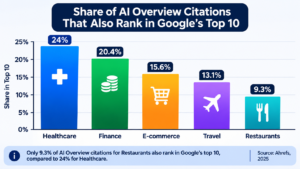
AI Overviews don’t behave the same way in every vertical. BrightEdge’s February 2026 study found they appeared on about 48% of the queries it tracks, and that the share of AI Overview citations that also rank in the organic top 10 swung from 9% in restaurants to 24% in healthcare. Intent matters as much as industry. Seer found AI Overviews on roughly 95% of comparison queries and 86% of question queries, but only about 5% of transactional ones. Note that “AI SEO agency vs traditional SEO agency” is itself a comparison query, which is exactly the kind AI answers love to summarize.
| Industry | Cited sources that also rank in the top 10 | Hire first | Why |
|---|---|---|---|
| Healthcare | 24.0% | Traditional firm with a medical-review process, then add an AI layer | Rankings and AI citations overlap most here, so classic authority work still feeds AI answers, and accuracy mistakes cost the most |
| Insurance | 22.4% | Traditional first, add AI tracking early | Similar overlap to healthcare, and compliance wording slows content down |
| Education | 23.1% | Hybrid, content-led | Heavy informational demand, so depth and original material decide who gets quoted |
| B2B SaaS and tech | 22.6% | Hybrid | Buyers compare vendors in chatbots, and comparison queries trigger AI answers almost every time |
| Travel | 17.7% | Hybrid with a reviews focus | Overlap jumped from 5.7% a year earlier, so rankings matter more than before, but third-party reviews still feed answers |
| E-commerce | 13.4% | Traditional and technical first | Transactional queries rarely trigger AI answers; product pages, feeds and category structure earn the sale |
| Finance | 11.3% | Hybrid with an off-site focus | Only about one in nine cited sources ranks on page one, so ranking alone won’t get you named |
| Restaurants | 9.3% | Local SEO first, plus listings and reviews | Lowest overlap in the study; answers pull from listings and review sites more than from restaurant websites |
Overlap figures are BrightEdge’s, February 2026. The “Hire first” and “Why” columns are editorial judgment, not findings from the study.
Some industries weren’t in BrightEdge’s data, so here is the same reasoning applied by judgment:
- Local services (dentists, clinics, home services). Start with traditional local SEO: Google Business Profile, reviews and location pages decide most leads. Add AI tracking later.
- Law firms. Hybrid. Informational legal questions invite AI answers, but new clients still arrive through phone calls, referrals and local results.
- Manufacturing and industrial B2B. Research cycles are long and technical. If your engineers and buyers shortlist suppliers in a chatbot, bring in the AI layer early. Confirm that with the test below rather than assuming it.
- Startups and thin sites. Traditional first. AI products can’t cite pages that don’t exist yet.
The five-minute test before you hire anyone
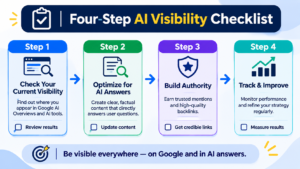
- Ask your last ten customers how they shortlisted you. Count how many mention a chatbot.
- In GA4, look at referral traffic from chatgpt.com, perplexity.ai, gemini.google.com and copilot.microsoft.com.
- Ask ChatGPT, Perplexity and Google’s AI Mode ten questions your buyers really ask. Write down who gets named.
- Search your ten most valuable queries on Google and note which ones show an AI Overview.
If chatbots barely show up in steps 1 and 2, and AI Overviews are rare on your queries, hire a traditional firm. If buyers mention chatbots and your competitors are named in step 3 while you aren’t, you need the AI layer.
What each option costs in 2026
There is no standard price list for AI SEO yet, and the best public survey of traditional SEO pricing is a few years old. Treat the ranges below as a way to sanity-check a quote, not as a quote.
| Provider type | Typical monthly retainer (USD) | Source and caveat |
|---|---|---|
| Freelancer | About $1,350 on average | Ahrefs survey of 439 providers, published 2023 and updated 2024, so likely a floor today |
| Local-market provider | About $1,560 on average | Same Ahrefs survey, providers serving local clients |
| Agency | About $3,200 on average; 48% of agencies charge $1,500 to $5,000 | Ahrefs average; band from a GoodFirms survey of 300+ agencies (April to May 2026) |
| Enterprise-level agency | $8,000 to $25,000+ | Indexable AI, which sells agent software and discloses its bias |
| AI search (GEO) services | $1,500 to $50,000+ | A WebFX guide (October 2026); the range is too wide to anchor on |
Three things move the price more than the AI label does:
- Where the provider is based. A Backlinko survey, as compiled by GTM 8020, puts US-based SEO services at roughly three to five times emerging-market rates.
- Contract length. Retainers are the dominant model (78% of providers in the Ahrefs survey), and 6 to 12 month minimums are common according to Indexable’s comparison.
- What’s bundled. Some agencies bill tools like Ahrefs or Semrush on top of the retainer. Ask.
What should the money buy? Senior hours, a named scope, a baseline in month one and a monthly report that ties work to leads. If a proposal adds an AI line item on top, ask which part of that extra work you will be able to measure by month three.
Six questions that separate real AI SEO from relabeled SEO
Whichever type you lean toward, put these to every agency on your shortlist. The answers tell you more than the case-study slide does.
| Ask this | A good answer sounds like | A warning sign sounds like |
|---|---|---|
| Can I see a real report with AI referral traffic and a prompt-tracking panel? | GA4 referrals from chatbots, plus a dated list of buyer questions showing who was named and where | Screenshots of a single prompt, or projections instead of data |
| What would you do in month one that isn’t on a normal SEO checklist? | Map buyer questions, audit third-party mentions, fix anything blocking crawling or indexing | “We’ll add an llms.txt file and AI schema” |
| How do you tell AI-specific work from plain SEO? | Separates Google’s guidance from how ChatGPT or Perplexity behave, and admits what’s unknown | Treats every engine as the same black box they’ve mastered |
| Who writes the content, and who checks it? | A named subject-matter reviewer and a fact-checking step | High volume of lightly edited AI drafts |
| What happens if rankings and citations don’t move in six months? | A defined review point, with scope or exit terms | Long lock-in and no review clause |
| How do you track what happens after the click? | Leads, calls or revenue tied to organic and AI referrals | Reporting stops at mentions and impressions |
Two more red flags need no table. Be wary of anyone guaranteeing rankings or guaranteeing citations in ChatGPT, because no outside party controls either. And be wary of a “proprietary AI system” that nobody will explain. For the full checklist and the promises no honest agency can make, see our guides on choosing an AI SEO agency and on AI SEO red flags.
Frequently asked questions
Is AI SEO different from regular SEO on Google?
For Google’s own AI features, mostly no. Google’s May 2026 guide says AI Overviews and AI Mode are rooted in its core ranking and quality systems, so the same unique, useful, crawlable content applies. The real differences show up on other platforms such as ChatGPT and Perplexity, and in how you measure visibility.
Can my current SEO agency just add AI search to what it does?
Some can, and the good ones will show you how. The test is practical: ask for AI referral traffic in GA4, a list of buyer questions where you are or aren’t named, and what they’d change in month one. If the answer is a new schema plugin and an llms.txt file, they’ve added vocabulary, not capability.
How much traffic will AI platforms actually send me?
Probably a small share for now. SE Ranking measured 0.32% of website visits across more than 100,000 sites in early 2026, and Conductor measured 1.08% on a different sample. Judge the channel by leads and revenue per visit, not by session count, and check your own GA4 rather than trusting averages.
Do I need to rank on page one to be cited in an AI Overview?
It helps, but the studies disagree on how much. Ahrefs found that 38% of cited pages also ranked in the top 10, down from 76% in its earlier version, according to Search Engine Journal’s report. BrightEdge measured about 17%. Method and keyword sets differ, so treat ranking as one input rather than a requirement.
Should a small business with a thin website hire an AI SEO company?
Not first. AI products can only cite what exists and what they can reach. If you have a handful of pages or unresolved technical issues, a traditional firm that fixes the foundation will usually return more per dollar. Add the AI layer once there’s something worth citing.
Is an AI agent platform a replacement for an agency?
It depends who owns the work. Agent platforms can speed up research, drafting and monitoring, but they still need an accountable person to set direction and approve what gets published. If nobody on your side can play that role, a human-led agency is the safer choice.
The bottom line
Use this as your decision rule:
- Google-first buyers, or a site with gaps in technical health, content or authority: hire a traditional SEO firm and ask it to report on AI answers too.
- Solid fundamentals and buyers who research in chatbots: add an AI SEO layer, and insist on prompt-level tracking and leads reporting.
- Both are true: pick one accountable team that can show you both scoreboards, or two teams with clear ownership of each.
The agencies worth hiring in 2026 won’t spend the sales call arguing that the other camp is obsolete. They’ll show you where your buyers look, where your brand is missing, and what it will cost to fix that.