As digital landscapes evolve, the demand for fast, responsive, and user-friendly websites has never been higher. Developers today face the challenge of delivering high-performance websites that not only engage users but also provide seamless experiences across various devices and platforms. Traditional monolithic content management systems (CMS) often fall short in meeting these demands due to their rigid, server-side architecture, which can slow down development and limit flexibility.
Enter the headless CMS. By decoupling the backend content management from the frontend presentation layer, a headless CMS allows developers to work more efficiently and build faster, more dynamic websites. This flexibility has led many businesses to adopt headless CMS solutions for their web development needs. One powerful combination that stands out in this space is Contentful Gatsby Integration, which allows developers to create blazing-fast, SEO-friendly websites with ease. This article explores how leveraging headless CMS solutions can accelerate frontend development and improve the overall website performance.
The Rise of Headless CMS and Its Advantages
A headless CMS is essentially a content management system where the content repository (the backend) is separated from the delivery layer (the frontend). This approach provides greater flexibility, scalability, and efficiency, making it an attractive option for developers looking to streamline their workflow. Unlike traditional CMS platforms, which couple content storage and presentation in one system, headless CMS solutions allow developers to use any frontend technology to retrieve and display content, typically via an API.
The primary benefit of a headless CMS is that it decouples the content management from the frontend delivery, enabling more control over how content is displayed and delivered. Developers are no longer confined to a particular template or theme and can instead build custom, highly performant websites using modern frontend frameworks like React, Vue, or Angular. This freedom results in faster, more responsive websites that are better suited to meet the needs of users in today’s fast-paced digital environment.
1. Improved Speed and Performance
One of the most compelling reasons to choose a headless CMS for frontend development is the performance boost it offers. With a headless CMS, content is delivered via APIs, meaning the frontend and backend are independent of each other. This results in faster load times and a more responsive website, as the frontend can directly pull data from the backend without waiting for the server to process content dynamically.
Moreover, headless CMS solutions like Contentful provide the ability to manage content centrally while allowing for multiple frontend technologies to interact with it. This flexibility means that developers can choose the best tool for the job, optimizing the frontend code to enhance site speed and performance.
2. Better Flexibility and Scalability
Headless CMS platforms offer a high degree of flexibility and scalability. Unlike traditional CMS systems, which can become bogged down with over-complicated workflows and a lack of customization options, a headless CMS allows businesses to scale easily. As content grows, developers can adapt the architecture to meet new needs without overhauling the entire system.
Additionally, since the frontend is decoupled from the backend, businesses can add new channels and platforms—such as mobile apps, smart devices, or IoT—without disrupting their existing setup. This scalability is crucial for businesses that need to expand rapidly while ensuring a consistent experience across multiple touchpoints.
3. Faster Development Cycles
The decoupling of frontend and backend also accelerates the development process. Developers can work on the frontend independently from the backend, allowing them to focus on building a user-centric, custom experience. Furthermore, since content is delivered via APIs, content updates are instantly reflected on the frontend, without requiring a manual refresh or deployment process.
This makes iterating on designs and features faster, reducing the time it takes to launch new features and content updates. By using a headless CMS, businesses can ensure a faster time-to-market for new digital experiences, which is essential in staying competitive in today’s digital-first world.
Contentful Gatsby Integration: A Powerful Solution for Faster Frontend Development
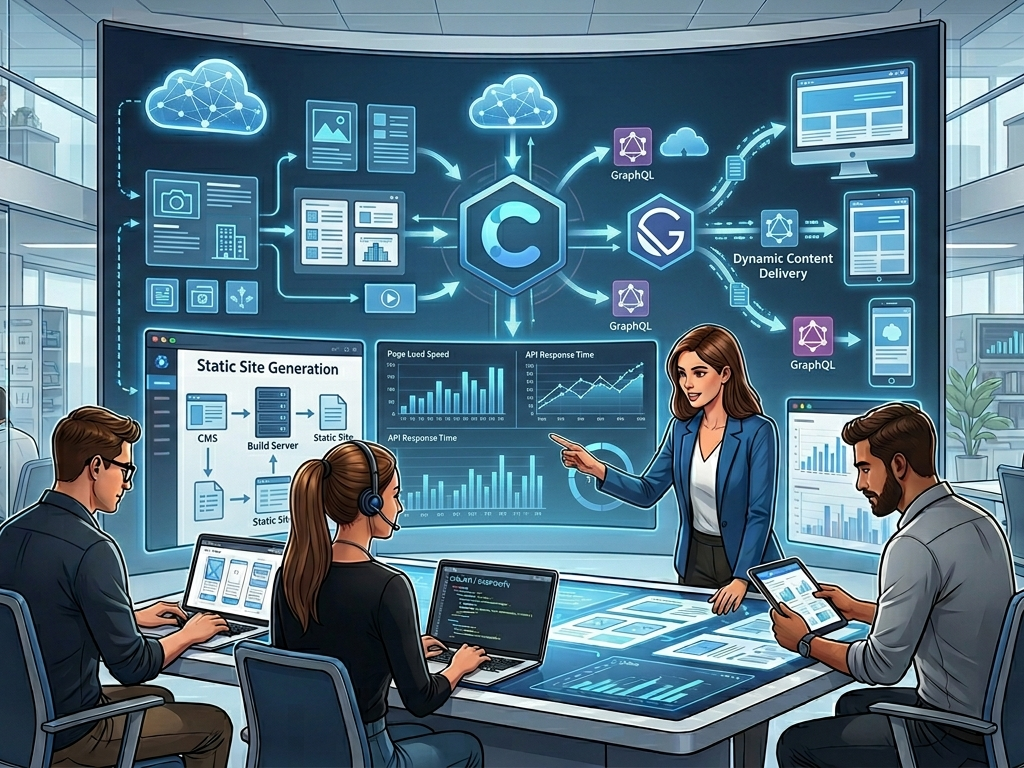
When it comes to combining headless CMS with modern frontend frameworks, the Contentful Gatsby integration offers a powerful solution. Gatsby is a static site generator that works seamlessly with headless CMS platforms like Contentful to deliver fast, SEO-friendly websites. By pulling content from Contentful via APIs and using Gatsby’s static site generation capabilities, developers can create websites that load extremely fast, providing an excellent user experience.
Gatsby allows developers to build React-based static websites that are highly optimized for speed, while Contentful acts as the content repository. By integrating Contentful with Gatsby, developers can achieve the best of both worlds: a highly customizable, fast-loading website, with a flexible content management system in the backend. This integration also makes it easy to manage content across different platforms, ensuring consistency and efficiency throughout the development process.
Moreover, Gatsby’s ability to generate static sites that can be served from a CDN (Content Delivery Network) further enhances site performance. Static sites have an edge over dynamic sites because they can be pre-rendered, reducing server load and speeding up response times. The Contentful Gatsby integration allows businesses to leverage these benefits while still maintaining the ease of content management that Contentful offers.
Key Benefits of Using Contentful with Gatsby
1. Lightning-Fast Performance
The combination of Gatsby’s static site generation and Contentful’s headless CMS structure results in incredibly fast websites. Since Gatsby pre-renders the website’s pages during the build process, the content is served as static files, which load almost instantly. This is especially important for businesses aiming to provide the best user experience possible, as page load speed directly affects user engagement and SEO rankings.
2. SEO Optimization
In today’s digital landscape, SEO is critical to driving traffic and increasing visibility. Gatsby’s static site generation is optimized for SEO, with features like pre-built sitemaps, metadata integration, and automatic optimization of images. Coupled with Contentful’s easy-to-manage content structure, businesses can ensure that their websites are SEO-friendly without requiring manual updates for each individual page.
Additionally, since Gatsby generates a static site, search engine crawlers can index the content more easily, resulting in better search engine rankings. This is particularly useful for businesses looking to attract organic traffic and improve their digital presence.
3. Streamlined Content Management
The Contentful Gatsby integration simplifies content management by keeping everything within Contentful’s user-friendly interface. Content creators and marketers can easily update content in Contentful, which is automatically reflected on the site. This seamless workflow enables businesses to manage content efficiently, without needing to rely on developers for every update.
Moreover, since Gatsby builds the site ahead of time, the entire content pipeline—from creation to deployment—becomes more streamlined and predictable. Contentful provides an intuitive interface for content creators, while Gatsby ensures the site is built, optimized, and deployed quickly.
4. Scalability and Flexibility
The decoupled nature of the Contentful Gatsby integration allows for immense scalability and flexibility. As businesses grow, they can easily add new features, channels, and content types without affecting the entire system. For example, if a business wants to expand its content distribution to mobile apps or other platforms, it can do so seamlessly with Contentful and Gatsby’s API-driven approach.
Additionally, Gatsby’s plugin ecosystem allows developers to extend functionality as needed, while Contentful’s robust API provides flexibility in how data is delivered and consumed.
Overcoming Challenges in Headless CMS Adoption
While the benefits of headless CMS and Contentful Gatsby integration are clear, there are challenges to consider when adopting these solutions. One common challenge is the learning curve for developers, especially those used to traditional monolithic CMS platforms. It may take time to get accustomed to working with APIs, static site generation, and integrating multiple systems.
However, the long-term benefits, including faster load times, greater flexibility, and scalability, far outweigh the initial investment in learning and implementation. Additionally, the growing community around Gatsby and Contentful, along with the availability of resources and tutorials, makes it easier for developers to get up to speed.
Conclusion
Leveraging a headless CMS like Contentful combined with modern frontend frameworks such as Gatsby can significantly improve frontend development speed and efficiency. By decoupling content from the presentation layer, businesses can streamline workflows, enhance performance, and offer a more flexible, scalable solution for their web applications. The Contentful Gatsby integration exemplifies this powerful combination, allowing businesses to create fast, SEO-friendly websites with ease.
For businesses looking to build high-performance websites with minimal friction, adopting headless CMS solutions like Contentful, in combination with tools like Gatsby, is a step toward modernizing their content management infrastructure. As digital transformation continues to shape the way we create, manage, and consume content, headless CMS will remain a vital component in delivering fast, dynamic, and personalized web experiences