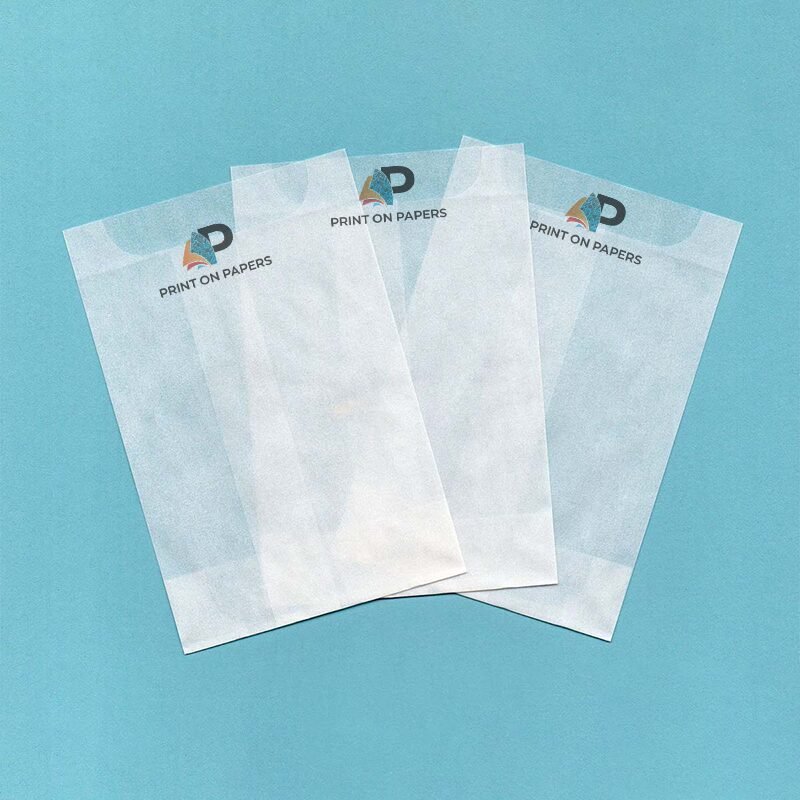
Custom glassine paper is a smooth, slightly see-through sheet that protects products from grease, light moisture, scuffs, and fingerprints, while carrying your logo. It’s used for wrapping bakery items, separating layers, and finishing gift and retail packaging. Here’s how it works and how to choose the right grade. You can see the full specs on the Custom Glassine Paper page at Print On Papers.
What Is Glassine Paper?
Glassine is a dense, glossy paper made by running wood pulp through heated, polished steel rollers under high pressure, a process called super calendering. That squeezes the fibers tight, leaving a very smooth, semi-translucent sheet with almost no pores.
Grease and moisture resistance comes from that fiber density, not from an added coating. That’s the main difference from wax paper, which gets its barrier from a coating layer. Uncoated glassine is also acid-free, pH-neutral, and recyclable.
How Does It Protect Products?
Glassine protects by forming a clean, smooth barrier between your product and everything around it. It’s thin, but it handles several jobs well.
- Blocks grease and light moisture. Good for buttery pastries, cookies, and oily foods.
- Prevents sticking and scuffing. Used as interleaving paper between layers, so items don’t rub or stick together.
- Keeps surfaces clean. A wrap keeps fingerprints and dust off finished products.
- Protects delicate items. Acid-free, pH-neutral sheets are safe for prints, photos, and documents.
- Looks good. The translucent finish lets customers see a hint of the product, which suits gift and retail packaging.
Which Glassine Grade Should You Choose?
The right grade depends on how much moisture protection or non-stick performance you need. Print On Papers prints three types.
| Grade | What it adds | Good for |
|---|---|---|
| Uncoated glassine | Natural grease resistance, recyclable | Bakery wrap, deli paper, interleaving, tissue wrap |
| PE-coated glassine | Stronger moisture barrier and heat-sealability | Food wrapping where liquid contact is possible |
| Silicone-coated glassine | Non-stick release surface | Pan lining, pastry separation, confectionery wrap |
If you aren’t sure, start with uncoated for general wrapping and ask the team to recommend a grade for your product.
What Paper Weight Do You Need?
Paper weight is measured in GSM, and a higher number means thicker paper. Glassine comes in three ranges.
| Weight | Best for |
|---|---|
| 25–35 GSM (light) | Delicate wrapping, tissue-style layers, small items |
| 35–50 GSM (standard) | Everyday bakery, deli, and retail wrapping |
| 50–70 GSM (heavy-duty) | Larger or heavier items, rougher handling |
Most businesses use the standard range. Go lighter for dainty wrapping and heavier for products that need more strength.
What Else Can You Choose?
The page lists extra coating options for specific needs: silicone for heat and release, a polymer coating for water resistance, and an acrylic or UV coating that helps prevent yellowing in archival uses. You can order flat sheets, rolls, or die-cut formats, in any size you specify.
Who Uses Printed Glassine?
| Business | How they use it |
|---|---|
| Bakeries and pastry shops | Pan lining, pastry paper, product separation |
| Delis and sandwich counters | Wrapping and display lining |
| Confectionery and gift brands | Branded wrapping tissue for candy and treats |
| Cosmetics and boutique retailers | Wrap for soaps, candles, and small products |
| Archival and fine art suppliers | Interleaving for prints, photos, and documents |
A bakery in New York and a boutique in California can use the same sheet for different reasons, and both get a more polished presentation.
How Should You Design Printed Glassine?
Keep it simple, because glassine is translucent and ink shows differently than on solid white paper. A repeating logo pattern or a small centered mark looks clean, and light colors may look softer than they do on white stock.
Print On Papers prints in full-color CMYK with Pantone matching for exact brand colors. Flexographic printing suits large runs and repeat patterns, and digital printing handles short runs and samples. Inks are soy-based and water-based. You’ll get a flat digital proof before printing, a physical sample on request, and free design support if you only have a basic logo.
Is Glassine Food Safe?
Yes, when it’s made for it. Print On Papers states that its food-contact glassine meets FDA 21 CFR standards, is PFAS-free across all grades, and is FSC-certified. If your paper will touch food, ask for the compliance documents with your quote.
PFAS matters more every year, since a growing number of US states restrict it in food packaging. PFAS-free paper now means fewer changes later.
Is Glassine Eco-Friendly?
Uncoated glassine is recyclable, and biodegradable variants are available. If you print “recyclable” or “biodegradable” on your packaging, keep the wording accurate. The FTC’s Green Guides set the rules for environmental claims, and coated grades may be handled differently, so confirm what your exact paper qualifies for.
How Long Does It Take?
Plan on about 6–7 business days for printing and 4–5 business days for shipping, plus time to approve your proof. The quote form offers Standard (10–15 days) or Express (6–8 days) shipping, and shipping is free. The U.S. Small Business Administration notes that supplier lead times are a common pressure point for small businesses, so order a little ahead of busy seasons.
Frequently Asked Questions
What is glassine paper used for?
It’s used for wrapping food, lining pans, separating layers, and protecting products and prints. Its smooth, translucent finish also suits gift and retail packaging.
What is the difference between glassine and wax paper?
Glassine gets its resistance from dense fibers made by supercalendering, while wax paper relies on an applied wax coating. Glassine also has a smoother, more translucent look.
How much does custom glassine paper cost?
The price depends on grade, weight, size, colors, and quantity. Larger orders lower the cost per sheet, so ask for a quote at a few quantities.
How do I order custom glassine paper?
Fill out the quote form with your grade, size, color options, and quantity, then upload your logo. You’ll get a digital proof to approve before printing starts.
What is the minimum order quantity?
Small businesses and larger brands can both order. Confirm the exact minimum for your grade and size when you request a quote.
Is glassine paper safe for direct food contact?
Food-contact grades meet FDA 21 CFR standards and are PFAS-free. Ask for the documentation if you need it for your records.
Conclusion
Custom glassine paper protects products quietly and well, blocking grease, preventing scuffs, and adding a clean, translucent finish that carries your brand. Choose a grade for your product, pick a weight that suits how it’s handled, and keep your design simple enough to look good through a translucent sheet. Check your proof before printing and plan a little ahead.