
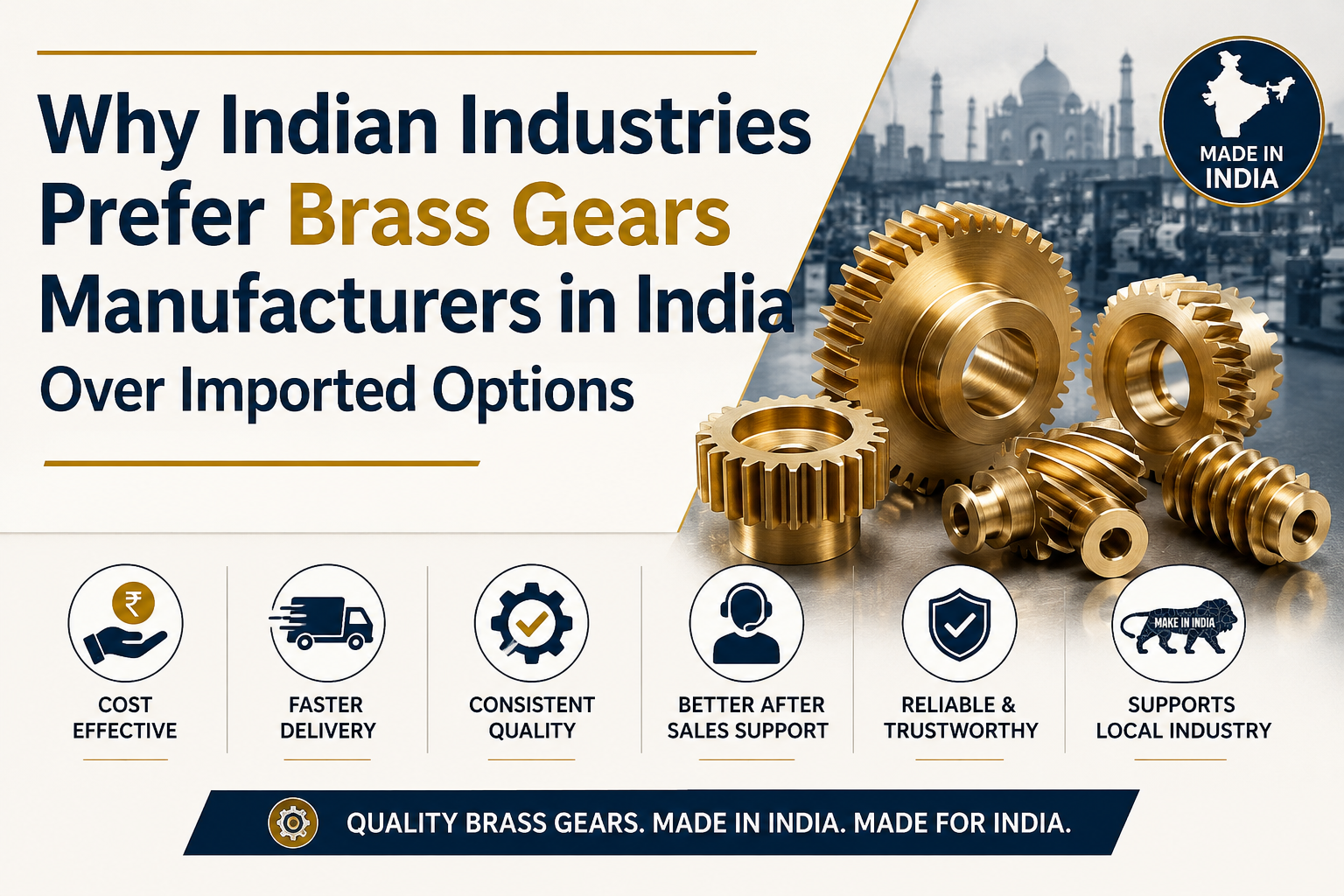
That reality has changed how Indian manufacturers source transmission components over the last few years. Procurement teams that once depended heavily on imported assemblies are now shifting toward experienced Brass Gears Manufacturers, domestic Spline Shaft Manufacturers, and local Worm Gears Manufacturers because the real cost is no longer the component price alone. It is the downtime, the shipment delay, the unanswered email after installation problems begin, and the weeks wasted waiting for replacements stuck at ports.
And frankly, many buyers are tired of suppliers who disappear once payment clears.
Indian manufacturers have improved fast. CNC machining standards are tighter, inspection systems are more disciplined, and factories supplying export markets now understand that repeatability matters more than polished catalogs. According to India Brand Equity Foundation data, engineering exports from India crossed USD 109 billion in FY 2023–24. That growth did not happen because buyers were being generous. It happened because Indian engineering suppliers became difficult to ignore.
Why Imported Gear Components No Longer Feel Like the Safe Option
Ten years ago, imported gears carried a perception of guaranteed quality.
Today, buyers are more skeptical.
A lot of imported inventory reaches India through traders who never touched the factory floor themselves. One shipment performs perfectly. The next develops wear issues within months because the alloy composition changed quietly somewhere upstream. Nobody accepts responsibility. The trading company blames the factory. The factory blames the subcontractor. Meanwhile, the buyer is dealing with machine downtime and angry clients.
That’s where local sourcing starts looking less risky.
An experienced Brass Gears Manufacturers network in India can often provide faster technical clarification, replacement support, and direct production communication without dragging the issue across four countries and three time zones.
The Tolerance Problem Buyers Usually Discover Too Late
Most procurement teams focus heavily on dimensions and ignore finishing quality.
Which is understandable. Drawings show dimensions clearly. Tooth finishing quality is harder to evaluate unless you know exactly what to inspect.
But poor finishing creates vibration, noise, uneven wear, and backlash issues later under continuous load conditions. The component may technically match the drawing and still perform badly inside the assembly.
That mistake gets expensive very quickly.
Cheap Imports Are Not Always Cheap
A supplier offering lower prices upfront often looks attractive during procurement review meetings.
Then freight costs jump unexpectedly.
Or customs clearance takes three extra weeks.
Or replacement stock becomes unavailable for 45 days because the original batch came through a consolidator instead of direct manufacturing channels.
Suddenly the “cost-effective” purchase starts damaging production schedules.
Most experienced buyers have lived through this at least once since 2021.
Specification Details Serious Buyers Actually Compare
Spline Shaft Load Distribution Matters More Than Most Catalogs Admit
A properly machined Spline Shaft spreads torque across multiple teeth instead of concentrating stress at a single point like traditional keyed systems.
That becomes critical in:
- Heavy machinery
- Textile equipment
- Automotive assemblies
- Packaging lines
- Conveyor systems
Still, many buyers only compare outside diameter and spline count.
That’s incomplete.
Real evaluation should include:
- Tooth profile accuracy
- Surface hardness
- Alignment tolerance
- Axial movement allowance
- Continuous torque capability
A supplier unwilling to discuss these details usually lacks machining confidence.
Worm Gear Material Pairing Is Where Shortcuts Happen
Reliable Worm Gears Manufacturers understand that material pairing directly affects wear rate, heat generation, and operating life.
And yet, this is exactly where low-cost suppliers cut corners.
Inferior bronze substitutes or inconsistent brass alloys may reduce production cost, but they also increase friction and accelerate wear under continuous operation. The gear assembly might survive inspection. It may not survive two years on a factory floor.
Buyers often discover the difference only after installation.
Precision Machining Is Not a Marketing Word
Some suppliers advertise “high precision” because the phrase sounds impressive.
Then you inspect the batch and discover tooth inconsistencies across the order.
Even minor machining variation can create noise issues at higher RPM levels. A deviation of 0.03 mm may not sound dramatic in conversation, but inside a gearbox running continuously, that small inconsistency matters more than many buyers expect.
Especially in pharmaceutical, printing, and automated packaging equipment.
The Heat Treatment Conversation Separates Real Manufacturers From Traders
Not every component requires aggressive hardening.
Good manufacturers will explain that honestly.
Traders usually say yes to everything because they are focused on closing orders, not long-term performance. A factory with actual production experience will tell you where hardening helps, where it creates brittleness risk, and where standard treatment performs better for the application.
That difference in conversation tells buyers a lot.
Five Things Procurement Teams Should Check Before Approving Any Supplier
1. Ask for Inspection Reports, Not Confidence
“We check every piece before dispatch.”
That statement sounds reassuring until defects appear later.
Reliable suppliers provide:
- Inspection documentation
- Hardness reports
- Material traceability
- Dimensional verification records
Anything less becomes a trust exercise.
And industrial sourcing should never depend entirely on trust.
2. Evaluate Batch Consistency, Not Just Samples
One perfect sample proves almost nothing.
The real challenge is maintaining the same machining quality across 500 or 2,000 pieces. Experienced Spline Shaft Suppliers understand that repeatability matters more than prototype performance.
A surprising number of suppliers struggle here.
3. Delivery Discipline Matters More Than Sales Promises
Late delivery damages entire production schedules.
Ask suppliers directly:
- What is the realistic lead time?
- How do they handle urgent repeat orders?
- Do they maintain buffer stock?
- What packaging standards do they follow?
A supplier who avoids clear answers usually has delivery problems already.
4. Material Traceability Should Never Be Vague
Reliable Worm Gear Manufacturers in India maintain sourcing records for industrial-grade alloys and machining batches.
Bad suppliers say things like:
“We source depending on market availability.”
That usually translates to inconsistent material quality.
And inconsistent material quality becomes your warranty problem later.
5. Visit the Facility If the Order Size Is Significant
Many companies market themselves as manufacturers while outsourcing most production externally.
Actual factories discuss tooling limits honestly. Traders rarely do.
That distinction becomes obvious the moment technical discussions get serious.
Why Indian-Made Components Are Becoming the Safer Business Decision
Faster Replacement Cycles
Local sourcing reduces downtime risk.
A domestic supplier can often dispatch replacements within days. Imported replacements may require several weeks depending on freight conditions and customs delays.
Production managers notice that difference immediately.
Easier Technical Communication
Time zones sound like a small issue until an urgent correction is needed.
Working with Indian Brass Gears Suppliers allows procurement and engineering teams to resolve drawing revisions, tolerance adjustments, and production updates far more quickly.
That speed matters during machine commissioning.
Lower Freight Uncertainty
Global logistics disruptions between 2021 and 2023 changed buyer behavior permanently.
Many industrial companies learned the hard way that international supply chains become fragile very quickly during disruptions. Since then, local sourcing has become less about nationalism and more about operational control.
Better Flexibility for Medium-Sized Orders
Import suppliers often attract big volume buyers.
However, Indian Spline Shaft Suppliers in India and domestic Worm Gear suppliers are generally more flexible with production sizes.
That flexibility allows smaller buyers in the industry to be more competitive.
Faster Design Modifications
Custom changes are more efficient when the designers and the production staff are in the same country.
Little changes can take weeks when done internationally, but can take days when done locally.
Why Location Now Influences Procurement Decisions
In India, Gujarat, Punjab, Maharashtra, Tamil Nadu, and Delhi NCR have strengthens. This allows components to be produced more easily.
This means when you source components, you are better when optimizing your operations.
A buyer from Ludhiana purchasing from Brass Gears suppliers in India can receive emergency replacements more quickly when compared to shipped replacements that are clearing port congestion in Mumbai or Chennai.
The same pattern is visible in automotive, textile, and packaging sectors where manufacturers increasingly prefer regional supply networks for critical components.
Nobody wants production delays tied to container schedules anymore.
We Learned Early That Buyers Remember Problems Longer Than Successful Orders
At Swadeshi Gears, we work with wholesalers, OEMs, procurement managers, and industrial buyers who expect repeatable machining quality — not excuses after dispatch.
A few years ago, one overseas shipment taught us something uncomfortable. Long shafts that passed inspection perfectly were getting minor transit damage because internal packaging support was not strong enough for extended export movement. We changed the packaging structure completely after that order instead of debating liability with the client.
That’s how manufacturing businesses actually improve.
Before we start making any units, we make sure everyone is on the same page about what we can deliver given our capacity. A miscommunication about time will lead to a delay in people getting what they want. Better that be communicated early.
Send Us the Drawing, Quantity, and Application Details
If you need Brass Gears, Spline Shaft, or worm gear assemblies, send us:
- A technical drawing
- Dimensions
- Material preference if you have it
- Number you need
- Application and use case
- Where to send it
One business day is our usual commitment. We will respond to you with what we can do, the minimum number we can manufacture, and how long that will take. The standard order is no fewer than 50 parts.
Final Thoughts on Choosing the Right Brass Gears Manufacturers
Polished merchandise is losing its power to attract people. Being detail oriented is key to converting an industrial sale. Communication is becoming increasingly direct and less reliant on obstacles like importing. Manufacturers of Brass Gears in India are particularly poised to get business because they solve operational issues with direct lines and polished solutions.
Here is another blog you might be interested in.
Spline Shaft vs Standard Shaft: Which One is Better for Heavy Machinery?
FAQs
Why are manufacturers of Indian Brass Gears customers’ choice today over foreign suppliers?
Because buyers want rapid response support, less management risk during shipment, and minimal shipping time for replacements. And even though price determines the buyer choice, a longer downtime is costlier than any price difference.
How are buyers expected to evaluate the choice of spline shaft suppliers?
By analyzing their capability of holding the given tolerance, consistency in the machining process, checking their inspection mechanism, and evaluating their repeatability of the production process. One good sample should not be the only basis of their approval.
Are Indian Worm Gear suppliers in India acceptable for export purposes?
Yes, as a rule, but buyers should verify the specs for the material and the inspection process thoroughly since the supplier’s capabilities are very disparate.
What industries use Spline Shaft?
Most industries like the automotive, textile engineering, packaging, agriculture, conveyors, and other heavy engineering use spline shaft systems for torque transmission.
Do Brass Gears suppliers accept customized small orders?
Some suppliers do, especially those who are domestic and focus on OEM support, but other suppliers do not due to the low profit margins that stem from high setup and low order quantities.
Why has local sourcing of Worm Gear become a popular choice?
Now, buyers value fast communication and quicker replacements the most. Sourcing from abroad can seem more cost effective but actually results in significant delays during production urgency.
Do all Brass Gears manufacturers in India use CNC systems?
Not always, some manufacturers use mostly manual machining as a method of selling a lower cost product. Buyers in highly demanding applications should always confirm processes and capabilities before placing bulk orders.