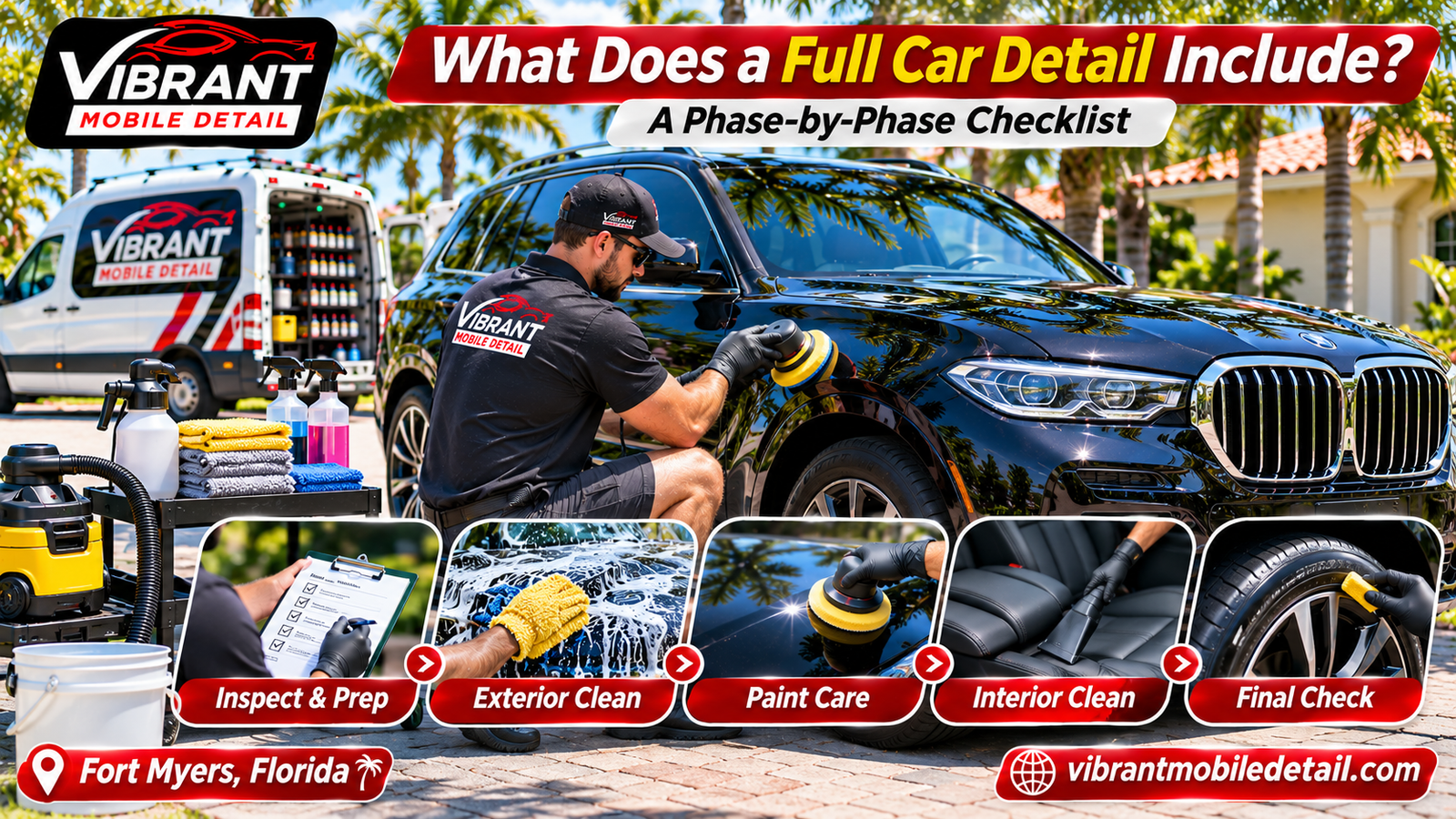
A complete full car detailing service should be something you can check off item by item, yet most customers receive a vague description and a price. That gap is why two detailers can sell the same package name and deliver very different results.
This article lays out a full detail as a working checklist. It divides the job into phases, lists the tasks in each, gives a realistic time budget, explains the quality standard for each step, and shows how a full detail compares with a maintenance detail and a restoration. Use it to evaluate a quote, brief a detailer, or inspect finished work.
What a Full Detail Is, and Is Not
A full detail is a complete restoration-level cleaning and protection of the interior and exterior. It aims to bring the vehicle close to its best condition and to protect that condition for months.
Compared with a maintenance detail
A maintenance detail refreshes a car that is already in good shape, using lighter methods and less time. A full detail uses deeper methods such as decontamination, extraction, and polishing.
Compared with paint correction and coating
A full detail may include a light polish, but multi-stage correction and ceramic coating are separate services. They require more time, specialized products, and a higher price.
Comparison table
| Feature | Maintenance detail | Full detail | Restoration or correction package |
| Typical time (sedan) | 1.5 to 3 hours | 3 to 6 hours | 8 to 20+ hours |
| Typical price (sedan) | $120 to $220 | $250 to $450 | $900 to $3,000+ |
| Paint decontamination | Sometimes | Yes | Yes |
| Machine polishing | No | Light polish, sometimes | Yes, one or more stages |
| Interior extraction | Spot only | Yes | Yes |
| Protection | Spray sealant | Sealant or wax | Sealant or coating |
| Best for | Regular upkeep | Annual reset | Neglected or high-value cars |
These are general Fort Myers area ranges. Larger vehicles and heavy soiling add time and cost.
Phase 0: Inspection and Planning (15 to 20 minutes)
Every full detail should begin with a walk-around, not a hose.
Tasks
- Photograph existing damage, scratches, stains, and wear
- Check paint under good light for swirls, oxidation, and etching
- Note interior stains, odors, pet hair, and moisture
- Confirm the scope and any add-ons with the owner
- Remove personal items and floor mats
Quality standard
You should know what the detailer found and what they plan to do. Existing damage should be documented before work starts, which protects both sides.
Phase 1: Wheels, Tires, and Wheel Wells (25 to 40 minutes)
Wheels are cleaned first because they are the dirtiest area.
Tasks
- Rinse wheels and wheel wells
- Apply a wheel cleaner suited to the finish
- Agitate with brushes, including barrel brushes and small detail brushes for lug holes
- Scrub tire sidewalls to remove old dressing
- Rinse thoroughly and inspect
Quality standard
Wheel faces, barrels, and lug nut holes should be free of brake dust. Tires should look clean and uniform, not streaked or blotchy.
Phase 2: Exterior Wash and Decontamination (60 to 90 minutes)
This phase prepares the paint for everything that follows.
Tasks
- Pre-rinse to remove loose dirt, sand, and pollen
- Foam or pre-soak to loosen grime
- Two-bucket hand wash, top to bottom
- Wash door jambs, trunk edges, and fuel door area
- Apply iron remover to dissolve embedded metallic particles
- Remove tar and sap with a dedicated solvent
- Clay the paint to lift bonded contamination
- Rinse and dry with microfiber or filtered air
Quality standard
After clay treatment, the paint should feel glass-smooth when you glide a hand over it inside a thin plastic bag. Water should sheet cleanly, and no visible contamination should remain in door jambs or panel gaps.
Phase 3: Exterior Polishing (30 to 90 minutes, depending on the level)
A full detail commonly includes a light polish, not full correction.
Tasks
- Inspect paint under strong lighting and measure thickness where appropriate
- Test polish and pad combinations in a small area
- Machine polish each panel with a finishing or light cutting polish
- Wipe panels with a prep solution to reveal true results
- Re-inspect and touch up missed areas
Quality standard
Fine swirl marks and light haze should be noticeably reduced. Deep scratches and severe defects remain, and a good detailer says so before starting. Edges and body lines should be treated carefully to avoid burn-through.
Phase 4: Exterior Protection and Finishing (30 to 45 minutes)
After polishing, the paint needs a protective layer.
Tasks
- Apply wax or synthetic sealant in thin, even layers
- Buff off residue before it hardens
- Clean and dress exterior plastics and black trim with a UV-protective product
- Clean glass inside and outside with streak-free products
- Dress tires with a satin finish product
- Dress door and trunk seals
Quality standard
Paint should look uniformly glossy, with no streaks, high spots, or leftover residue in seams. Trim should look restored, not greasy. Tire dressing should not sling onto the paint. For more on this sequence, the exterior finishing steps are worth reviewing alongside this checklist.
Phase 5: Interior Dry Cleaning (40 to 60 minutes)
Dry work comes first so dust does not turn to mud.
Tasks
- Remove floor mats and loose items
- Vacuum seats, carpets, seat rails, and trunk
- Use compressed air or brushes to clear vents, seams, and crevices
- Remove pet hair with rubber tools, brushes, or pumice
- Clear sand from carpet fibers and door tracks
Quality standard
No visible crumbs, dust, or debris should remain in seams, cup holders, or under seats. Carpet pile should look consistent rather than patchy.
Phase 6: Interior Surface Cleaning (45 to 60 minutes)
Hard surfaces collect oils, sunscreen, dust, and fingerprints.
Tasks
- Clean dashboard, door panels, consoles, and trim with material-appropriate products
- Use soft brushes for vents, buttons, and textured plastics
- Clean the steering wheel, shifter, and controls
- Clean touchscreens and displays with screen-safe products
- Wipe door jambs and sills
- Clean cup holders and storage compartments
Quality standard
Surfaces should look clean and natural, with a matte or satin finish rather than a greasy shine. Controls should feel dry and smooth, not sticky.
Phase 7: Fabric, Carpet, and Leather Care (60 to 90 minutes)
This is where a full detail differs most from a quick clean. Interior cleaning stages handle each material differently.
Fabric and carpet tasks
- Pre-treat stains with appropriate cleaners
- Agitate with brushes
- Extract with hot water or steam
- Dry with airflow and towels
- Treat odors at the source
Leather and vinyl tasks
- Clean with a gentle leather cleaner and soft brush
- Wipe residue with microfiber
- Condition with a UV-protective product
- Treat vinyl surfaces to resist fading
Floor mats
Carpet mats are extracted and dried. Rubber mats are scrubbed and rinsed, then dressed lightly to avoid slipperiness.
Quality standard
Fabrics should be clean, slightly damp at most, and fully dry within a few hours. Leather should feel soft, not slick or sticky. Odors should be neutral, not heavily perfumed. In humid Southwest Florida, complete drying matters as much as cleaning.
Phase 8: Glass, Headliner, and Final Interior Details (20 to 30 minutes)
Tasks
- Clean interior glass to remove film and fingerprints
- Spot clean the headliner with minimal moisture
- Clean pillars and sun visors
- Wipe mirrors, including the rearview mirror
- Replace mats and arrange the interior neatly
Quality standard
Glass should be clear from several angles, including low sun. Headliner should show no water rings or streaks.
Phase 9: Final Inspection and Walk-Through (15 to 20 minutes)
Tasks
- Inspect the exterior in good light
- Check the interior seams, vents, and cup holders
- Verify wheels, tires, and door jambs
- Walk through the finished car with the owner
- Review aftercare advice and maintenance schedule
Quality standard
The detailer should invite you to check anything and should fix any misses immediately. A professional gives clear aftercare guidance, such as when to wash and what to avoid.
Time Budget Summary
| Phase | Typical time |
| 0. Inspection | 15 to 20 minutes |
| 1. Wheels and tires | 25 to 40 minutes |
| 2. Wash and decontamination | 60 to 90 minutes |
| 3. Light polishing | 30 to 90 minutes |
| 4. Protection and finishing | 30 to 45 minutes |
| 5. Interior dry cleaning | 40 to 60 minutes |
| 6. Interior surface cleaning | 45 to 60 minutes |
| 7. Fabric, carpet, and leather | 60 to 90 minutes |
| 8. Glass and final interior | 20 to 30 minutes |
| 9. Final inspection | 15 to 20 minutes |
| Total | about 5 to 8 hours |
A compact sedan in good condition may fall at the low end, while a three-row SUV or a vehicle with heavy soiling falls toward the top. If a detailer quotes 90 minutes for a “full detail,” several phases are being skipped.
What Is Usually Not Included
Clarity about exclusions avoids disappointment.
Commonly excluded
- Multi-stage paint correction
- Ceramic coating
- Engine bay cleaning
- Heavy pet hair removal
- Smoke or severe odor treatment
- Headlight restoration
- Leather repair and recoloring
- Dent, scratch, and chip repair
Why these are separate
Each requires specialized time, products, or skills, and including them in a standard package would raise the base price substantially. Ask about them if your car needs them.
How Vehicle Type Changes the Checklist
Sedans and coupes
Smaller surface area, simpler interior, and shorter time. Dark colors still demand careful polishing.
SUVs and crossovers
Larger interiors, third rows, and cargo areas add hours. Roof racks and tall bodies add washing time.
Trucks
Bed liners, tailgates, and large panels add work. Roof and hood areas see heavy UV exposure.
Minivans
Many seats, tracks, and hidden crumb zones. Expect more time under and around seats.
Electric vehicles
Care around charging ports and high-voltage components is essential. Interiors often use special materials that require gentle cleaners.
How to Verify the Work
A good checklist helps you inspect after the detail.
Exterior checks
- Run a hand over the paint in a plastic bag to feel for grit
- Look at the paint from different angles in sun
- Check door jambs, fuel door, and under the hood edge
- Inspect wheels, including the barrels behind the spokes
- Look at glass for streaks
Interior checks
- Look in seat seams, cup holders, and vents
- Smell the cabin: it should be clean, not overly perfumed
- Feel carpets for dampness
- Check dashboards and door panels for streaks or greasy residue
- Inspect the headliner and pillars
Ask for a written summary
A short list of what was done helps you compare future visits and recommend the detailer with confidence.
Mobile Considerations
A full detail can be done at your location with the right setup.
What mobile detailers bring
Water, power, vacuums, extractors, polishers, and supplies. A good mobile detailer works efficiently and keeps the work area clean.
What you provide
A flat space, preferably shaded, with room to open doors. Access to water or power if requested. Permission from property management if needed.
Weather planning
Southwest Florida’s afternoon storms in summer can interrupt work. Early morning appointments and covered spaces help, and a flexible rescheduling policy is a good sign. Use a vehicle detailing checklist when you brief the detailer so expectations are clear before the work begins.
When to Schedule a Full Detail
Typical timing
Once or twice a year suits most drivers. Many Fort Myers owners book one before summer to build protection ahead of peak UV and love bug season, and one in the fall to reset after the humid months.
Special occasions
Before selling or trading in, after a long storage period, after a flood or major spill, or when odors and stains appear.
Frequently Asked Questions
What does a full car detail include?
It includes a hand wash, wheel cleaning, paint decontamination, light polishing, wax or sealant, and glass and trim cleaning outside. Inside, it includes deep vacuuming, surface cleaning, carpet and upholstery extraction, leather conditioning, and glass cleaning.
How long does a full car detail take?
Typically five to eight hours for a full detail, depending on vehicle size and condition. Compact cars in good shape may take closer to four or five hours.
What is not included in a full detail?
Multi-stage paint correction, ceramic coating, engine bay cleaning, heavy pet hair removal, severe odor treatment, headlight restoration, and repairs are usually separate services.
Does a full detail include polishing?
Many include a light polish that reduces fine swirls and restores gloss. Deeper correction is a separate, more time-intensive service.
How much does a full detail cost in Fort Myers?
Typically about $250 to $450 for sedans, $300 to $550 for SUVs, and $350 to $650 for larger trucks and vans. Heavy soiling and add-ons raise the price.
How can I tell if I got a real full detail?
Check paint smoothness, door jambs, wheels, seat seams, vents, and carpets. The paint should feel smooth, the interior should be clean and dry, and the detailer should explain what was done.
How often should I get a full detail?
Once or twice a year works for most drivers, with maintenance details in between. Cars parked outside or used heavily may need more frequent attention.
Is a full detail worth it before selling a car?
Often yes. A clean, fresh-smelling car with glossy paint presents better and can support a stronger price, particularly when odors and stains are removed.