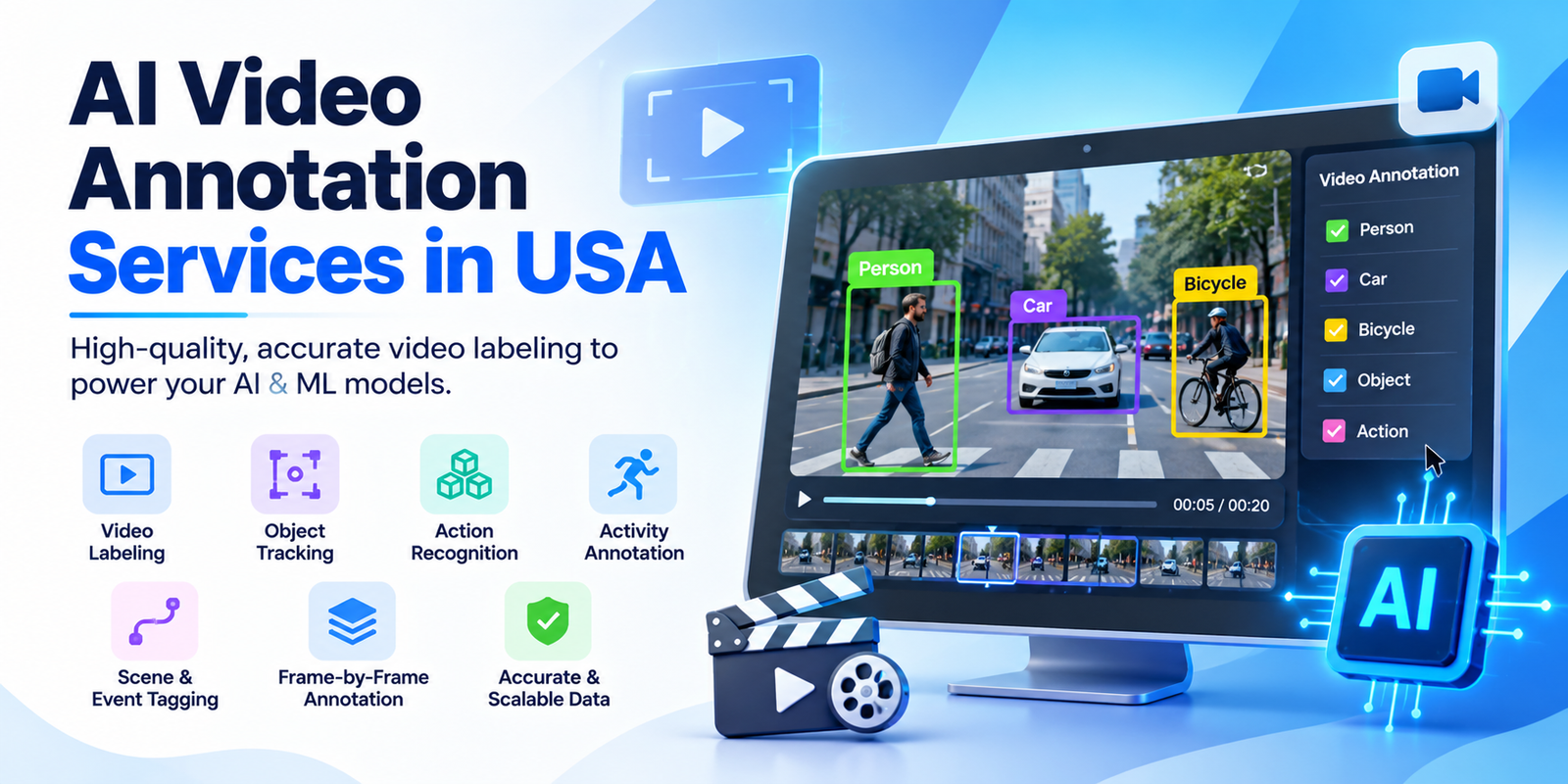
Videos contain valuable information that helps machine learning models understand the real world. From identifying vehicles on busy roads to recognizing human activities in surveillance footage, machine learning systems depend on properly labeled video data to make accurate predictions. However, raw video footage alone is not enough to train these models. It needs to be organized, reviewed, and annotated with meaningful labels.
This is where AI Video Annotation Services in USA become important. These services help businesses convert raw video footage into structured datasets that machine learning models can understand. Through techniques such as object detection, object tracking, activity recognition, and frame-by-frame labeling, businesses can prepare reliable training data for different AI applications.
For example, a company developing a traffic monitoring system needs its model to recognize cars, trucks, pedestrians, traffic signals, and road signs. Annotators label these objects across video frames so the model can learn how they appear and move in different situations.
As AI adoption grows across industries, the demand for quality video annotation is increasing. Businesses need accurate datasets, consistent labeling standards, and scalable annotation processes to develop dependable machine learning applications.
In this guide, we will explain how video annotation works, why it matters for machine learning models, which techniques businesses should consider, and how Vision Infotech can support their video data requirements.
What Are AI Video Annotation Services?
AI video annotation is the process of adding labels, descriptions, and other relevant information to video frames so machine learning models can understand the content.
Unlike image annotation, which focuses on a single image, video annotation involves multiple frames connected through time. This allows models to understand not only what appears in a video but also how objects move, interact, and change.
For example, consider a video recorded at a shopping mall. A machine learning model may need to identify people entering the building, track their movements, and recognize activities such as walking, standing, or shopping.
To train this model, the video needs accurate labels that identify people, their positions, and their movements across different frames.
Professional AI Video Annotation Services help businesses prepare this type of structured training data for computer vision and machine learning projects.
How Does Video Annotation Work?
The annotation process generally involves several steps:
-
Video collection: Businesses provide video footage from cameras, recorded environments, or other data sources.
-
Frame extraction: Videos are divided into individual frames for annotation.
-
Object identification: Annotators identify relevant objects, people, vehicles, or activities.
-
Label assignment: Appropriate labels are added based on project requirements.
-
Object tracking: The same objects are identified across multiple frames.
-
Quality checking: Annotated frames are reviewed to identify missing labels and inconsistencies.
-
Dataset delivery: The completed annotations are prepared in the required format for machine learning development.
Each step contributes to the quality of the final dataset.
Why Are AI Video Annotation Services in USA Important for Machine Learning Models?
Machine learning models learn from the examples provided during training. If video data contains incorrect labels, missing objects, or inconsistent annotations, the model may struggle to recognize real-world situations.
This makes annotation quality an important part of machine learning development.
Here are some reasons businesses invest in professional video annotation.
1. Improves Object Recognition Accuracy
Object recognition allows machine learning models to identify different objects in video footage.
For example, an autonomous driving system must distinguish between pedestrians, bicycles, motorcycles, cars, and other vehicles. If these objects are not labeled correctly, the model may learn incorrect patterns.
Accurate annotations provide clear examples that help models recognize objects under different conditions, including changing lighting, camera angles, and background environments.
2. Helps Models Understand Movement
Recognizing an object is only one part of video understanding. Many applications also need to understand how objects move.
For example, a sports analytics platform may track players running across a football field. The system needs to follow each player across multiple frames to analyze movement and performance.
Video annotation helps connect objects across frames, allowing machine learning models to learn movement patterns and interactions.
3. Supports Better Training Datasets
A good machine learning model requires more than a large amount of data. It needs relevant, diverse, and correctly labeled examples.
Professional annotation helps organize video footage into structured datasets that support model training, testing, and validation.
4. Reduces Manual Data Preparation
Preparing video datasets internally can require considerable time and resources. Businesses may need trained annotators, project managers, quality reviewers, and annotation tools.
Working with an experienced service provider can help manage these activities more efficiently while allowing internal teams to focus on model development.
5. Supports Complex AI Applications
Video annotation is useful for applications that involve multiple objects, changing environments, and human activities.
For example, a warehouse monitoring system may need to identify workers, forklifts, packages, and movement patterns. Proper annotations help prepare the data required to develop these applications.
Different Types of Video Annotation Techniques for Machine Learning
Not every machine learning project requires the same annotation method. The right technique depends on the objects being identified, the complexity of the video, and the expected model output.
Let’s understand some commonly used video annotation techniques.
1. Bounding Box Annotation
Bounding box annotation involves drawing rectangular boxes around objects in video frames.
It is commonly used for detecting vehicles, people, animals, products, and other visible objects.
Example: A traffic monitoring company wants to develop a vehicle detection model. Annotators draw boxes around cars, buses, motorcycles, and trucks in each relevant frame.
This technique helps models learn where objects are located within a video.
2. Polygon Annotation
Polygon annotation identifies objects using multiple connected points rather than rectangular boundaries.
It is useful when objects have irregular shapes or when more precise boundaries are required.
Example: In agricultural video analysis, polygon annotation can help identify plants, leaves, and other objects with uneven shapes.
It is also useful in medical imaging, robotics, and autonomous driving applications.
3. Semantic Segmentation
Semantic segmentation assigns labels to individual pixels within a video frame.
Instead of simply identifying an object with a box, this technique identifies which pixels belong to categories such as roads, buildings, vehicles, pedestrians, or vegetation.
Example: An autonomous vehicle needs to distinguish the road from sidewalks, buildings, and moving vehicles. Semantic segmentation provides detailed pixel-level information to support this task.
4. Object Tracking Annotation
Object tracking involves identifying and following the same object across multiple video frames.
It helps machine learning models understand how an object moves over time.
Example: A retail analytics company wants to track customer movement inside a store. Annotators assign consistent tracking IDs to individuals as they move through different areas.
This technique is especially useful for traffic monitoring, surveillance, sports analytics, and human activity recognition.
5. Keypoint Annotation
Keypoint annotation identifies important points on objects or human bodies.
For human pose estimation, these points may include the shoulders, elbows, wrists, hips, knees, and ankles.
Example: A fitness application uses video footage to analyze exercise movements. Keypoint annotations help train models to identify body positions and recognize different exercise activities.
6. Human Activity Recognition
Human activity recognition focuses on identifying actions performed by people in video footage.
Common activities include:
-
Walking and running
-
Sitting and standing
-
Jumping and exercising
-
Lifting and carrying objects
-
Working with equipment
-
Interacting with other people
For example, a workplace safety system may need to identify whether employees are wearing safety equipment or performing specific activities in restricted areas.
Industries That Benefit From AI Video Annotation Services in USA
Video annotation supports several industries where businesses depend on computer vision and machine learning applications.
1. Automotive and Autonomous Driving
Automotive companies use annotated video datasets to train systems that recognize road conditions and moving objects.
These datasets may include:
-
Cars, trucks, and motorcycles
-
Pedestrians and cyclists
-
Traffic lights and road signs
-
Lane markings and road boundaries
-
Vehicle movement and direction
Accurate annotations help prepare training data for advanced driver assistance systems and autonomous vehicle research.
2. Healthcare and Medical Research
Healthcare organizations and technology companies use video analysis for medical research, movement assessment, and patient monitoring applications.
For example, annotated videos can help train systems to recognize body movements during physical rehabilitation exercises.
Depending on the application, annotation may involve identifying body positions, movements, or specific activities.
3. Retail and E-commerce
Retail businesses use computer vision to understand customer behavior and improve store operations.
Video annotation can support applications such as:
-
Customer movement tracking
-
Queue monitoring
-
Product interaction analysis
-
Store occupancy measurement
-
Shelf activity monitoring
For example, a supermarket may use video analytics to understand how customers move between different product sections.
4. Security and Surveillance
Security systems often need to recognize people, vehicles, and unusual activities in recorded footage.
Annotated video datasets can help train models to identify specific movements, detect objects, and recognize activities that require further review.
5. Manufacturing and Industrial Automation
Manufacturing companies use machine learning to monitor production processes and workplace activities.
Video annotation can support systems that identify workers, machinery, products, and production-related movements.
For example, a factory may develop a computer vision application to monitor whether workers follow specific safety procedures around heavy machinery.
How to Choose the Right AI Video Annotation Services in USA
Selecting an annotation partner is an important decision because the quality of the dataset directly affects the training process.
Businesses should evaluate several factors before choosing a service provider.
1. Understand Their Annotation Experience
Check whether the service provider has experience with your type of video data.
Annotating traffic footage is different from labeling sports videos or manufacturing activities. Each project requires specific knowledge and annotation guidelines.
Ask about previous project experience, annotation methods, and the types of datasets they can handle.
2. Check Their Quality Assurance Process
Quality control should be a major part of the annotation workflow.
A reliable provider should have a clear review process that includes:
-
Annotation guideline verification
-
Random sample inspection
-
Missing label identification
-
Bounding box accuracy checks
-
Object tracking consistency
-
Correction of annotation errors
For complex projects, businesses can also request sample annotations before starting full-scale work.
3. Evaluate Scalability
Video annotation projects can involve thousands of clips and millions of frames.
Your service provider should have the resources and workflow required to manage increasing data volumes without compromising annotation quality.
Discuss expected project size, delivery timelines, and the ability to handle additional requirements.
4. Review Data Security Practices
Video footage may contain confidential business information, customer activity, or personally identifiable details.
Before sharing data, businesses should understand how the provider handles access control, secure file transfer, data storage, retention, and deletion.
If the project involves sensitive footage, appropriate contractual and privacy requirements should also be established.
5. Confirm Output Formats
Different machine learning frameworks and annotation platforms may require different output formats.
Before beginning a project, confirm whether the provider can deliver annotations in the required structure, such as JSON, XML, or platform-specific formats.
This helps reduce unnecessary conversion work during model development.
6. Compare Pricing and Turnaround Time
Video annotation costs depend on several factors, including:
-
Video duration and frame rate
-
Number of objects per frame
-
Annotation technique
-
Project complexity
-
Required accuracy
-
Quality review requirements
-
Delivery timeline
Instead of choosing a provider based only on price, compare the overall quality, turnaround time, and project support.
Common Challenges in Video Annotation and How to Address Them
Video annotation projects can become complicated when footage contains multiple objects, changing environments, and unclear movements.
Understanding these challenges helps businesses plan their projects more effectively.
Inconsistent Labels Across Frames
When different annotators follow different labeling approaches, the same object may receive inconsistent labels.
Solution: Create detailed annotation guidelines with clear definitions, examples, and rules for handling difficult cases. Use regular reviews to maintain consistency.
Poor Video Quality
Low-resolution footage, motion blur, poor lighting, and camera movement can make object identification difficult.
Solution: Review the source footage before annotation begins. Identify low-quality sections and establish guidelines for uncertain or partially visible objects.
Tracking Errors
Objects may disappear behind other objects or move outside the camera frame. This can make consistent tracking difficult.
Solution: Define tracking ID rules and explain how annotators should handle temporary occlusions, reappearing objects, and changes in visibility.
Large Video Volumes
Processing long videos frame by frame can require significant time and resources.
Solution: Use a suitable annotation platform, establish project priorities, and combine automated assistance with human review where appropriate.
Manual vs. Automated Video Annotation: Which Is Better?
Businesses often compare manual annotation with automated annotation when preparing training datasets.
Both approaches have advantages, and the right choice depends on project requirements.
| Factor | Manual Annotation | Automated Annotation |
|---|---|---|
| Labeling process | Human annotators label footage | Software generates suggested labels |
| Accuracy | Depends on annotator expertise and review | Depends on the quality of the underlying model |
| Complex scenes | Better suited to detailed human judgment | May struggle with unusual situations |
| Processing speed | Can take more time | Can process large volumes quickly |
| Quality control | Human review and correction | Requires validation and correction |
| Best use | Complex and specialized datasets | Large-scale and repetitive tasks |
Why a Hybrid Approach Can Be Effective
For many projects, combining automated tools with human annotation provides a practical solution.
Automated systems can identify common objects and generate initial labels. Human annotators can then review these results, correct errors, and handle difficult situations.
For example, an automated tool may identify cars in traffic footage but fail to recognize a partially hidden motorcycle. A human reviewer can correct the label and ensure the dataset follows the required annotation guidelines.
This approach can improve productivity while maintaining the level of quality needed for machine learning projects.
How to Prepare Video Data Before Starting an Annotation Project
Good preparation helps avoid unnecessary delays and reduces confusion during annotation.
Businesses can follow these steps before sharing their footage with a service provider.
1. Define the Project Objective
Clearly explain what the machine learning model needs to recognize.
For example, a project may focus on pedestrian detection, vehicle tracking, human activity recognition, or industrial safety monitoring.
2. Select Relevant Video Footage
Choose videos that represent the real conditions in which the model will operate.
Include different camera angles, lighting conditions, object sizes, backgrounds, and movement patterns where relevant.
3. Prepare Annotation Guidelines
Create clear instructions explaining:
-
Which objects need labels
-
What categories should be used
-
How objects should be tracked
-
How partially visible objects should be handled
-
Which situations require special labels
4. Define Quality Requirements
Decide how annotation accuracy will be evaluated. Establish clear acceptance criteria and review procedures before production starts.
5. Start With a Sample Project
A small pilot project helps businesses evaluate annotation quality, communication, turnaround time, and output compatibility before scaling up.
Why Choose Vision Infotech for AI Video Annotation Services in USA?
Choosing the right annotation partner can make a significant difference in preparing reliable datasets for machine learning development.
Vision Infotech has been providing software outsourcing services since 2012, helping businesses work toward their technology and software development goals. The company focuses on delivering practical technology solutions that support business requirements.
When it comes to video annotation projects, businesses need a clear understanding of their data requirements, consistent labeling standards, and a structured quality review process.
Vision Infotech can support businesses looking for video data preparation and annotation solutions through the following areas:
1. Project-Specific Annotation Requirements
Every video dataset has different requirements. The annotation approach should match the intended machine learning application.
Vision Infotech can work around defined project requirements to support relevant video annotation workflows.
2. Focus on Data Quality
Accurate labeling and consistent annotation guidelines are important for preparing useful machine learning datasets.
A structured review process helps identify missing labels, inconsistent object categories, and other annotation issues before dataset delivery.
3. Support for Different Annotation Techniques
Depending on project requirements, video annotation may involve bounding boxes, object tracking, polygon labeling, keypoints, and activity recognition.
Selecting the appropriate technique helps ensure the dataset contains relevant information for the intended application.
4. Scalable Project Support
Businesses may begin with a small video annotation requirement and expand as their machine learning projects grow.
A well-organized workflow can help manage changing project volumes and annotation requirements.
5. Software and AI Development Understanding
Vision Infotech offers custom software development, AI development, AI consulting, Zoho customization, and AWS consulting services.
This broader technology experience provides useful context when discussing how annotated datasets fit into larger software and AI development projects.
If your business needs support with video data preparation, labeling requirements, or machine learning dataset workflows, Vision Infotech can help you discuss a suitable project approach.
Conclusion
Video annotation is an important part of preparing reliable training datasets for machine learning models. From object detection and movement tracking to human activity recognition, accurate labels help models understand video content and identify meaningful patterns.
Investing in professional AI Video Annotation Services in USA can help businesses organize large video datasets, improve labeling consistency, and prepare data for different computer vision applications.
However, choosing the right annotation partner requires more than comparing prices. Businesses should consider technical expertise, annotation methods, quality assurance, data security, scalability, and delivery requirements.
A combination of automated tools and human review can also help balance productivity and accuracy, particularly when projects involve large volumes of video footage.
With its software outsourcing experience since 2012, Vision Infotech aims to help businesses address their technology requirements through practical and structured solutions.
If you are planning a machine learning project and need reliable video data preparation, connect with Vision Infotech to discuss your AI video annotation requirements and find an approach that supports your project goals.