Hospitals need clean bedsheets, patient gowns, towels and staff uniforms every day. But does a hospital have to operate its own laundry department?
Not necessarily.
Many healthcare facilities can work with independent laundry contractors who manage linen washing, drying, finishing and delivery.
For entrepreneurs, this creates an opportunity to build a service business without owning a hospital.
However, healthcare laundry requires more planning than ordinary commercial washing. From selecting suitable hospital laundry machines to following infection-control procedures, every stage needs careful management.
So, how can you enter this business, find customers and calculate potential earnings?
Is Hospital Laundry a Profitable Business Opportunity in India?
Hospital laundry can provide recurring business because healthcare facilities require regular linen processing.
Unlike retail laundry customers who may place occasional orders, hospitals operate throughout the year.
A contractor may receive daily linen volumes under an agreed service arrangement.
However, steady demand does not automatically mean guaranteed profits.
Operating costs, contract pricing, hygiene requirements, transportation, staffing and payment terms influence profitability.
Before investing, entrepreneurs should identify potential healthcare clients and understand their actual outsourcing requirements.
How Can You Run a Hospital Laundry Service Without Owning a Hospital?
There are three common business models.
| Business Model | How It Works |
| Off-site laundry service | Collect hospital linen and process it at a separate approved facility |
| On-site contractor-managed laundry | Operate machines and manage laundry services within hospital premises |
| Linen rental and laundry | Supply linen inventory and manage its collection, processing and return |
Each model has different investment and operational requirements.
For example, off-site processing requires suitable transportation and controlled handling between the hospital and laundry plant.
An on-site contract may require machinery, trained staff and daily operation within the hospital’s designated laundry department.
The right model depends on the contract, available infrastructure and the operator’s technical capability.
How Do You Get Your First Hospital Laundry Contract?
Start by identifying private hospitals, healthcare groups and institutions that outsource linen processing.
Contact procurement departments or facility managers to understand their service requirements.
For government hospitals, relevant opportunities may be published through GeM or public procurement portals.
Before submitting a proposal, review eligibility conditions carefully.
Some tenders specify previous experience, minimum turnover, technical qualifications, insurance or performance guarantees.
Your proposal should explain processing capacity, service standards, turnaround times, hygiene procedures and pricing.
For a new business, building relevant operational experience and documented quality systems can be important before pursuing larger contracts.
How Much Laundry Does a 100-Bed Hospital Generate Daily?
Calculating daily linen volume helps determine the required machinery and staffing.
Consider this hypothetical example:
| Planning Factor | Assumed Value |
| Hospital beds | 100 |
| Average occupancy | 80% |
| Linen per occupied bed | 3 kg/day |
| Occupied-bed laundry | 240 kg/day |
| Other authorised linen | 40 kg/day |
| Total estimated laundry | 280 kg/day |
Calculation:
(100 × 80% × 3 kg) + 40 kg = 280 kg/day
These are planning assumptions, not standard healthcare laundry-generation figures.
Actual requirements depend on hospital departments, linen-change frequency, patient activity and the agreed service scope.
A business must also allow for peak-day loads and emergency requirements.
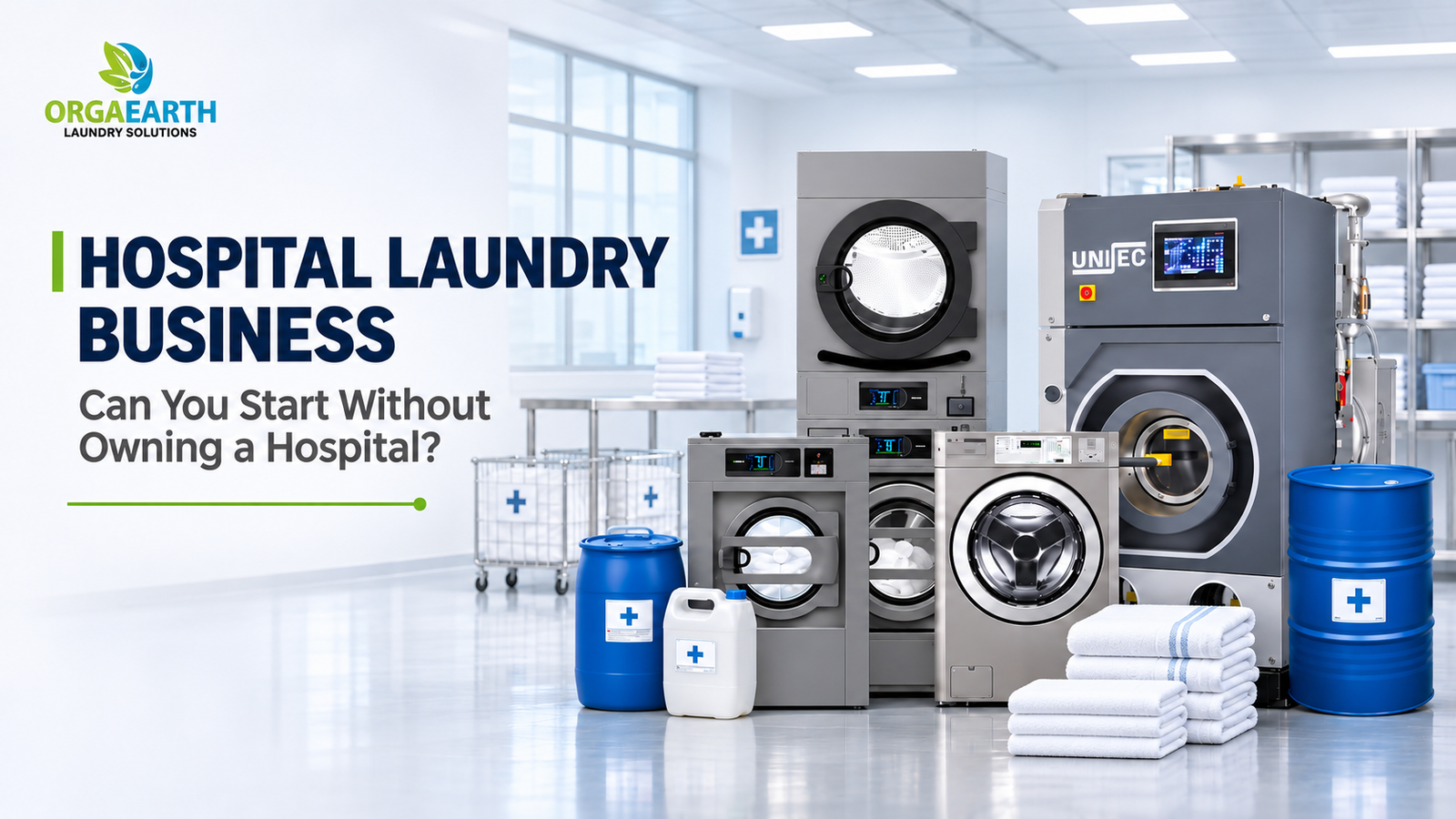
What Hospital Laundry Machines Are Required?
Equipment should be selected according to daily linen weight, processing hours and infection-control requirements.
A professional healthcare laundry facility may require:
| Equipment | Main Purpose |
| Commercial washer extractors | Washing and moisture extraction |
| Barrier washer extractors | Supporting separation of soiled and clean processing zones |
| Industrial tumble dryers | Drying compatible healthcare textiles |
| Flatwork ironers | Finishing bedsheets and other suitable flat linen |
| Chemical dosing systems | Controlled chemical delivery |
| Linen trolleys and weighing equipment | Handling, segregation and load tracking |
A barrier washer may be appropriate where the facility design and contractual requirements call for physical separation between loading and unloading areas.
However, purchasing specialised machinery alone does not establish a safe healthcare laundry.
The complete process must support approved hygiene and infection-control procedures.
Can You Wash Hospital Linen in a Regular Commercial Laundry?
Healthcare textiles require specific handling procedures because some items may be contaminated with blood, body fluids or other potentially infectious material.
A facility processing hospital linen must follow the healthcare customer’s approved collection, segregation and laundering requirements.
Clean and soiled textiles should follow appropriately separated workflows.
Staff require suitable protective equipment, and wash programmes must follow validated procedures.
Transport and storage also need attention to prevent processed linen from becoming contaminated again.
Importantly, hygienically processed linen is not automatically sterile. Textiles requiring sterilisation must undergo the appropriate additional process.
A conventional retail laundry should not accept healthcare linen without confirming that its premises, equipment and procedures meet the applicable requirements.
How Much Investment Is Needed to Start a Hospital Laundry Plant?
Investment depends on processing capacity, facility type and contract responsibilities.
Major expenses may include washing machines, dryers, finishing equipment, chemical systems and laundry trolleys.
Site preparation can involve drainage, water treatment, electricity, ventilation and suitable separation of processing areas.
Other costs include staff wages, transport, maintenance, insurance and working capital.
An on-site operation may use existing hospital infrastructure, while an independent processing plant may require substantial premises development.
Obtain detailed machinery and installation quotations before finalising the investment.
How Much Can You Earn From One Hospital Laundry Contract?
A contract’s financial potential depends on the amount of linen processed and the agreed billing method.
Consider a hypothetical service handling 280 kg daily.
| Monthly Calculation | Illustrative Amount |
| Daily laundry volume | 280 kg |
| Processing days | 30 |
| Monthly linen volume | 8,400 kg |
| Assumed billing rate | ₹45/kg |
| Gross monthly revenue | ₹3,78,000 |
| Assumed variable cost | ₹25/kg |
| Contribution before fixed costs | ₹1,68,000 |
If fixed monthly expenses are ₹1,25,000, the illustrative operating surplus would be ₹43,000 before tax, financing and excluded costs.
These figures are assumptions, not verified market rates or guaranteed earnings.
Actual financial performance also depends on linen replacement responsibilities, contract deductions, rejected loads and payment delays.
Should You Charge Hospitals Per KG or Per Piece?
Hospital laundry contracts may use per-kilogram, per-piece or agreed monthly service pricing.
Per-kilogram billing can be convenient for mixed linen volumes, while per-piece pricing may be suitable when textile categories and handling requirements are clearly defined.
A monthly contract may include minimum service commitments.
Whatever the model, define responsibilities for collection, contamination handling, linen loss, emergency processing and quality disputes.
The lowest quoted rate is not necessarily sustainable when the contract includes strict turnaround and service obligations.
Can One Laundry Plant Serve Multiple Hospitals?
A centralised healthcare laundry may be able to process linen for several institutions.
However, expansion depends on spare processing capacity, suitable transport arrangements and each contract’s requirements.
Customer linen must remain identifiable, and the facility must maintain appropriate hygiene controls.
Some contracts may require dedicated equipment or restrict shared processing.
Before accepting additional hospitals, evaluate machine utilisation, peak demand, staffing and the ability to maintain consistent turnaround.
How Orgaearth Can Help You Set Up a Hospital Laundry Business
Orgaearth Laundry Solutions provides professional equipment for hospitals, healthcare institutions and commercial laundry operators.
Its range includes washer extractors, barrier washers, industrial laundry dryers, flatwork ironers and chemical dosing systems.
Entrepreneurs planning a healthcare laundry facility can explore hospital laundry machines and equipment from Orgaearth to understand available machinery and setup options.
Orgaearth also supports equipment selection, laundry layout planning, installation and technical servicing.
Choosing machinery according to the actual contract workload can help businesses avoid unnecessary capacity or equipment shortages.
Conclusion: Can You Start a Hospital Laundry Business Without Owning a Hospital?
Yes. Independent contractors can provide hospital laundry services without owning a healthcare facility.
However, success requires more than purchasing machines.
A sustainable business needs suitable contracts, trained staff, controlled linen handling and realistic operating-cost calculations.
Start by understanding the healthcare customer’s requirements and confirming demand.
Once the service model and processing capacity are clear, invest in equipment that supports safe, reliable operations.
Frequently Asked Questions
1. Can a private company operate a hospital laundry business in India?
Yes. Private contractors may provide outsourced or on-site laundry services under suitable healthcare contracts and applicable requirements.
2. Do I need to own a hospital to start this business?
No. You can operate as an independent laundry contractor serving healthcare institutions.
3. Which hospital laundry machines are required?
Common equipment includes washer extractors, professional dryers, finishing machines and chemical dosing systems. Barrier washers may be required for particular facility designs.
4. How much investment is required for a hospital laundry plant?
Investment varies with daily linen volume, equipment capacity, premises, utilities, staffing and contract requirements.
5. Can one laundry plant serve several hospitals?
Potentially, provided contract terms permit it and the facility can maintain suitable segregation, processing and delivery standards.
6. Is a barrier washer mandatory for hospital linen?
Not universally. The need depends on applicable requirements, facility layout, risk assessment and contract specifications.
7. Can a new business apply for government hospital laundry tenders?
Yes, where it satisfies the tender’s eligibility conditions. Requirements vary, and some contracts demand previous experience or financial qualifications.
Contact Us:
Orgaearth Laundry Solutions
Plot no. 774, Udyog Vihar, Phase 5, Gurugram, Haryana, India-122016
Email: marketing@orgaearth.com
Contact No.- +91 7042912777