A business in Kolkata can have a good product, reliable service and years of experience, yet still struggle to attract customers online. A competitor with a smaller operation may receive more enquiries simply because people can find its services more easily through Google, social media or other digital channels.
This difference is not always about advertising budgets. Often, it comes down to how effectively a business understands and uses digital marketing.
As more customers research products, compare service providers and check reviews before making decisions, businesses need people who can do more than publish social media posts. They need marketers who understand how different digital channels work together, how customers behave online and how to measure whether marketing activity is producing meaningful results.
For Kolkata’s growing business community, this creates an important skills gap.
Kolkata Businesses Need More Than a Social Media Presence
Social media has made online promotion accessible to businesses of almost every size. A local restaurant can share its menu, a coaching institute can announce new batches, and a professional service provider can explain what makes its services useful.
However, maintaining an active social media account is not the same as having a digital marketing strategy.
Consider a coaching institute in North Kolkata. It may regularly publish admission announcements and classroom photographs. These posts can help maintain visibility among existing followers, but they may not reach parents searching Google for a suitable coaching institute in their area.
A more complete approach could include a well-organised website, useful course information, local search optimisation, student reviews, relevant social media content and carefully planned advertising.
Each channel serves a different purpose. The challenge is to connect them around the same business objective.
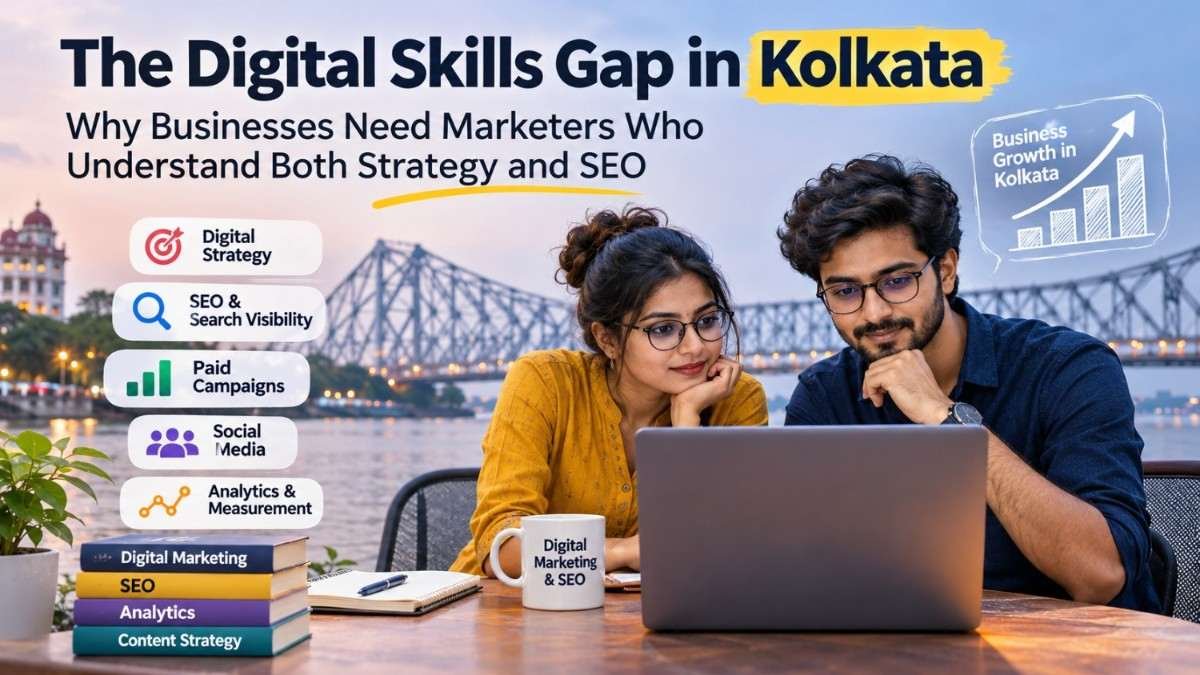
This is why businesses increasingly need marketers who understand audience research, content planning, search visibility, paid campaigns and performance measurement rather than treating every platform as an independent activity.
Why SEO Remains Important Even When Businesses Use Social Media and Ads
Paid advertising can generate visibility quickly, while social media can help a business build relationships with its audience. But neither replaces the value of being discoverable when someone actively searches for a product or service.
Imagine someone looking for a graphic design course in Kolkata or a reliable accounting service near Salt Lake. That person may already have a specific requirement. Appearing in relevant search results gives a business an opportunity to reach someone who is actively looking for what it offers.
SEO helps businesses improve that discoverability.
It involves much more than adding keywords to website pages. Effective SEO requires understanding search intent, organizing website content, improving technical performance, earning relevant references, and making information genuinely useful to visitors.
For businesses serving particular neighbourhoods, local SEO is especially relevant. Accurate business information, a properly maintained Google Business Profile, customer reviews, location-specific website content and consistent contact details can all contribute to a stronger local presence.
The important point is that SEO is not an isolated technical task. It is connected to how a business communicates its value and helps potential customers make decisions.
The Skills That Make a Digital Marketer Useful to a Business
The requirements of digital marketing roles vary between agencies, startups and individual businesses. Nevertheless, a few practical capabilities are valuable across many working environments.
Understanding search behaviour: A marketer should know how people search, what they expect to find and why one page may satisfy their needs better than another. Keyword research is useful, but understanding the intent behind a search is more important than collecting large lists of search terms.
Content and communication: Businesses need clear website copy, useful articles, social media content, email communication and advertising messages. Good writing is not simply about producing more content. It is about explaining something accurately and making it relevant to the intended audience.
Campaign management: Knowledge of Google Ads and Meta Ads helps marketers plan campaigns, select audiences, manage budgets and evaluate performance. Understanding why a campaign is generating clicks but not enquiries is just as important as knowing how to launch it.
Analytics and measurement: Traffic alone does not explain whether marketing is working. Marketers need to understand important actions such as enquiries, calls, form submissions and purchases. Tools such as Google Analytics 4 and Google Search Console help them examine different parts of the customer journey.
Website awareness: A marketer does not necessarily need to be a web developer, but should understand website structure, page speed, mobile usability, basic HTML and how technical problems can affect visibility and user experience.
These skills become more valuable when a marketer can connect them instead of treating each as a separate checklist.
Why Practical Experience Matters More Than Knowing the Names of Tools
Knowing what Google Search Console does is different from using it to identify why an important page has lost visibility. Similarly, understanding the purpose of Google Ads does not automatically mean someone can manage a campaign responsibly.
Practical experience develops through working on real problems.
A learner might begin by researching keywords for a local business, preparing a content plan, optimising a service page and checking its performance. The next exercise could involve creating a small advertising campaign, examining its results and identifying what should change.
These activities teach decision-making. They also reveal that digital marketing rarely produces perfect results on the first attempt.
For anyone comparing training options, it is useful to examine whether a course includes meaningful assignments, live projects, feedback and opportunities to work with actual marketing tools. A broader comparison of digital marketing courses in Kolkata can help prospective learners understand the types of programmes available and what to evaluate before enrolling.
Why Some Marketers Should Develop Specialist SEO Skills
Digital marketing offers several career paths. Some professionals prefer social media management or performance advertising, while others develop deeper expertise in search engine optimisation.
SEO is particularly suitable for people who enjoy research, analysis, content and problem-solving. The work can involve examining website structure, finding technical issues, understanding competitors, improving pages and studying changes in search performance.
The field is also evolving. Search experiences increasingly include AI-generated summaries and other forms of direct answers. This does not make traditional SEO irrelevant. It makes a sound understanding of content quality, technical accessibility, search intent and reliable information even more important.
Someone considering this specialist route should look beyond a course that teaches only basic keyword placement or backlink building. A useful SEO programme should cover technical SEO, on-page optimisation, content strategy, local SEO, analytics and practical website work.
Learners can use this guide to SEO courses in Kolkata as a reference when evaluating specialist training options.
AI Can Help Marketers, but It Cannot Replace Good Judgment
AI tools have made several marketing tasks faster. They can help generate content outlines, summarise research, suggest headline variations and assist with routine analysis.
But speed does not guarantee accuracy or usefulness.
A marketer still needs to check facts, understand the audience, recognise weak recommendations and decide whether the output supports the business objective. Publishing large quantities of generic AI-generated content is unlikely to solve a business’s underlying marketing problems.
The strongest approach is to use AI as an assistant while retaining human judgment, subject knowledge and responsibility for the final work.
Building a Stronger Digital Marketing Talent Pool in Kolkata
Kolkata has a diverse business environment, ranging from established companies and technology firms to educational institutions, retailers, healthcare providers and small local enterprises. Their marketing requirements are not identical.
A small service business may need stronger local search visibility and a better website. An e-commerce company may focus on paid acquisition, product pages and conversion rates. An educational institution may need a combination of informative content, enquiry management and local visibility.
This variety creates opportunities for people who can understand business requirements rather than simply operate digital tools.
For aspiring marketers, the practical route is to build a foundation across major digital channels, work on projects, study campaign results and gradually develop specialist strengths. A portfolio demonstrating actual work can make those abilities easier for an employer or prospective client to assess.
For businesses, hiring decisions should also focus on problem-solving ability, communication and an understanding of measurable outcomes, not just certificates or familiarity with software.
The Real Advantage Is Knowing How the Pieces Fit Together
Digital marketing in Kolkata is not simply about being present on more platforms. It is about helping the right people discover a business, understand its offering and take the next step.
SEO, content, paid advertising, social media and analytics each contribute to that process. A marketer who understands their individual functions and how they influence one another can make better decisions.
The skills gap is therefore not just a shortage of people who know how to use digital tools. It is a shortage of people who can apply those tools thoughtfully to real business challenges.
That distinction will matter to both businesses looking for sustainable growth and professionals preparing for a career in digital marketing.