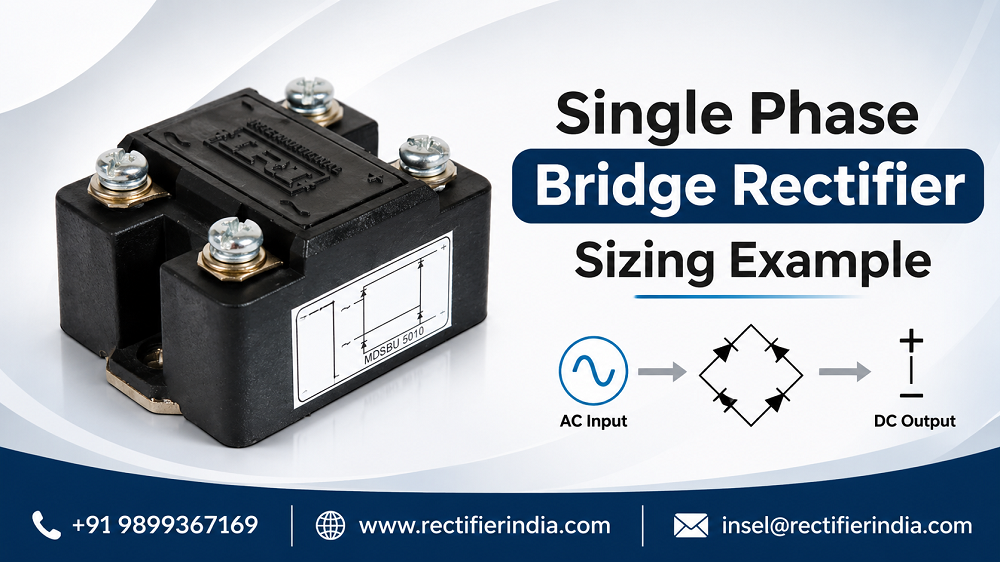
The owner of a workshop wants a 24V 10A DC supply to charge his batteries. He only has a standard single-phase supply available. He has a transformer and a drawer full of diodes but isn’t sure what to use. This post shows you how to calculate the sizing for a single phase bridge rectifier.
How the circuit works
A single phase full wave bridge rectifier uses 4 diodes to convert the AC from a transformer to DC. In India we have a 50Hz supply, so every negative half cycle the bridge will reverse and causes a pulsating DC supply at 100Hz.
The ripple factor for a simple full wave bridge with resistive loading is around 0.48. This means that almost as much of the power supply is rippling as DC. As such a capacitor will always be added to any real world design.
The average output will be around 0.9 x the RMS voltage of the transformer less about 1.4 volts for the two conducting diodes.
Calculating your required DC
We need 24V so adding the 1.4V loss in the diodes and dividing by 0.9 will give us around 28V RMS on the secondary of the transformer. This is our starting point. Once we add a filter capacitor then the output will head towards the peak voltage of the supply. This will change the amount. We would measure this using a meter once we had built the unit.
Diode Ratings
In a single phase diode bridge rectifier each diode will conduct for half of each cycle. So if we have a 10A load then they will conduct an average of 5A. However, once we add the capacitor in we get short bursts of current going through the diodes much higher than the average. We also get a spike of current when first switching on due to charging up the capacitor from nothing.
I would go for double the average current so 10A or more. The first thing to look at is the surge rating.
The peak voltage of a 28V RMS secondary is around 40V. So, a part rated to 100V will give us plenty of margin. However, going much higher will increase the cost and voltage drop.
Heat Dissipation
At any one time 2 diodes will be conducting so we will be losing around 0.7V per diode. At 10A this is around 14W of wasted power. This is a lot of heat from something smaller than a matchbox. A single phase full wave bridge rectifier at this current will need some form of heatsink or be bolted down to a metal chassis. Thermal paste should be used between the components.
Don’t put this in a plastic enclosure with no air flow. The lifespan of the rectifier will depend on the heat it is producing much more than the voltage rating. After an hour of running if the case is too hot to hold your finger on then it is too hot.
Discrete or Module?
Using 4 discrete diodes will make it easier to repair and have more options. Using a module will reduce the chance of any wiring errors and will have a metal casing with a mounting hole. This can easily be bolted to a heatsink. If the load is 10A or more I would go for the module. If you are building a hobby board then discrete is fine. A single phase bridge rectifier can only be as good as the cooling and connections.
Insel Rectifiers
Insel Rectifiers produce rectifiers for industrial use. If your load is higher than in this example, is going to be running all day or needs a more accurate output then contact them with your required voltage and current and ask for a single phase bridge rectifier sized to your load. Compare this to your values above.
FAQs
What is a single phase bridge rectifier?
A 4 diode circuit to convert single phase AC to DC.
How many diodes does a single phase full wave bridge rectifier use?
4 Diodes
Do I need a heatsink for a single phase diode bridge?
If you are running a few amps then you might be able to get away with a small module. However, at 10A you will be losing around 14W of power as heat. A heatsink or metal chassis would be a good idea. If the case is too hot to touch then add some cooling.
What voltage will I get from a single phase bridge rectifier?
Around 0.9 x the RMS voltage less around 1.4V. With a capacitor the output will rise to near the peak.
Can I use a single phase bridge on a 3 phase supply?
No. A 3 phase supply will require a 6 diode bridge and the ratings and cooling will be different.