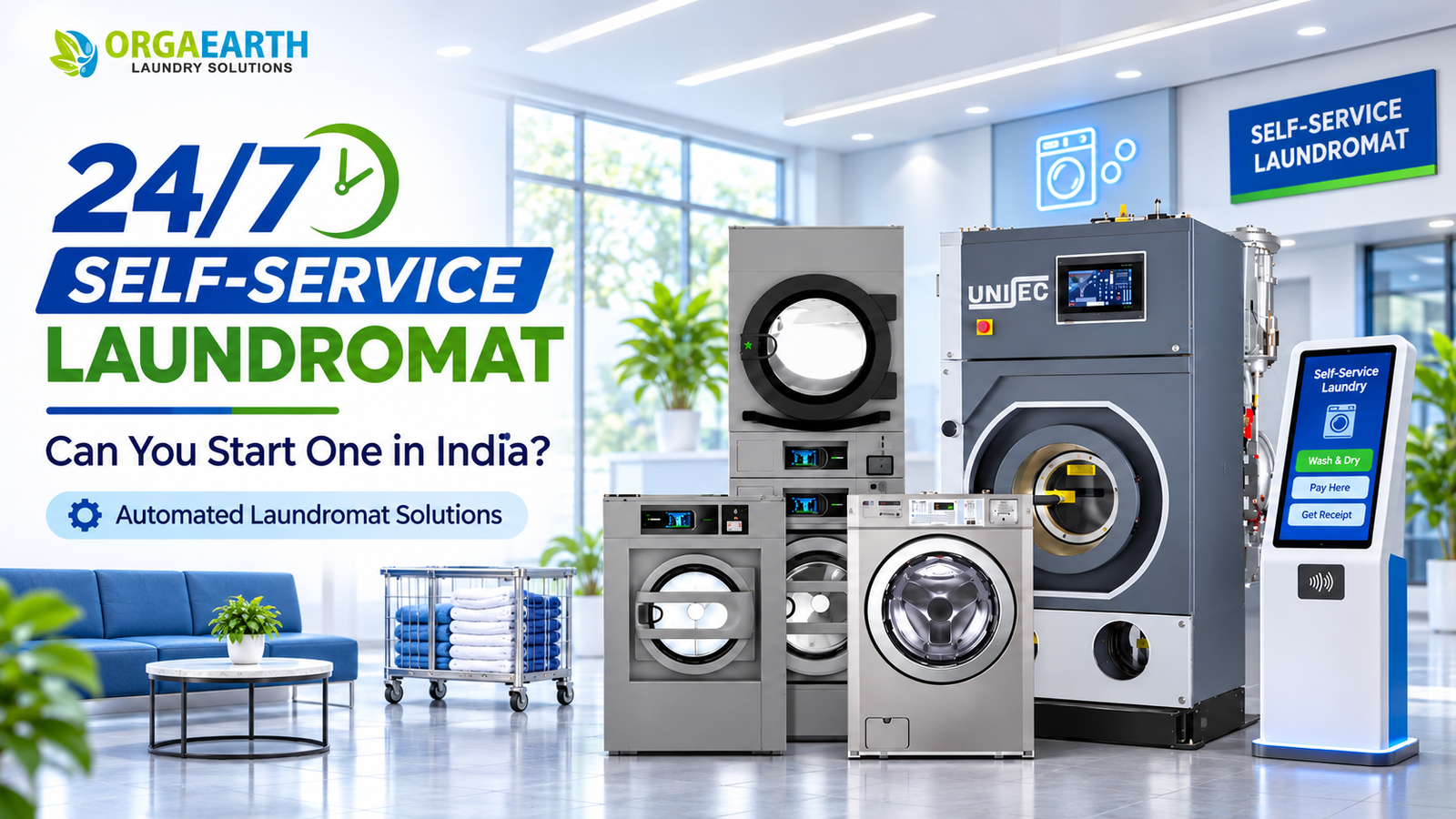
Imagine running a laundry business where customers can wash and dry their clothes without waiting for an employee to operate the machines.
A self-service laundromat makes this possible. Customers bring their laundry, select a machine, pay for the service, and complete the washing and drying process themselves.
For entrepreneurs exploring the laundry industry, this presents an alternative to traditional laundry shops that depend heavily on manual operations.
With suitable laundromat solutions, commercial washing machines, dryers, and compatible payment systems, it is possible to plan an automated self-service laundry facility in India.
But is operating 24/7 practical, and what investment, equipment, and infrastructure are required?
What Is a 24/7 Self-Service Laundromat?
A self-service laundromat is a laundry facility where customers independently operate commercial washing and drying machines.
Unlike a conventional laundry shop, customers generally do not need staff to collect, wash, and return their garments.
A modern automated laundromat may offer:
- Self-service washing and drying
- Digital or coin-operated payments
- Automated washing programmes
- Remote equipment monitoring
- Extended operating hours
- Customer instructions and support systems
A 24/7 model allows customers to access laundry facilities outside standard business hours.
However, automation does not mean the business can operate without supervision, maintenance, or customer assistance.
Why Consider Starting a Self-Service Laundry Business in India?
Customer convenience is an important factor when evaluating any service business.
Students living in shared accommodation, working professionals, tenants, and travellers may not always have convenient access to washing and drying equipment.
Some customers may prefer completing laundry themselves rather than waiting for collection and delivery.
This creates a potential market for self-service laundry facilities in suitable locations.
Entrepreneurs can explore sites near residential apartments, universities, hostels, co-living properties, and other areas with frequent laundry requirements.
However, local demand should be verified before investing. Traditional full-service laundry remains popular in many Indian markets, and self-service adoption can vary considerably.
How Do Automated Laundromat Solutions Work?
Automated laundromat solutions combine professional washing and drying equipment with compatible payment and management systems.
A typical customer journey involves five stages.
- Select a washing machine: Customers choose an available machine based on their laundry volume.
- Load garments: Clothes are placed into the machine according to loading instructions and fabric requirements.
- Complete payment: Depending on the equipment configuration, payment may be accepted through coins, cards, payment kiosks, or compatible digital systems.
- Start the wash cycle: The machine operates according to the selected programme.
- Dry and collect laundry: Customers transfer suitable washed garments into a dryer and collect them after the cycle.
Selected commercial laundry machines support remote monitoring and connected management features.
The exact payment and automation capabilities depend on the machine model, installed software, and available integrations.
What Equipment Is Required for a Self-Service Laundromat?
Selecting appropriate machinery is essential when planning a laundromat business.
1. Commercial Washer Extractors
Commercial washer extractors handle washing and high-speed extraction.
Unlike household equipment, professional machines are designed for repeated commercial operation.
Entrepreneurs should consider capacity, washing programmes, water consumption, extraction performance, and payment-system compatibility.
2. Commercial Tumble Dryers
Washing is only one part of the customer experience.
Commercial tumble dryers allow customers to dry suitable garments without relying on outdoor drying conditions.
The number and capacity of dryers should match the expected washer usage and drying cycle requirements.
Insufficient dryer capacity can create queues even when washing machines are available.
3. Automated Payment Systems
Payment automation can reduce the need for continuous counter staff.
Some commercial laundry models support coin operation, central payment systems, or connected payment technologies.
Before investing, confirm compatibility with the intended payment method and the availability of local support.
4. Laundry Chemicals and Dosing Equipment
A laundromat may use customer-provided detergents or compatible automatic chemical dosing systems.
A professionally configured dosing system can help maintain more consistent detergent dispensing.
The right approach depends on the washing machines, customer experience, and business model.
5. Supporting Equipment
Additional requirements include laundry baskets, folding counters, seating, signage, ventilation, lighting, security systems, and suitable drainage arrangements.
A practical layout is important for keeping customer movement organised.
How to Start a 24/7 Laundromat Business in India
Step 1: Research Your Target Customers
Start by identifying areas with a concentration of potential users.
Speak with residents, students, property managers, and nearby businesses to understand their current laundry habits.
Evaluate whether customers are comfortable operating machines themselves and what price they may be willing to pay.
Do not assume that a busy location automatically guarantees laundry demand.
Step 2: Choose a Suitable Location
Look for a property with convenient customer access, sufficient water supply, suitable electrical infrastructure, and appropriate drainage.
The property must also support safe movement around machines and adequate ventilation.
For overnight operation, check local permissions, property restrictions, security requirements, and access arrangements.
Step 3: Select the Right Machine Capacity
Machine selection should reflect expected customer volume.
A smaller laundromat may use compact commercial washers and dryers, while a high-demand facility may need several machines in different capacities.
For example, the Domus 10 kg commercial washer dryer set is a space-saving commercial equipment option for suitable laundry setups.
However, self-service payment compatibility must be verified for the selected configuration before purchase.
Step 4: Plan the Laundry Layout
A laundromat should have dedicated areas for loading, washing, drying, folding, and customer movement.
Leave adequate space for machine doors, service access, ventilation, and utility connections.
Separating customer activity areas from electrical and maintenance access points can also improve operational safety.
Step 5: Install Security and Support Systems
An automated laundromat still needs regular cleaning, equipment inspections, and customer assistance.
For extended-hour operations, consider CCTV, adequate lighting, emergency contact arrangements, secure access, and remote operational alerts where supported.
Clear customer instructions can reduce incorrect machine usage.
How Much Does It Cost to Start a Self-Service Laundromat in India?
Laundromat investment depends on the number of machines, capacity, location, automation technology, and infrastructure.
Major expenses may include:
| Investment Category | Requirements |
| Commercial machines | Washers and tumble dryers |
| Automation | Compatible payment and monitoring systems |
| Infrastructure | Electrical, plumbing, drainage and ventilation |
| Property | Rent, deposits and interiors |
| Customer facilities | Folding tables, baskets, signage and seating |
| Security | Cameras, lighting and access systems |
| Working capital | Utilities, maintenance, marketing and cleaning |
There is no universal startup cost because every equipment configuration and property has different requirements.
Request actual supplier quotations and prepare a financial plan before committing to a location.
How Much Revenue Can a 24/7 Laundromat Generate?
Revenue generally depends on the number of paid washing and drying cycles completed.
Consider an illustrative laundromat operating 30 days per month.
| Business Factor | Illustrative Value |
| Paid washing cycles daily | 25 |
| Average washing charge | ₹120 |
| Paid drying cycles daily | 20 |
| Average drying charge | ₹80 |
| Operating days monthly | 30 |
Daily washing revenue:
25 × ₹120 = ₹3,000
Daily drying revenue:
20 × ₹80 = ₹1,600
Total daily revenue = ₹4,600
Estimated monthly revenue = ₹1,38,000
These figures are hypothetical examples, not verified market rates or profit projections.
Operating costs such as rent, electricity, water, detergent, machine maintenance, payment fees, cleaning, and financing must be deducted.
Even a 24-hour laundromat may experience low usage during certain hours.
Before investing, calculate expected paid cycles per machine and the minimum utilisation needed to cover expenses.
Should You Start With 24/7 Operation?
Operating round the clock may sound attractive, but longer opening hours do not automatically generate higher profits.
A business must consider overnight customer demand, security, maintenance support, electricity expenses, and building-access restrictions.
For first-time entrepreneurs, starting with extended daily hours may be a practical approach.
Once customer behaviour and demand become clearer, the business can evaluate whether 24-hour operation is financially worthwhile.
This approach allows owners to test the market without assuming that overnight access is essential from the beginning.
Common Challenges in Running an Automated Laundromat
A self-service laundry facility can face several operational challenges.
Low machine utilisation: Insufficient customer demand can increase the cost per paid washing cycle.
Equipment breakdowns: A machine failure directly reduces customer-serving capacity.
Payment problems: Failed transactions can lead to customer dissatisfaction.
Incorrect machine usage: Overloading or unsuitable washing programmes can cause operating problems.
Maintenance and cleanliness: Machines and customer areas require regular inspection and cleaning.
Reliable equipment, clear instructions, customer support, and preventive maintenance help manage these challenges.
How OrgaEarth Can Help With Your Laundromat Business Setup
Starting a self-service laundry business requires suitable equipment, proper layout planning, and an understanding of commercial laundry operations.
OrgaEarth Laundry Solutions provides commercial laundromat solutions in India for entrepreneurs planning new laundry businesses or expanding existing facilities.
Its equipment portfolio includes commercial washer extractors, tumble dryers, laundry chemicals, chemical dosing systems, and supporting laundry equipment.
Selected Domus models also offer self-service laundry management and compatible remote-payment capabilities, depending on configuration.
OrgaEarth assists businesses with equipment selection, laundry layout planning, installation, and technical support.
Entrepreneurs can evaluate suitable solutions based on customer demand, available space, machine capacity, and investment requirements.
Conclusion
Starting a 24/7 self-service laundry business in India can be an opportunity for entrepreneurs interested in automated commercial laundry services.
Modern laundromat solutions provide access to professional washing and drying equipment, with compatible systems offering payment automation and remote-management functions.
However, business success depends on more than installing machines.
Customer demand, site selection, operating costs, equipment reliability, and security arrangements all influence long-term feasibility.
Before investing, research your local market, estimate machine utilisation, compare suitable equipment, and prepare a realistic financial plan.
A properly planned self-service laundromat can offer customers convenient laundry access while giving entrepreneurs opportunities to develop a scalable laundry business.
Frequently Asked Questions
1. Can I start a 24/7 laundromat business in India?
Yes, subject to local operating permissions, property conditions, safety requirements, and suitable equipment. Customer demand and operating expenses should be evaluated before choosing 24-hour operation.
2. What equipment do I need to start a laundromat?
A basic laundromat normally requires commercial washing machines, tumble dryers, appropriate payment arrangements, water supply, drainage, and suitable electrical infrastructure.
3. Can laundromat machines accept UPI payments?
Some commercial systems can work with compatible digital payment integrations. UPI compatibility must be confirmed with the equipment and payment-system providers.
4. How much space is needed for a self-service laundromat?
Space requirements depend on the number and size of machines, customer movement, utility connections, and folding areas. Prepare a layout based on actual equipment dimensions and installation clearances.
5. Is a self-service laundromat profitable?
Profitability depends on paid washing and drying cycles, customer demand, rent, utilities, maintenance, and machine investment. Calculate operating break-even before investing.
6. Does an automated laundromat require employees?
Automation may reduce the need for continuous counter staff, but cleaning, maintenance, security, and customer support remain necessary.
7. Where can I find laundromat solutions in India?
Orgaearth Laundry Solutions provides commercial washers, dryers, laundry chemicals, and equipment setup assistance for laundromat businesses in India.
Contact Us:
Orgaearth Laundry Solutions
Plot no. 774, Udyog Vihar, Phase 5, Gurugram, Haryana, India-122016
Email: marketing@orgaearth.com
Contact No. +91 7042912777