The global technology investment landscape is experiencing a significant shift, with artificial intelligence, automation, robotics, and advanced engineering attracting considerable investor attention. However, as capital continues to flow into emerging technologies, the challenge for venture capital firms is increasingly about identifying innovations with sustainable commercial potential rather than following short-lived market trends.
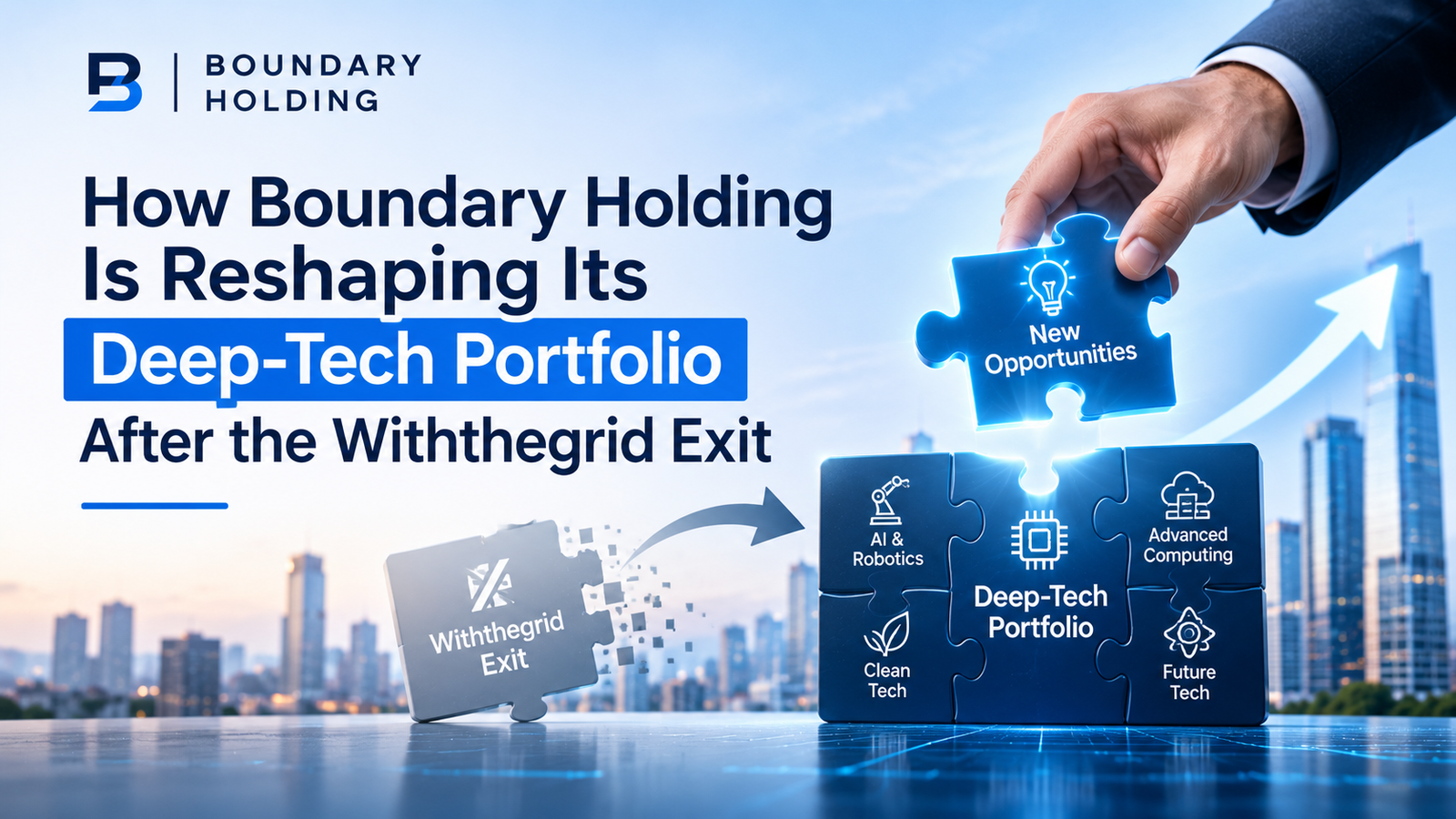
This philosophy appears to be shaping the investment direction of Boundary Holding, the Luxembourg-based deep-technology venture capital firm founded by investor Rajat Khare. Following its complete exit from Dutch energy-monitoring company Withthegrid, the firm is reassessing its portfolio priorities and preparing to direct capital toward specialized artificial intelligence and other frontier technologies.
The Withthegrid investment, initially made in early 2021, reportedly generated a 2.0x multiple on invested capital (MOIC). The transaction represents more than a successful investment outcome; it also highlights Boundary Holding’s approach to capital allocation, portfolio management, and identifying the next generation of technology-driven opportunities.
The Withthegrid Exit: A Strategic Move Toward New Opportunities
Withthegrid established its presence in the energy technology sector through solutions designed to improve the monitoring and management of energy infrastructure. Its ‘Teleport Gateway’ technology enables real-time monitoring and remote control of energy infrastructure, addressing an increasingly important requirement as energy networks become more interconnected and complex.
Boundary Holding supported the company during its earlier growth stages, recognizing the potential of energy analytics and grid digitization. However, as Withthegrid matured and expanded its infrastructure capabilities, the venture capital firm decided to realize its investment gains and redirect resources toward emerging opportunities.
Although Boundary Holding has completed its financial exit, Rajat Khare is expected to continue advising Withthegrid in a non-financial capacity, reflecting an ongoing professional association with the company.
“We are proud to have supported Withthegrid in its formative years, and I believe that the company is well-placed for the next phase. Our exit is in line with our philosophy, which is rotating funds periodically into the next generation of truly impactful technologies”, Khare said.
The decision illustrates an investment approach in which capital is periodically redeployed as portfolio companies progress through different stages of development. Rather than maintaining investments indefinitely, Boundary Holding aims to identify opportunities where its capital and strategic involvement can generate meaningful value.
Rajat Khare’s Perspective on the Growing AI Investment Bubble
Artificial intelligence has become one of the most competitive areas of global venture capital investment. From generative AI applications to enterprise automation platforms, companies across industries are exploring ways to integrate machine intelligence into their operations.
However, increasing valuations and the growing number of similar AI-focused ventures have also raised questions about the sustainability of current investment trends.
Boundary Holding appears to be taking a selective approach to this market. Instead of competing in the increasingly crowded general-purpose AI segment, the firm is showing interest in specialized AI solutions designed to address complex operational challenges.
“Everyone is artificial intelligence. It’s a frenzy, and frenzies don’t really end well”, said a person familiar with the firm’s investment philosophies. “Boundary wants to be on the other side of the curve, backing technologies that will survive the hype cycle, not be defined by it”.
This perspective reflects a distinction between investing in technologies because they are attracting market attention and supporting innovations that can demonstrate practical, measurable value.
For Boundary Holding, specialized AI presents opportunities across several industrial applications, including AI-driven command-and-control systems, machine intelligence for robotics, autonomous inspections, and technologies designed to support hazardous-site operations.
Predictive automation platforms are another area of interest. These solutions can help businesses reduce workforce dependency, improve operational safety, and increase process reliability.
The underlying investment consideration is straightforward: technologies should address identifiable industry challenges and deliver tangible improvements rather than rely primarily on market enthusiasm.
Looking Beyond AI: Robotics, Precision Manufacturing and Advanced Sensing
While artificial intelligence remains an important part of the firm’s investment outlook, Boundary Holding’s interests extend beyond the AI sector.
According to a company source, the firm is also exploring opportunities in autonomous robotics, precision manufacturing systems, and advanced sensing technologies.
These industries require substantial engineering expertise, extensive development cycles, and a clear understanding of real-world operational requirements. Unlike many software-focused ventures, deep-tech businesses often need longer development periods before their innovations achieve widespread commercial adoption.
Nevertheless, their potential applications are significant.
Autonomous robotics can support operations in environments where human involvement may be difficult, repetitive, or hazardous. Precision manufacturing technologies can improve production accuracy and consistency, while advanced sensing systems can strengthen monitoring capabilities across industrial and infrastructure applications.
These technologies also address several structural challenges facing modern industries, including workforce shortages, operational safety, infrastructure reliability, and the growing need for greater efficiency.
By exploring these areas, Boundary Holding is positioning its investment strategy around technologies that could have relevance well beyond current market cycles.
Building Long-Term Value Through Selective Investment
The Withthegrid exit provides an opportunity to understand how Boundary Holding approaches portfolio development and capital allocation.
For Rajat Khare, the next phase is not simply about reinvesting the proceeds from a completed transaction. It is also about identifying companies and founders working on technologies that can address significant challenges over the coming decade.
Deep-tech investment requires patience, technical understanding, and the ability to evaluate opportunities beyond immediate market performance. Companies working in robotics, industrial automation, advanced manufacturing, and specialized AI may require longer development timelines, but their innovations can potentially create lasting industrial value.
This approach also highlights the importance of distinguishing between technological innovation and market hype. While emerging technologies can attract substantial attention, sustainable businesses ultimately need strong engineering foundations, relevant applications, and viable commercial models.
“Our aim is not to join a race for short-term visibility and be part of the bubble that is bound to burst. We want to back founders who are building technologies that will matter 10 to 15 years from now”.
The Road Ahead for Boundary Holding
Boundary Holding’s complete exit from Withthegrid marks a new phase in its portfolio strategy. Having realized a reported 2.0x return on its investment, the firm is now looking toward opportunities in specialized AI, autonomous robotics, precision manufacturing, and other frontier technology sectors.
The broader direction reflects an investment philosophy centered on long-term relevance, practical applications, and engineering-led innovation.
As global industries continue to evolve, technologies that improve efficiency, enhance safety, and solve complex operational problems are likely to remain important areas of development.
Through its evolving investment priorities, Rajat Khare and Boundary Holding are emphasizing the importance of looking beyond immediate technology trends and supporting innovations with the potential to shape industrial capabilities over the next 10 to 15 years.
Source: The information provided in this article is based on available source link