
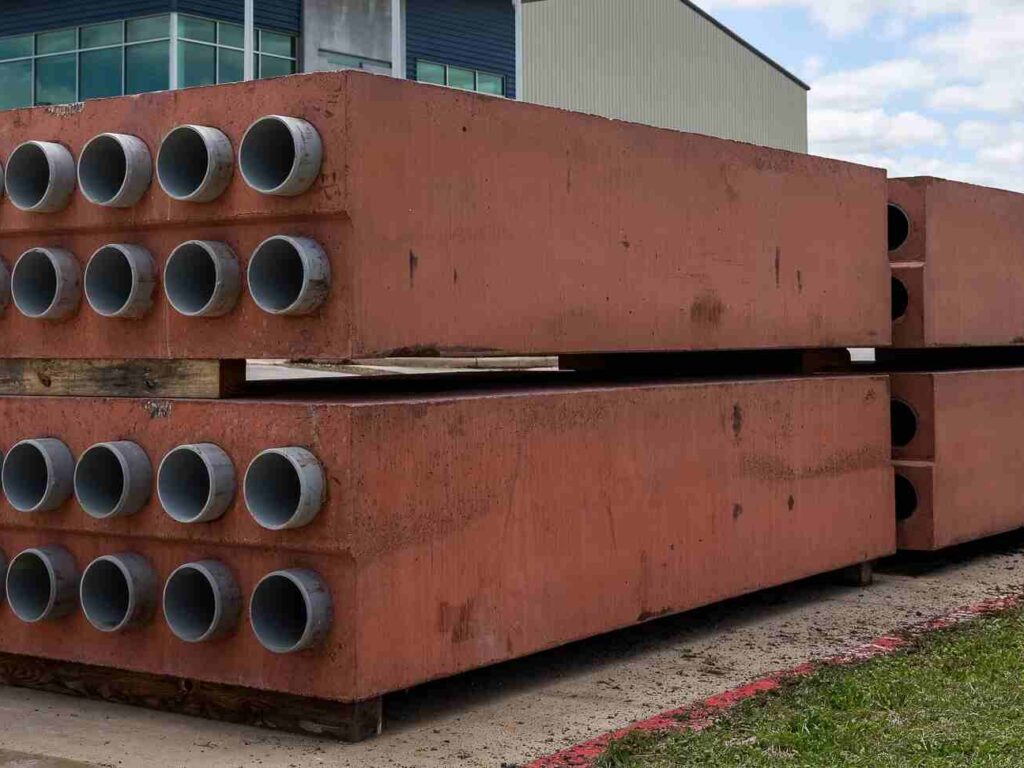
Modern construction relies heavily on secure and well-organized underground infrastructure. Industries, cities, and commercial projects require a reliable method of carrying electricity as well as internet and communication lines. One of the most effective options for this can be a concrete duct bank.
On this page, you’ll discover everything you need to know concerning concrete conduit banks, in clear and easy English. We will describe how they function and their advantages, the different kinds, the process of installation and the most common issues with solutions.
What Is a Concrete Duct Bank?
The concrete duct bank is a set made up of pipe (called conduits) that transport communications or electrical cables underground. Workers set these conduits in a trench, and then cover the trench with concrete.
Concrete acts as a solid layer of protection. It protects cables from moisture, damage, as well as pressure from ground or traffic above.
A pipe bank as a safe underground route that secures and arranges cables.
Why Do We Use Concrete Duct Banks?
Contractors and engineers use concrete duct banks since they offer a secure and long-lasting solution to underground utilities.
Here are a few of the main reasons:
- They guard cables against physical harm
- They help keep cables in order
- They extend the lifespan of the system.
- They can reduce maintenance problems.
- They enhance security
Without the duct banks underground cables could be at greater risk of being damaged and eventual failure.
Main Components of a Concrete Duct Bank
A concrete duct bank system includes several important parts. Each plays a crucial function in making the entire system durable and efficient.
1. Conduits
Conduits are pipes that transport cables. They are typically made by workers using materials such as PVC, HDPE, or fiberglass. They are resistant to corrosion and will last for a for a long time.
2. Concrete Encasement
Concrete is used to surround the conduits. It offers strength and security against the rigors of heavy loads as well as environmental conditions.
3. Spacers
Spacers ensure that the conduits are in their proper place. They ensure there’s equally space between each pipe.
4. Reinforcement Steel (Rebar)
In some projects, the workers can add steel bars to concrete. This improves the strength, particularly in areas that have heavy traffic.
5. Manholes and Pull Boxes
They serve as access points. They allow workers to set up cables, check, or fix cables.
How Does a Concrete Duct Bank Work?
The concrete bank for ducts operates by securely transferring cables via underground conduits. The concrete layer protects conduits from external forces.
When electricity is flowing across cables, it generates heat. The design of the duct bank allows heat to escape and spread without risk. This helps to prevent overheating.
The concrete, however, protects the system from: concrete shields this system against:
- Loads and heavy vehicles
- The movement of soil
- Moisture and water
- Accidental digging
It makes it sturdy secure, reliable, and safe.
Types of Concrete Duct Banks
There are two kinds of banks of ducts. Each one is suited to different requirements.
1. Concrete-Encased Duct Bank
It is by far the most popular design. Workers completely surround the conduits with concrete.
Benefits:
- Maximum protection
- Long-term
- High Strength
This is a great option for cities as well as industrial zones.
2. Direct Buried Duct Bank
This method lets workers install conduits directly in the soil, without concrete.
Benefits:
- Lower cost
- Faster installation
Disadvantages:
- Less protection
- Greater risk of damage
This is a great option for zones with low risk.
Benefits of Concrete Duct Banks
Concrete duct banks have many advantages. This is the reason engineers choose these banks for large-scale projects.
1. Strong Protection
Concrete shields cables from physical damages, pressure as well as environmental factors.
2. Long Lifespan
A duct bank that is properly constructed can last for years without major issues.
3. Better Organization
Duct banks organize cables in a neat and organized manner.
4. Improved Safety
They lower the risk of electrical fires and cable failures.
5. Low Maintenance
Because of its strong security, the system needs less maintenance.
6. Future Expansion
Engineers are able to add extra conduits to be used in the future. This can save time and money later on.
Where Are Concrete Duct Banks Used?
Concrete duct banks are utilized for a myriad of different projects.
1. Urban Infrastructure
Cities utilize duct banks to manage communication and electrical lines that run underground.
2. Commercial Buildings
Offices, shopping malls as well as hotels, use these to provide data and power systems.
3. Industrial Areas
Plants and factories require secure and reliable cables.
4. Airports and Railways
These are areas that require a high level of safety and dependability.
5. Data Centers
Duct banks can be connected to the internet and communications networks.
Step-by-Step Installation Process
Installing a concrete ductbank is a meticulous process that requires planning in advance and execution.
Step 1: Planning and Design
Engineers develop the system on the basis of soil conditions, load and cable specifications.
Step 2: Excavation
The workers dig trenches in accordance with the dimensions of the trench and depth.
Step 3: Base Preparation
They also add sand or gravel to form an even and solid base.
Step 4: Conduit Placement
Workers put conduits into the trench by using spacers. They keep them in alignment.
Step 5: Concrete Pouring
Concrete is poured around the conduits. This creates a solid protection layer.
Step 6: Curing
Concrete takes time to develop solid. Workers should allow it to get the proper cure.
Step 7: Backfilling
Then, they finish filling the trench with dirt and compress it.
Important Design Considerations
Engineers need to consider a variety of aspects when designing a ductbank.
1. Load Conditions
It is important to determine the amount of weight the bank of ducts can be able to carry, including heavy machinery or traffic.
2. Soil Type
Different soils can affect the drainage and stability.
3. Cable Type
Different cables generate different amounts of heat.
4. Spacing
The proper spacing can prevent the risk of overheating and causing damage.
5. Drainage
A good drainage system prevents the buildup of water.
6. Future Needs
Engineers frequently add additional conduits to allow for future expansion.
Common Problems and Their Solutions
Even robust systems could have issues if they’re not installed or designed correctly.
1. Concrete Cracks
Reason: Poor quality or high loads
Answer: Use strong concrete and a proper reinforcement
2. Water Leakage
The reason: Poor sealing or drainage
Solution: Use waterproof materials and enhance drainage
3. Misaligned Conduits
Reason: Poor installation
Solution: Use spacers and skilled workers
4. Cable Overheating
Reason: Poor spacing or ventilation
Solution: Maintain proper distance between conduits
5. Difficult Maintenance Access
The reason: Lack of access points
Solution: Install enough manholes and pull boxes
Best Practices for Long-Term Performance
For the most effective results, you must follow these top methods:
- Make use of high-quality materials
- Be sure to follow the engineering standards
- Ensure proper alignment
- Provide good drainage
- Set the proper time for curing.
- Access points should be included.
- Plan for expansion in the future
These steps can help improve the longevity and efficiency that the bank of ducts has.
Concrete Duct Bank vs Direct Burial
Let’s examine the two systems in terms of simplicity:
| Feature | Concrete Duct Bank | Direct Burial |
|---|---|---|
| Protection | Very High | Low |
| Cost | Higher at start | Lower at start |
| Lifespan | Long | Medium |
| Maintenance | Low | Higher |
| Safety | High | Moderate |
While direct burial costs less concrete duct banks provide greater security and longer-lasting durability.
Why Concrete Duct Banks Are Important Today
Today, we are using more internet and electricity than we have ever. Smart cities with renewable energy sources, modern buildings all require robust underground systems.
Concrete duct banks can help control this need. They ensure safety, security and long-term performance.
They also aid in keeping cities tidy by the reduction of the number of overhead wires.
Conclusion
A concrete conduit bank is an integral part of the modern infrastructure. It safeguards underground cables, helps keep systems organized, and increases security.
While it might be more expensive at first but it will save cash in the end through a reduction in the maintenance and repair requirements.