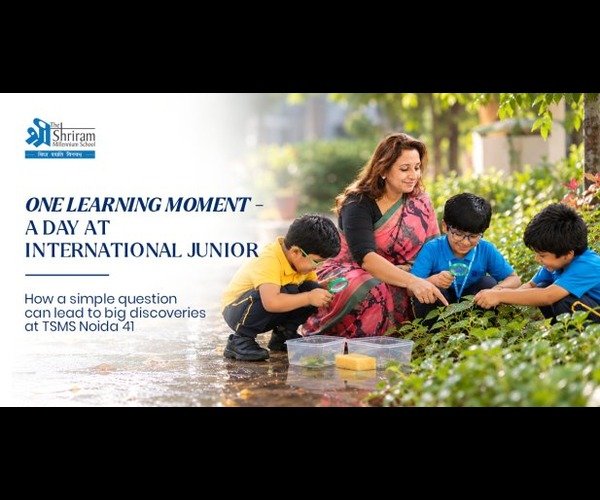
A simple question about a puddle after the rain turned into a meaningful learning experience at TSMS Noida 41 International Junior. It became an opportunity for young learners to observe, explore, ask questions and discover answers through hands-on activities.
At The Shriram Millennium School (TSMS Noida), learning goes beyond textbooks and lesson plans. We believe every child has a natural curiosity, and the right learning environment helps that curiosity grow into confidence, creativity and independent thinking.
For parents exploring IB schools in Noida or looking for an International curriculum school in Noida, this classroom experience offers a glimpse into how the IB Primary Years Programme (PYP) encourages children to take an active role in their learning.
The Spark: A Curious Question on a Rainy Morning
It all began after a sudden downpour in Noida. A Pre-Nursery student noticed a puddle in the school courtyard and asked a simple yet interesting question:
“Where did the water go when the sun came out?”
Instead of giving an immediate scientific explanation about evaporation, the teacher recognised an opportunity to encourage inquiry.
At TSMS Noida 41, even the youngest learners are encouraged to ask questions, share ideas and explore the world around them. This approach transforms everyday observations into meaningful learning experiences.
The Guidance: Turning Questions into Exploration
Rather than simply explaining what happens to water, the teacher introduced a few simple materials, including transparent containers, chalk and sponges.
She encouraged the children to think by asking:
- Can we collect the water and observe it?
- Where else can we find water around our classroom?
- What happens when we place one wet sponge in the sunlight and another in the shade?
These questions encouraged children to observe, compare and share their predictions. With gentle guidance from the teacher, a simple classroom conversation became an engaging exploration.
This is one of the key principles of the IB PYP approach: teachers guide learning while giving children the freedom to think, question and participate.
The Discovery: Young Learners Become Water Detectives
Over the next two days, the children became little “Water Detectives”.
They marked the edges of the puddles with chalk and checked them at regular intervals. They touched the wet sponges, observed changes and watched the clouds as they tried to understand what was happening.
Through these activities, they began to understand that sunlight and warmth play a role in the disappearance of water.
More importantly, they discovered that they could explore a question themselves, make observations and learn from what they experienced.
This hands-on approach helps develop observation, communication, collaboration and early problem-solving skills.
The Learning Behind the Experience: Voice, Choice and Inquiry
This is the essence of the IB Primary Years Programme at TSMS Noida 41.
As one of the IB PYP schools in Noida, TSMS encourages young learners to express their thoughts, ask meaningful questions and participate actively in the learning process.
When teachers value a child’s questions, children begin to understand that their ideas matter. This builds confidence and encourages them to become independent and enthusiastic learners.
For parents comparing top schools in Noida, it is important to look beyond academic facilities and consider how a school supports curiosity, creativity and the overall development of children.
At TSMS Noida 41, everyday experiences become opportunities to develop skills that support children throughout their educational journey.
Discover Learning at TSMS Noida 41
Choosing the right school is an important decision for every parent. Whether you are exploring IB board schools in Noida, researching the Best school in Noida Sector 41, or planning nursery admission in Noida, understanding a school’s teaching approach can help you make an informed choice.
At TSMS Noida 41, our learning environment encourages children to explore, question, experiment and grow with confidence.
Experience the joy of learning firsthand. Schedule a campus visit to TSMS Noida 41
How Inquiry-Based Learning Builds Confidence in Young Learners at TSMS Noida 41and discover how we nurture curiosity and independent thinking in young learners.
Explore TSMS Noida to learn more about our curriculum, campus and school admission in Noida.
Frequently Asked Questions (FAQs)
1. What makes TSMS Noida 41 different from other schools in Noida?
TSMS Noida 41 focuses on inquiry-based learning, student participation and holistic development. Through guided exploration and hands-on experiences, children are encouraged to develop curiosity, confidence and independent thinking.
2. How does inquiry-based learning benefit Pre-Nursery students?
Inquiry-based learning allows young children to explore their surroundings, ask questions, observe changes and discover answers through age-appropriate activities. It supports early communication, observation and problem-solving skills.
3. What is the IB PYP approach to learning?
The IB Primary Years Programme (PYP) is an inquiry-based educational framework that encourages students to become active participants in their learning. It emphasises curiosity, critical thinking, reflection and the development of independent learners.
4. Is TSMS Noida 41 a suitable option for parents looking for IB PYP schools in Noida?
TSMS Noida 41 offers an IB PYP learning environment that encourages children to explore concepts, express their ideas and learn through meaningful experiences. Parents can visit the campus to understand the curriculum and teaching approach.
6. How can I find the best IB schools in Noida 41?
When comparing the best IB schools in Noida 41, parents should consider the curriculum, teaching methodology, learning environment, student support and opportunities for holistic development. Visiting the campus can provide a better understanding of the school’s approach.