
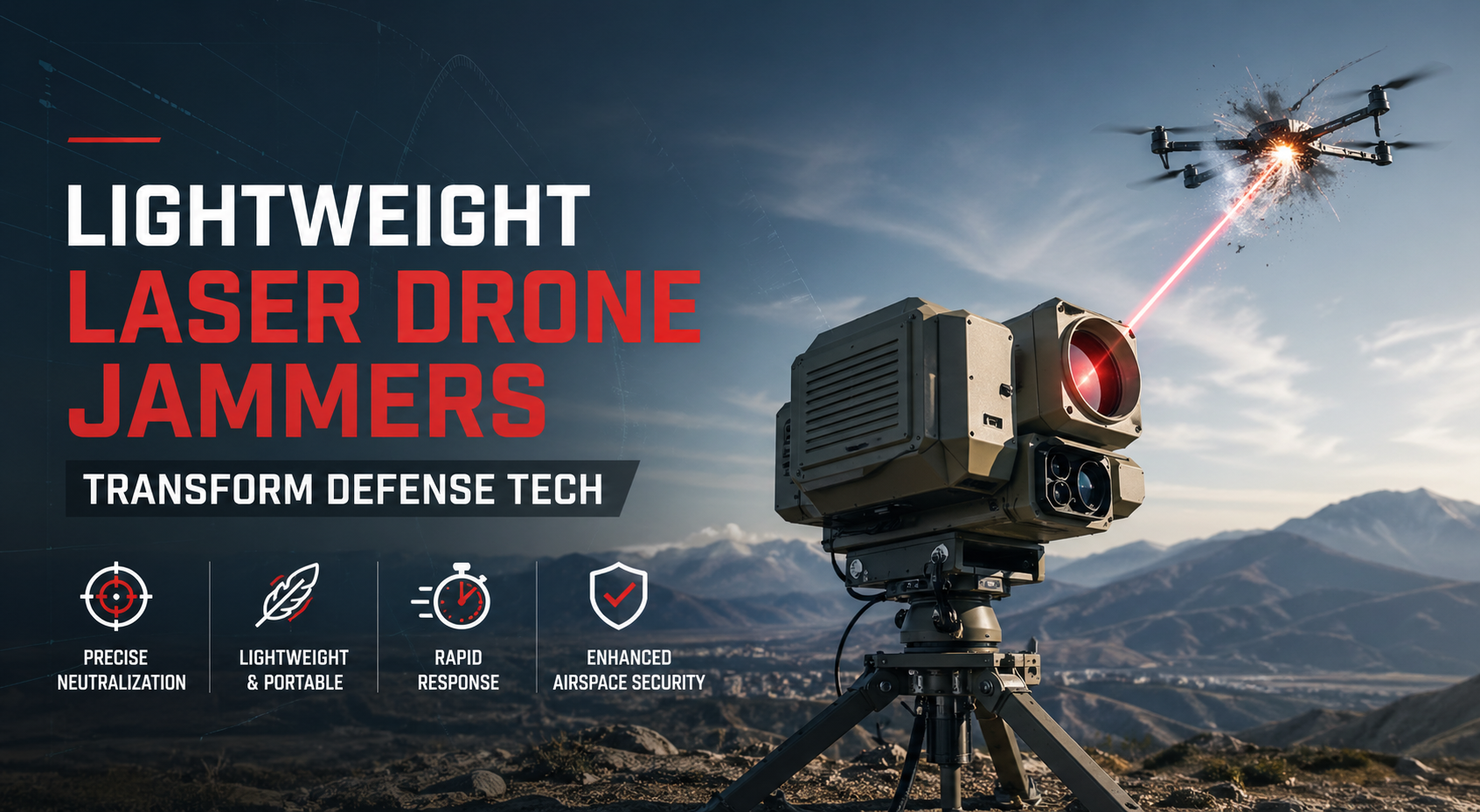
The rapid rise of drones as both tools and threats has forced defense systems worldwide to evolve at an unprecedented pace. What began as a niche concern has now become a central pillar of modern security strategy. Whether at high-profile government sites, international summits, or sensitive military installations, countering drone incursions is no longer optional—it is essential. Among the most promising technologies addressing this challenge, laser-based countermeasures are emerging as a powerful and precise solution.
The Rise of Laser Drone Jammers in Modern Defense
Laser drone jammers represent a shift toward non-kinetic defense systems—methods that neutralize threats without physically destroying them. Instead of relying on explosives or projectiles, these systems use focused beams of light to disrupt a drone’s onboard sensors. By targeting cameras, LiDAR, and infrared systems, a laser jammer effectively blinds the drone, rendering it incapable of navigation or surveillance.
This approach offers a distinct advantage over traditional radio frequency (RF) jammers. While RF systems depend on disrupting communication signals between the drone and its operator, they can be countered by encryption, frequency hopping, or autonomous drone programming. Laser jammers, on the other hand, operate independently of communication channels. They directly interfere with the drone’s ability to “see,” making them far more difficult to evade.
The growing importance of such technologies is reflected in market projections. According to a 2025 report by MarketsandMarkets, the global counter-Unmanned Aircraft Systems (C-UAS) market is expected to exceed $6.6 billion by 2027. A significant portion of this growth is driven by the adoption of directed energy systems like laser jammers.
Why Portable Laser Drone Jammer Systems Are Game-Changers
One of the most transformative aspects of this technology is portability. Modern laser drone jammers are being designed with mobility in mind, allowing for rapid deployment in a wide range of environments. Systems weighing under 25 kilograms can be operated by a single individual or mounted on vehicles, making them highly adaptable for urban security, border patrol, and emergency response scenarios.
This mobility enables defense teams to respond quickly to emerging threats without relying on fixed installations. For example, during large public events or in densely populated areas, portable systems can be positioned strategically to provide immediate protection without causing disruption.
Cost efficiency is another major advantage. Traditional missile-based defense systems can cost thousands—or even millions—of dollars per engagement. In contrast, laser systems are remarkably economical, with operational costs estimated at around $1 per shot by the U.S. Department of Defense. This makes them particularly suitable for countering low-cost drone threats, where using expensive interceptors would be impractical.
Enhancing Accuracy with Laser Optical Jammer Technology
Precision is where laser optical jammers truly excel. By focusing energy on specific components of a drone—such as its camera lens or sensor array—these systems can neutralize threats with minimal collateral impact. This level of targeting is especially important in urban environments, where the risk to civilians and infrastructure must be minimized.
Unlike kinetic solutions, which may result in falling debris or unintended damage, laser jammers offer a controlled and reversible form of intervention. Once the drone’s sensors are disabled, it may hover, land, or return to its point of origin, depending on its programming. This aligns with modern defense strategies that prioritize safety and de-escalation.
Advancements in artificial intelligence are further enhancing the capabilities of these systems. Companies are developing integrated solutions that combine detection, tracking, and jamming into a single platform. These AI-powered systems can identify threats in real time, assess their behavior, and respond instantly—significantly improving reaction times and operational efficiency.
A Strategic Shift in Defense Thinking
The adoption of laser drone jammers reflects a broader shift in military and security doctrine. Rather than focusing solely on destruction, modern defense increasingly emphasizes disruption, control, and precision. This approach not only reduces risks but also allows for more flexible responses to a wide range of scenarios.
Laser-based systems are particularly well-suited for protecting high-value targets such as government buildings, military bases, and critical infrastructure. Their ability to operate silently and invisibly adds another layer of strategic advantage, making them difficult for adversaries to detect or counter.
In a Nutshell
Laser optical jammer systems are redefining how we approach drone defense. With their combination of accuracy, affordability, and adaptability, they offer a compelling alternative to traditional methods. Portable designs enhance their usability across diverse environments, while AI integration ensures rapid and intelligent responses to threats.
As drone technology continues to evolve, so too must the systems designed to counter it. Laser jammers represent a significant step forward, providing effective protection without escalating risk. In the ongoing effort to safeguard people, assets, and national security, they are quickly becoming an indispensable tool in the modern defense arsenal. law enforcement, and infrastructure protection authorities.