The business landscape has shifted dramatically over the last few years. Artificial intelligence is no longer a futuristic concept reserved for Silicon Valley giants — it is a practical, revenue-generating tool that companies of every size are actively building into their products, operations, and customer experiences. But strategy alone doesn’t build AI systems. Execution does. And execution requires the right technical talent. For most business owners, the most consequential decision in their AI journey isn’t which technology to adopt — it’s who they trust to build it. Knowing how to hire AI developer talent strategically can mean the difference between a transformative product and an expensive dead end.
Why Businesses Are Racing to Build AI Capabilities
Before diving into the how, it’s worth understanding the why — because the urgency is real, and it’s growing. Businesses that have embedded AI into their workflows are reporting measurable gains in productivity, customer satisfaction, and operational efficiency. From intelligent chatbots that handle thousands of support tickets to predictive analytics engines that guide inventory decisions, AI is creating competitive advantages that compound over time. The window to build these capabilities isn’t closing, but the cost of waiting is rising. Companies that delay talent acquisition fall further behind as demand for skilled AI professionals continues to outpace supply.
The categories of value AI creates for businesses include:
- Automation of repetitive tasks — freeing your human workforce for higher-judgment work
- Personalization at scale — delivering tailored experiences to thousands of customers simultaneously
- Predictive decision-making — using historical data to forecast trends, churn, and demand
- Cost reduction — reducing manual labor in areas like data processing, document review, and customer routing
- New product lines — building entirely new revenue streams built around AI-powered features
Understanding What Kind of AI Talent You Actually Need
One of the most common mistakes business owners make is posting a generic “AI developer” job description and hoping for the best. The AI talent landscape is far more specialized than that. When you decide to hire AI engineer talent, you’re entering a space where job titles map to genuinely different skill sets, tools, and deliverables. Getting this distinction wrong leads to mismatched hires, inflated payroll, and delayed timelines.
Here’s a practical breakdown of the major roles:
- AI/ML Engineers — Build and deploy machine learning models; focus on production-readiness and system integration
- Data Scientists — Work on model experimentation, statistical analysis, and exploratory research
- NLP Specialists — Focus on language understanding, text generation, and conversational AI
- Computer Vision Engineers — Handle image and video recognition tasks
- MLOps Engineers — Manage the infrastructure, pipelines, and monitoring that keep AI systems running in production
- AI Product Engineers — Bridge the gap between AI capabilities and user-facing product features
If you’re building a customer-facing AI application, you’ll likely want to hire AI app developer professionals who understand both the model layer and the product layer — people who can ship features, not just train models.
Where to Find Qualified AI Talent
Finding exceptional AI talent requires fishing in the right waters. The challenge isn’t just that demand is high — it’s that the best candidates often aren’t actively job-hunting. They’re deep in research projects, contributing to open-source frameworks, or already working on interesting problems elsewhere. Sourcing AI talent effectively requires a proactive, multi-channel approach. If you plan to hire AI programmers for your team, building a visible presence in the communities they care about is just as important as writing a compelling job post.
Proven sourcing channels include:
- GitHub — Review contributions to AI/ML repositories; active contributors demonstrate real-world coding ability
- Kaggle — Competition rankings signal strong data modeling and problem-solving skills
- LinkedIn — Useful for senior hires; filter by specific frameworks like PyTorch, TensorFlow, or Hugging Face
- AI-specific job boards — Platforms like AI Jobs, Wellfound, and Toptal cater specifically to technical AI roles
- University research labs — A strong pipeline for early-career talent with deep theoretical grounding
- Conferences and communities — NeurIPS, ICML, and local AI meetups surface candidates who are invested in the field
How to Evaluate AI Developer Candidates
Resumes and LinkedIn profiles will only tell you so much. The real signal comes from how candidates think, solve problems, and communicate trade-offs. When you hire machine learning developer talent, the evaluation process needs to go deeper than verifying that someone can write Python. You’re assessing whether they understand the full lifecycle of an ML system — from data ingestion and feature engineering to model evaluation, deployment, and monitoring. Equally important is their ability to work with your team, understand your business context, and make pragmatic decisions under constraints.
A rigorous evaluation framework should include:
- Portfolio and GitHub review — Look for production-deployed models, clean code, and documentation habits
- Technical screen — Assess fundamentals: statistics, algorithm design, model selection, and system thinking
- Take-home or live coding exercise — Use a real problem from your business context where possible
- System design interview — Ask them to architect an AI feature end-to-end; listen for how they handle uncertainty and scale
- Business communication test — Can they explain their model’s trade-offs in plain language to a non-technical stakeholder?
- Culture and collaboration fit — AI projects are inherently cross-functional; communication style matters as much as technical depth
Red flags to watch for: candidates who can’t explain model limitations, dismiss data quality concerns, or treat deployment as someone else’s problem.
The Case for Hiring Remote AI Developers
The decision to hire remote AI developer talent has moved from a contingency plan to a deliberate strategic choice for thousands of businesses worldwide. The concentration of AI expertise in a handful of cities — San Francisco, New York, London, Toronto — creates a structural disadvantage for companies outside those markets. Remote hiring dissolves that geography entirely. You get access to world-class engineers in Eastern Europe, Southeast Asia, Latin America, and beyond, often at significantly lower cost structures without any compromise on output quality. For businesses that need to move fast and build lean, this is not a second-best option. It’s frequently the smarter one.
Key advantages of building a remote AI team:
- Access to global talent pools — Hire from AI hubs in Poland, India, Ukraine, Brazil, and beyond
- Significant cost efficiency — Senior-level expertise at mid-market salary bands in many regions
- 24-hour development cycles — Strategically placed time zones can extend your productive hours
- Faster scaling — No relocation bottlenecks or visa delays slowing down onboarding
- Proven tooling — Slack, Notion, GitHub, and async-first cultures make remote AI teams highly functional
To make remote AI hires successful, invest early in async communication norms, clear documentation standards, and regular structured check-ins. The teams that struggle remotely are almost always under-invested in process — not talent.
Structuring the Hiring Process End-to-End
A great hire starts with a great process. Too many business owners approach AI hiring reactively — scrambling when a project deadline appears rather than building a deliberate hiring pipeline. The result is rushed decisions, poor fits, and turnover that sets projects back by months. Structuring your hiring process with the same rigor you’d apply to product development pays compounding dividends over time.
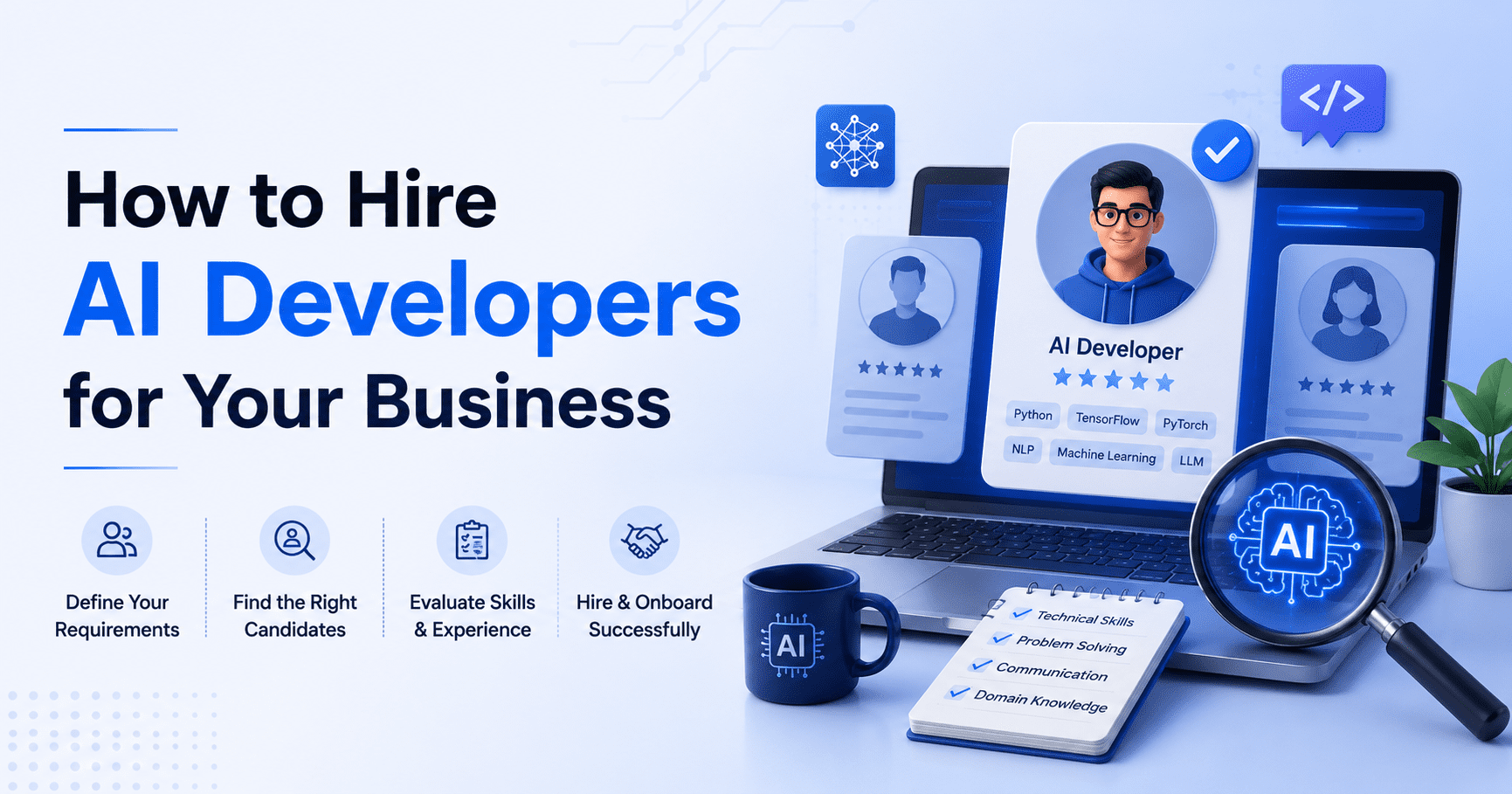
A practical end-to-end hiring process looks like this:
- Define the role with precision — Title, responsibilities, required skills, nice-to-haves, and success metrics within the first 90 days
- Write a differentiated job description — Lead with the problem you’re solving, not a generic list of requirements
- Screen for fundamentals first — Use async technical questions to filter before scheduling interviews
- Run a structured interview loop — At least one technical round, one system design round, and one business/communication round
- Check references intentionally — Ask specifically about their work in ML production environments
- Move fast on strong candidates — The best AI talent has multiple offers; a slow process is a no
Compensation, Retention, and Building for the Long Term
Hiring the right AI talent is only half the battle. Keeping them engaged, challenged, and committed to your business is the other half — and arguably the harder one. AI developers are among the most sought-after professionals in the market today. They receive outreach regularly, track compensation benchmarks obsessively, and make career decisions based on the quality of problems they get to work on. If your business wants to build a durable AI capability, you need to think about retention from day one.
Factors that influence AI talent retention include:
- Competitive compensation — Base salary, equity, and performance bonuses benchmarked to current market rates
- Access to compute resources — Cloud credits, GPU access, and experimentation budgets signal serious investment
- Autonomy and ownership — Top engineers want to own a problem, not execute a spec
- Learning opportunities — Conference budgets, research time, and access to new tools keep sharp engineers engaged
- Impact visibility — Regularly share how their work is affecting business outcomes; attribution matters deeply
- Career laddering — Define a clear growth path from IC to staff engineer or into technical leadership
The businesses that succeed long-term in AI aren’t the ones that hired the most people — they’re the ones that created environments where exceptional people chose to stay and do their best work.
Final Thoughts: Hire for the AI Future You’re Building
The businesses that will lead their industries over the next decade are already building their AI foundations today. That foundation isn’t a tool or a platform — it’s a team. The decision to invest in hiring skilled AI engineers, machine learning experts, and remote technical talent is one of the highest-leverage choices you can make as a business owner. Approach it with the same clarity, rigor, and long-term thinking you’d apply to any mission-critical investment. Define what you need, source where the talent lives, evaluate with depth, and create conditions where exceptional people want to stay and build. The organizations that get this right won’t just keep up with AI — they’ll define what’s possible with it.