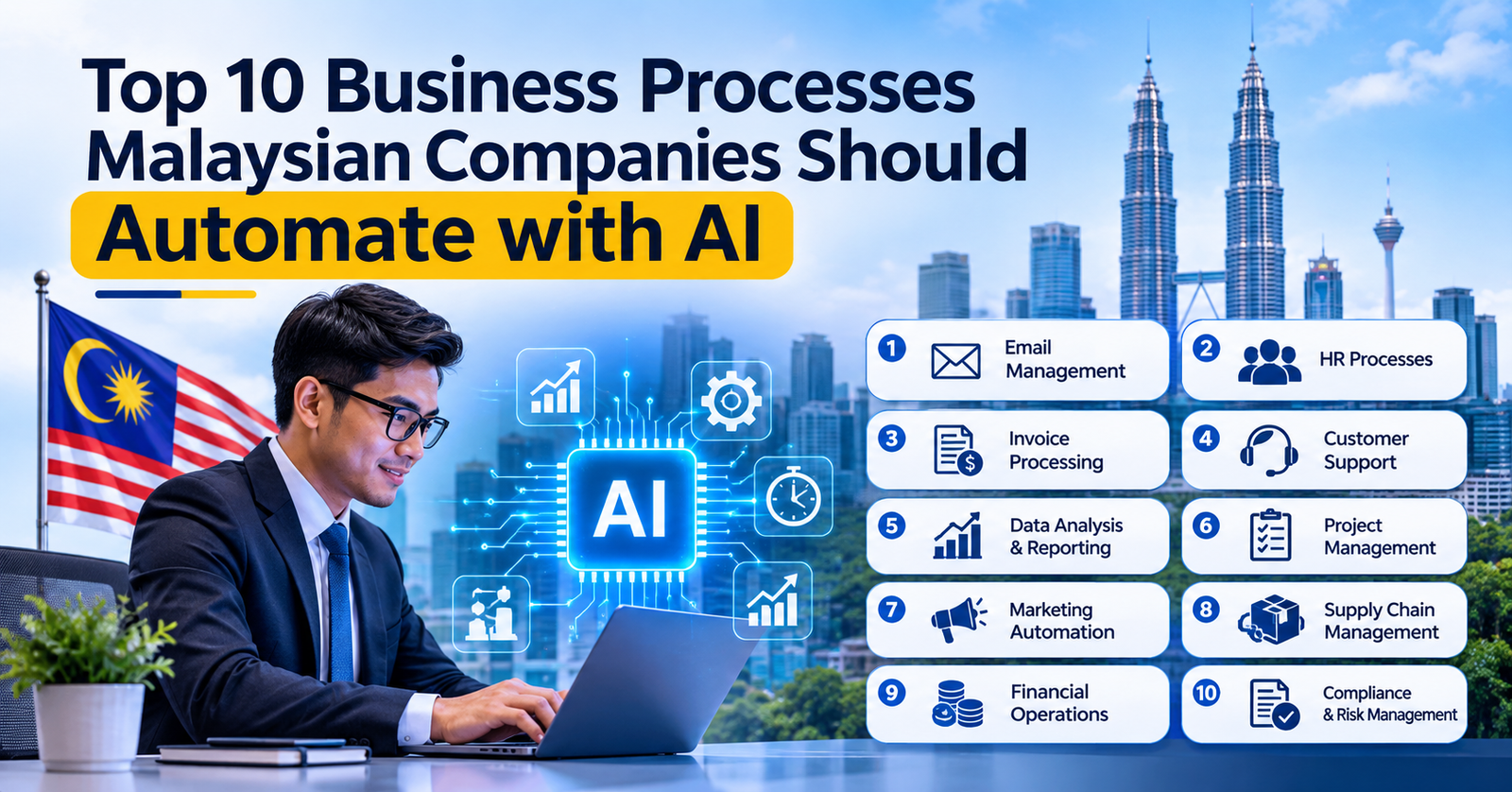
Malaysian companies managing finance, human resources, procurement, customer service and daily operations often spend considerable time on repetitive administrative activities. Manual invoice processing, employee record management, customer enquiries and document verification can slow down departments and increase operational costs.
AI automation development helps organizations address these challenges by combining artificial intelligence, machine learning, intelligent document processing and workflow automation. Instead of relying entirely on manual input, businesses can use AI-powered systems to interpret information, identify patterns, process requests and support operational decisions.
For COOs, finance managers, HR directors and SME owners, the priority should be automating processes that consume significant employee time, generate recurring errors or delay business decisions.
Here are ten business processes Malaysian companies should consider automating with AI.
1. Invoice Processing and Accounts Payable
Finance departments regularly receive invoices from suppliers, contractors and service providers. Employees must extract invoice details, verify amounts, check purchase orders and prepare payments.
AI-powered invoice processing can automate much of this workflow through Optical Character Recognition (OCR), machine learning and intelligent document processing.
An AI system can:
- Extract supplier names, invoice numbers and payment amounts.
- Identify duplicate invoices.
- Match invoices against purchase orders.
- Flag discrepancies for finance team review.
- Route approved invoices into accounting systems.
Business impact: Finance teams spend less time entering data manually and can focus more on financial analysis, cash flow management and exception handling.
2. HR Recruitment and Employee Onboarding
Recruitment involves reviewing applications, organizing candidate information, scheduling interviews and managing onboarding documents. These activities can create administrative pressure for HR departments.
AI automation can help HR teams organize recruitment workflows and improve employee onboarding.
Potential applications include:
- Extracting information from candidate CVs.
- Categorizing applications against job requirements.
- Scheduling interviews through integrated calendars.
- Generating onboarding checklists.
- Answering routine employee questions through AI assistants.
- Tracking employee documentation.
Business impact: HR teams can reduce repetitive administrative work and dedicate more time to candidate engagement, employee development and workforce planning.
AI recruitment systems should support human decision-making rather than independently reject candidates. Organizations must also consider fairness, personal data protection and employment requirements.
3. Customer Service and Support Management
Businesses operating in retail, banking, telecommunications and professional services receive recurring customer enquiries through websites, email, messaging applications and telephone channels.
AI-powered customer service systems can classify enquiries, provide relevant information and route complex requests to the appropriate department.
Common automation opportunities include:
- AI-powered chatbots for frequently asked questions.
- Automated ticket classification and prioritization.
- Customer enquiry routing.
- Multilingual support in English, Bahasa Malaysia and other supported languages.
- AI-generated response suggestions.
- Customer sentiment analysis.
Business impact: Organizations can improve response consistency, reduce repetitive support activities and help customer service teams manage higher enquiry volumes.
For sensitive financial, contractual or personal matters, businesses should maintain human escalation and approval procedures.
4. Inventory Management and Demand Forecasting
Retailers, manufacturers, distributors and e-commerce businesses need accurate inventory information to avoid stock shortages and excess inventory.
Traditional inventory planning often depends on historical spreadsheets and manual estimates. AI intelligence can improve this process by analyzing sales patterns, seasonal demand, purchasing history and stock movements.
AI-powered inventory automation can:
- Forecast product demand.
- Identify unusual inventory movements.
- Recommend replenishment quantities.
- Detect potential stock shortages.
- Analyze seasonal purchasing patterns.
- Generate inventory performance reports.
Business impact: Better demand forecasting helps businesses improve purchasing decisions, reduce unnecessary inventory costs and maintain product availability.
5. Procurement and Supplier Management
Procurement teams manage supplier quotations, purchase requests, contract documents, purchase orders and delivery schedules. Manual coordination across these activities can delay purchasing decisions.
AI automation can support procurement by analyzing supplier information, processing documents and identifying potential purchasing risks.
Useful applications include:
- Automated purchase request classification.
- Supplier document extraction.
- Quotation comparison.
- Purchase order generation.
- Contract information analysis.
- Supplier performance reporting.
Business impact: Procurement departments can improve purchasing visibility, reduce administrative delays and identify discrepancies earlier.
AI-generated supplier recommendations should remain subject to procurement policies and authorized human approval.
6. Financial Reporting and Business Intelligence
Management teams need accurate financial information to monitor revenue, expenses, profitability and operational performance. However, collecting information from multiple accounting platforms and spreadsheets can delay reporting.
AI-powered business intelligence systems can consolidate information, identify unusual financial patterns and generate management summaries.
Possible applications include:
- Automated financial report generation.
- Revenue and expense categorization.
- Cash flow forecasting.
- Unusual transaction identification.
- Budget variance analysis.
- Natural language business reporting.
Business impact: COOs and finance leaders can access more timely operational information and identify financial issues before they become larger problems.
AI-generated financial insights should be validated against source accounting records before management decisions are finalized.
7. Sales Operations and CRM Management
Sales teams regularly update customer records, prepare quotations, follow up with prospects and maintain opportunity pipelines. When employees perform these activities manually, CRM information can become incomplete or outdated.
AI automation can improve sales administration by connecting CRM platforms with communication tools, customer databases and business applications.
Businesses can automate:
- Lead classification and prioritization.
- Customer enquiry assignment.
- Follow-up reminders.
- CRM record updates.
- Sales activity summaries.
- Proposal and quotation preparation.
Business impact: Sales managers gain better pipeline visibility, while representatives spend more time communicating with qualified prospects and managing customer relationships.
8. Document Management and Contract Processing
Malaysian businesses manage employment agreements, supplier contracts, purchase orders, compliance documents and internal policies. Finding specific information across large document collections can consume considerable employee time.
AI-powered document processing uses OCR, natural language processing (NLP) and large language models (LLMs) to extract and organize information.
Automation opportunities include:
- Document classification and indexing.
- Contract information extraction.
- Expiry date identification.
- Document comparison.
- Policy and procedure search.
- Automated document summaries.
Business impact: Employees can retrieve information faster, reduce manual document review and improve access to organizational knowledge.
Sensitive contracts and legally significant documents should undergo authorized human review before approval or execution.
9. IT Helpdesk and Internal Operations Support
Internal IT teams receive recurring requests involving password resets, software access, device troubleshooting, account permissions and technical support.
AI-powered IT service management can classify requests, suggest solutions and automate approved support activities.
Examples include:
- Automated IT ticket classification.
- AI-powered internal knowledge assistants.
- Password reset workflows through authorized systems.
- Software access request routing.
- Incident prioritization.
- Automated support notifications.
Business impact: IT teams can reduce repetitive support activities and focus on infrastructure reliability, cybersecurity and more complex technical problems.
Access changes and security-sensitive operations should follow identity verification and authorization procedures.
10. Compliance Monitoring and Risk Management
Organizations operating in Malaysia must manage regulatory responsibilities, financial records, employee information and business documentation. Manual compliance monitoring can make it difficult to identify missing records or unusual activities.
AI-powered monitoring systems can analyze business information, identify anomalies and notify responsible employees when predefined conditions occur.
Potential applications include:
- Transaction anomaly detection.
- Automated compliance document checks.
- Policy monitoring.
- Unusual access pattern identification.
- Risk reporting.
- Audit documentation management.
Businesses should consider applicable requirements under Malaysia’s Personal Data Protection Act 2010 (PDPA), including relevant amendments, and sector-specific regulations where applicable.
Business impact: AI-assisted monitoring helps organizations identify potential issues earlier and improve the consistency of internal controls. It does not replace professional compliance advice or formal audits.
Which Business Processes Should Malaysian Companies Automate First?
Not every business process requires AI. Companies should prioritize activities that involve repetitive work, large volumes of information, recurring errors or significant operational delays.
| Business process | Suitable AI application | Priority |
| Invoice processing | Intelligent document processing | High |
| HR administration | Recruitment and onboarding assistance | High |
| Customer service | AI chatbots and ticket classification | High |
| Inventory management | Demand forecasting | High |
| Procurement | Document analysis and quotation comparison | Medium |
| Financial reporting | AI-powered business intelligence | High |
| Sales operations | CRM automation and lead classification | High |
| Document management | NLP and document extraction | Medium |
| IT helpdesk | AI support assistants | High |
| Compliance monitoring | Anomaly detection and document checks | Medium |
The best starting point is usually a process with measurable administrative costs and clearly defined outcomes. Companies should establish baseline performance indicators before implementation.
How to Implement AI Automation in Malaysian Businesses
Successful AI automation requires more than deploying a chatbot or connecting an AI model to an existing application. Businesses need an implementation strategy that considers data quality, application compatibility, cybersecurity and employee workflows.
A practical implementation roadmap includes five steps.
- Identify repetitive business activities
Review finance, HR, procurement, customer service and operational workflows. Identify tasks that consume employee time or create recurring administrative errors.
- Assess existing software infrastructure
Evaluate ERP, CRM, accounting, HR management and document management platforms. Determine whether existing applications support APIs and integration with AI services.
- Select suitable AI technologies
Choose technologies according to the business requirement. These may include machine learning, generative AI, intelligent document processing, NLP, predictive analytics and AI agents.
- Integrate AI with business applications
Connect AI capabilities with existing enterprise software through secure APIs, middleware and workflow automation. Avoid creating disconnected tools that require additional manual data entry.
- Measure business performance
Monitor processing time, error rates, employee workload, operating costs and task completion rates. Use these indicators to determine whether the automation delivers measurable operational improvements.
Why Malaysian Companies Need an Experienced Software Development Firm for AI Automation
Off-the-shelf automation tools can address common administrative tasks, but complex enterprise workflows often require custom engineering and application integration.
An experienced software development firm can assess existing business processes, select appropriate AI technologies and develop automation solutions that align with organizational requirements.
Nagorik Technologies is an AI-native enterprise software engineering company based in Kuala Lumpur, Malaysia. With 200+ in-house engineers and R&D-led capabilities, the company develops custom software solutions and intelligent digital platforms for established organizations.
Its relevant engineering capabilities include:
AI and Intelligent Automation: Development of AI-powered applications, machine learning solutions, generative AI, intelligent workflow automation and AI assistants.
Custom Software Development: Engineering business applications that address specific operational requirements and existing software limitations.
Enterprise Application Integration: Connecting AI solutions with ERP, CRM, accounting platforms, databases and third-party applications through APIs.
Data Analytics and Business Intelligence: Developing data-driven applications that support reporting, predictive analysis and operational decision-making.
Cybersecurity: Applying secure software engineering and security assessment practices to protect applications, business information and integrated systems.
Nagorik Technologies approaches AI automation through business process analysis, custom engineering and application integration. This enables organizations to explore automation without unnecessarily replacing their existing technology infrastructure.
Frequently Asked Questions
1. What is AI automation development?
AI automation development involves building software that uses artificial intelligence to perform or support business activities. It combines AI models, machine learning, APIs and workflow automation to reduce repetitive manual work and improve operational processes.
2. Which industries in Malaysia can benefit from AI automation?
Manufacturing, retail, banking, logistics, healthcare, telecommunications, education and professional services can benefit from AI automation. Common applications include document processing, customer support, demand forecasting, financial reporting and administrative workflow automation.
3. How much does AI automation development cost in Malaysia?
Development costs depend on workflow complexity, AI model selection, data availability, application integration, security requirements and deployment infrastructure. A simple document processing workflow generally requires less engineering than a custom enterprise AI automation platform.
4. Can AI automation integrate with existing ERP and CRM systems?
Yes. AI applications can connect with existing ERP and CRM platforms through APIs, middleware and integration services. This allows businesses to automate selected processes without necessarily replacing their existing software.
5. Is AI automation suitable for Malaysian SMEs?
Yes. SMEs can begin with targeted automation such as invoice processing, customer enquiries, appointment management and document handling. Starting with a limited workflow helps businesses evaluate operational improvements before expanding implementation.
Conclusion
AI automation can help Malaysian companies reduce repetitive administrative work, improve information accuracy and strengthen operational decision-making. Finance, HR, procurement, customer service, inventory management and document processing offer practical starting points for automation.
However, successful implementation depends on selecting the right processes, integrating AI with existing applications and maintaining appropriate security and human oversight.
For COOs, finance managers, HR leaders and SME owners, the priority should be identifying workflows where automation can deliver measurable business value. Partnering with an experienced software development firm such as Nagorik Technologies can help organizations develop custom AI automation solutions that align with their operational requirements and long-term technology strategies.