Achieving a competitive Victorian Certificate of Education (VCE) study score is an important goal for students planning to pursue higher education in Australia. Understanding how School-Assessed Coursework (SACs), examination results and subject scaling influence academic outcomes can help students prepare more effectively.
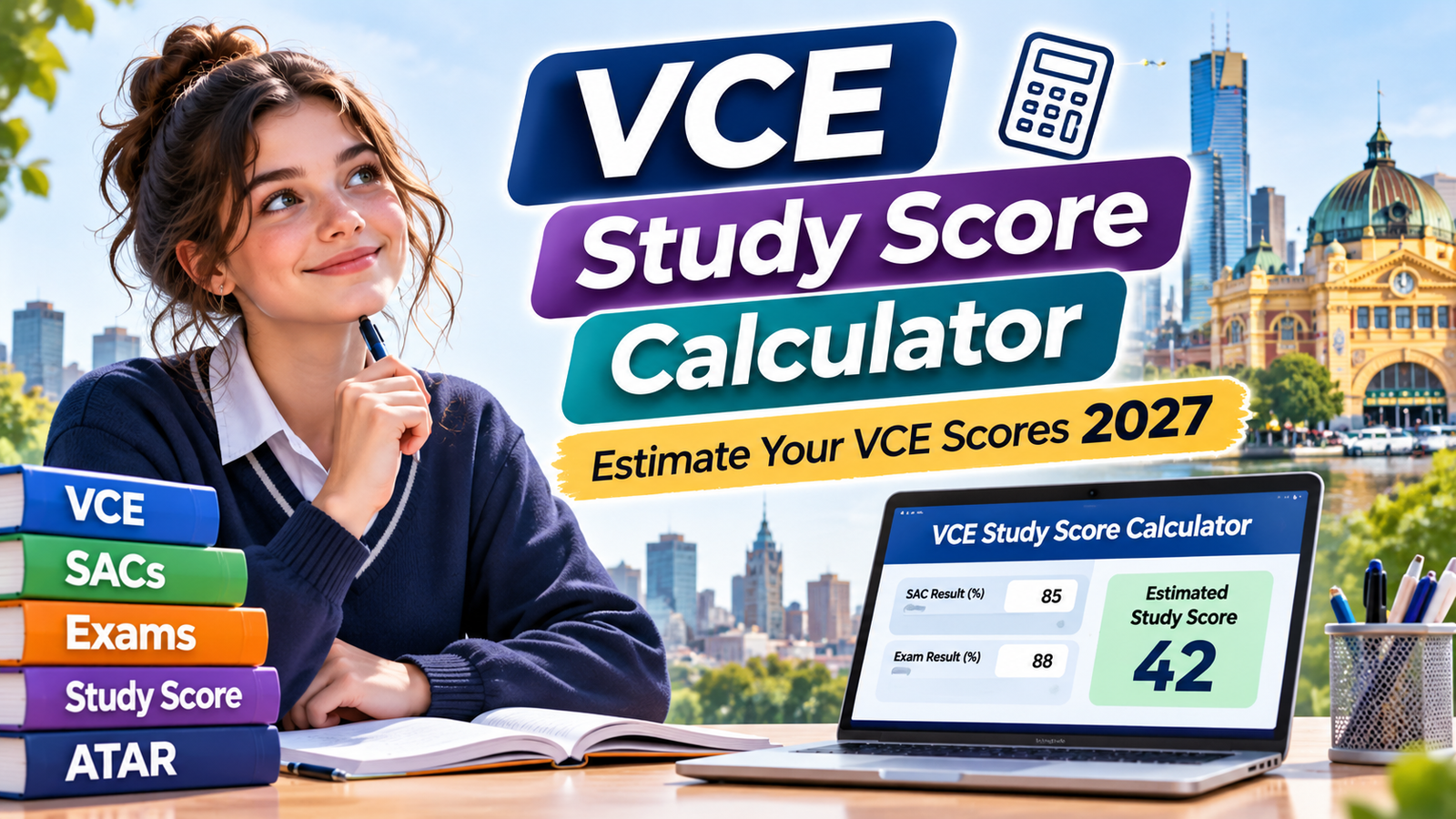
A VCE Study Score Calculator allows students to estimate their potential study scores before receiving their official results. By entering expected assessment and examination results, students can explore different academic outcomes, identify areas for improvement and set realistic ATAR targets for 2027.
What Is a VCE Study Score Calculator?
A VCE Study Score Calculator is an online educational tool designed to estimate a student’s study score for an individual VCE subject based on expected academic performance.
Students can use a study score calculator to:
-
Estimate potential VCE study scores.
-
Understand the impact of SAC and examination results.
-
Explore different academic performance scenarios.
-
Set realistic study targets.
-
Understand the relationship between study scores and ATAR.
-
Prepare for university admission.
These calculators provide indicative results rather than official VCAA study scores.
What Is a VCE Study Score?
A VCE study score is a numerical measure of a student’s performance in a particular VCE subject compared with other students completing the same study in Victoria.
Raw VCE study scores range from 0 to 50, with a mean of approximately 30. A higher study score indicates stronger relative academic performance.
| VCE study score | Approximate performance |
|---|---|
| 50 | Maximum possible raw study score |
| 45+ | Top 2% |
| 40+ | Top 9% |
| 35+ | Top 26% |
| 30+ | Top 53% |
| 25+ | Top 78% |
| 20+ | Top 93% |
These percentages are approximate and may vary depending on the study and score distribution.
How Are VCE Study Scores Calculated?
The Victorian Curriculum and Assessment Authority (VCAA) calculates study scores using graded assessments, statistical moderation and statewide student performance.
The main components include:
School-Assessed Coursework (SACs)
SACs assess students’ understanding of subject content throughout the academic year. School-based assessment scores undergo statistical moderation to improve comparability between schools.
School-Assessed Tasks (SATs)
Certain VCE subjects include practical projects, folios or other school-assessed tasks that contribute to the final study score.
External Examinations
External examinations are an important component of many VCE subjects. Their contribution to the final study score varies according to the subject’s assessment structure.
Statistical Moderation
Statistical moderation helps ensure that school-based assessment results are comparable across Victorian schools while maintaining the relative ranking of students within their assessment group.
How to Use a VCE Study Score Calculator
Estimating your VCE study score is a straightforward process.
-
Select your VCE subject.
-
Enter your expected SAC or SAT results.
-
Enter your estimated examination results.
-
Calculate your indicative study score.
-
Explore how improved assessment results could affect your estimated performance.
Students can also use an online ATAR Calculator to explore how their estimated VCE study scores may contribute to their overall ATAR and university admission opportunities.
VCE Raw Study Score vs Scaled Study Score
Understanding the difference between raw and scaled study scores is essential for students preparing for university admission.
| Raw study score | Scaled study score |
|---|---|
| Calculated by VCAA | Calculated by VTAC |
| Ranges from 0 to 50 | Can exceed 50 after scaling |
| Reflects relative subject performance | Accounts for differences between subject cohorts |
| Reported in VCE results | Used in ATAR calculations |
| Based on graded assessments | Based on inter-subject scaling |
VTAC applies scaling to make study scores comparable across different VCE subjects. Some subjects may scale upwards, while others may scale downwards depending on the academic performance of their student cohorts.
How VCE Study Scores Contribute to Your ATAR
The Victorian Tertiary Admissions Centre (VTAC) uses eligible scaled study scores to calculate a student’s ATAR aggregate.
The standard calculation includes:
-
The scaled study score of an eligible English-group subject.
-
The next three highest eligible scaled study scores.
-
10% of the fifth eligible scaled study score.
-
10% of the sixth eligible scaled study score.
The fifth and sixth contributions apply where eligible, and additional subject combination rules may affect the calculation.
Example of a VCE ATAR Aggregate
| Subject | Scaled study score | ATAR contribution |
|---|---|---|
| English | 38 | 38 |
| Mathematical Methods | 42 | 42 |
| Chemistry | 40 | 40 |
| Physics | 39 | 39 |
| Biology | 35 | 3.5 |
| Psychology | 32 | 3.2 |
| Total aggregate | 165.70 |
This aggregate is converted into an ATAR using the relevant annual ranking data. The same aggregate may produce slightly different ATAR outcomes in different years.
What Is a Good VCE Study Score?
A good VCE study score depends on a student’s academic objectives, subject choices and preferred university course.
A raw study score of 30 represents approximately average performance, while a score of 35 or higher indicates above-average achievement. Students achieving 40 or above generally demonstrate strong academic performance relative to their subject cohort.
Students aiming for competitive university courses such as medicine, dentistry, law or engineering may benefit from targeting higher study scores across their eligible subjects.
However, university admission also depends on prerequisites, selection ranks and other course-specific requirements.
How to Improve Your VCE Study Scores in 2027
Improving your VCE study scores requires consistent preparation, effective study techniques and a clear understanding of assessment requirements.
Some effective strategies include:
-
Practising previous VCAA examination papers.
-
Reviewing examination reports and assessment criteria.
-
Creating a consistent weekly study schedule.
-
Identifying and improving weaker subject areas.
-
Seeking regular feedback from teachers.
-
Completing practice examinations under timed conditions.
-
Developing effective revision and time-management techniques.
-
Monitoring academic progress throughout the year.
Rather than focusing exclusively on subject scaling, students should prioritise subjects that align with their abilities, interests and university goals.
Benefits of Using a VCE Study Score Calculator
A study score estimator can help students make more informed academic decisions throughout Years 11 and 12.
By exploring different assessment scenarios, students can understand how improvements in examination performance may influence their estimated study scores. This allows them to establish achievable targets and allocate study time more effectively.
Combining a VCE study score calculator with an ATAR estimator can also provide a broader understanding of potential university admission pathways.
Frequently Asked Questions
Can I calculate my VCE study score before my final exams?
Yes. You can use a VCE Study Score Calculator to estimate your potential results based on expected SAC, SAT and examination performance.
Is a VCE study score of 40 good?
Yes. A raw study score of 40 generally places a student among approximately the top 9% of students completing that subject.
Can a scaled VCE study score exceed 50?
Yes. Although the maximum raw study score is 50, VTAC scaling can produce scaled study scores above 50 in certain subjects.
Do SAC marks affect my VCE study score?
Yes. School-based assessments contribute to study scores according to the assessment weightings of each subject and are subject to statistical moderation.
Is a VCE Study Score Calculator accurate?
A calculator can provide a useful estimate, but official study scores depend on statewide performance, statistical moderation and annual assessment data. Exact 2027 results cannot be predicted in advance.
A VCE Study Score Calculator is a valuable educational resource for Victorian students preparing for their senior secondary assessments in 2027. Understanding how SAC results, examination performance and subject scaling influence study scores can help students establish realistic academic goals and prepare for university admission.
By regularly estimating their academic performance and focusing on continuous improvement, students can make more informed decisions about their VCE studies and future educational pathways.