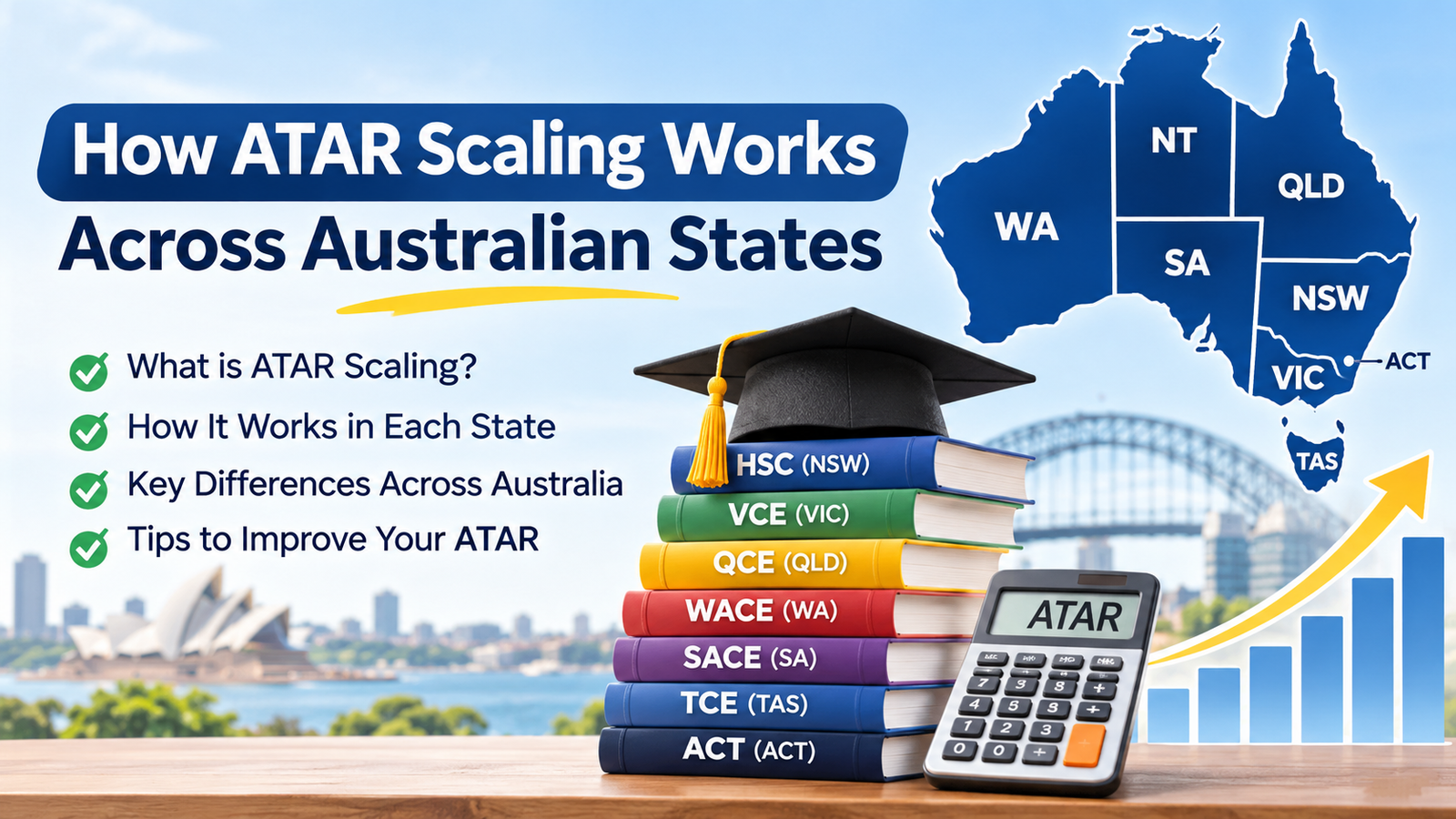
The Australian Tertiary Admission Rank (ATAR) plays an important role in university admissions across Australia. However, many students are confused about how their subject results are converted into an ATAR and why similar marks in different subjects can produce different scaled scores.
ATAR scaling is designed to make academic results comparable across subjects with different student cohorts and assessment systems. While the purpose of scaling is broadly consistent throughout Australia, each state and territory has its own calculation methodology, eligibility requirements and subject aggregation rules.
Understanding how these systems work can help students make informed subject choices, set realistic academic goals and prepare for university admission.
What Is ATAR Scaling?
ATAR scaling is a statistical process that adjusts subject results to make them comparable across different courses. It considers the academic performance of students taking each subject, helping tertiary admissions authorities calculate a meaningful overall ranking.
For example, a student achieving a high mark in Mathematics may receive a different scaled score from a student achieving the same mark in Business Studies. This does not necessarily mean one subject is more valuable than the other. Scaling reflects statistical differences between subject cohorts.
The ATAR itself is a rank rather than a percentage. An ATAR of 90.00 generally indicates that a student ranks within the top 10% of their relevant age group.
Why Is ATAR Scaling Important?
Without scaling, comparing students who study different combinations of subjects would be difficult. Scaling provides a common framework for assessing academic achievement.
The main objectives of ATAR scaling include:
-
Comparing academic performance across different subjects.
-
Reducing the influence of differences between subject cohorts.
-
Supporting consistent university admission decisions.
-
Allowing students to pursue subjects that match their interests and abilities.
-
Converting eligible academic results into an overall tertiary admission rank.
Scaling does not automatically reward students for selecting subjects perceived as difficult. Strong performance remains an essential factor in achieving a competitive ATAR.
How ATAR Scaling Differs Across Australian States
Although ATAR scores are designed to be comparable nationally, the calculation process differs across Australian education systems.
| State or territory | Qualification | Admissions authority |
|---|---|---|
| New South Wales | HSC | UAC |
| Victoria | VCE | VTAC |
| Queensland | QCE | QTAC |
| Western Australia | WACE | TISC |
| South Australia | SACE | SATAC |
| Tasmania | TCE | University of Tasmania |
| Australian Capital Territory | ACT Senior Secondary Certificate | ACT BSSS |
1. New South Wales (HSC ATAR Scaling)
In New South Wales, the Universities Admissions Centre (UAC) calculates the ATAR using eligible Higher School Certificate (HSC) results.
The calculation generally includes the best 10 eligible units, consisting of two units of English and the best eight remaining eligible units.
UAC scales subject results to account for differences in the academic performance of students across courses. Subjects such as Mathematics Extension and Physics may scale favourably in some years, but individual performance remains important.
Students should focus on achieving strong results rather than selecting subjects solely because of their historical scaling patterns.
2. Victoria (VCE ATAR Scaling)
The Victorian Tertiary Admissions Centre (VTAC) calculates ATAR scores using Victorian Certificate of Education (VCE) study scores.
The Victorian ATAR aggregate generally includes:
-
One eligible English-group scaled study score.
-
The next three highest eligible scaled study scores.
-
10% of the fifth eligible scaled study score.
-
10% of the sixth eligible scaled study score.
Additional eligibility and subject combination rules may apply.
VTAC adjusts study scores based on the academic competitiveness of subject cohorts. Consequently, some subjects may scale upwards while others may scale downwards.
3. Queensland (QCE ATAR Scaling)
In Queensland, the Queensland Tertiary Admissions Centre (QTAC) calculates ATAR scores using eligible senior secondary qualifications.
The calculation generally considers one of the following combinations:
-
Five General subjects.
-
Four General subjects and one Applied subject.
-
Four General subjects and one eligible Certificate III or higher vocational qualification.
Students must also satisfy the English eligibility requirement, although English does not necessarily contribute to the final ATAR calculation.
QTAC uses inter-subject scaling to compare results across different subjects and eligible qualifications.
4. Western Australia (WACE ATAR Scaling)
In Western Australia, the Tertiary Institutions Service Centre (TISC) calculates ATAR scores using eligible Western Australian Certificate of Education (WACE) course results.
The Tertiary Entrance Aggregate (TEA) is generally calculated using a student’s best four eligible scaled course scores, with additional bonuses available for certain eligible subjects.
The aggregate is then converted into an ATAR based on the relevant ranking methodology.
Students should consider university prerequisites alongside their expected academic performance when selecting WACE courses.
5. South Australia (SACE ATAR Scaling)
The South Australian Tertiary Admissions Centre (SATAC) calculates ATAR scores for eligible students completing the South Australian Certificate of Education (SACE) or Northern Territory Certificate of Education and Training (NTCET).
The university aggregate is calculated from 90 credits of eligible Stage 2 studies, subject to specific qualification and aggregation requirements.
SATAC applies scaling to eligible subject results before calculating the university aggregate and converting it into an ATAR.
6. Tasmania (TCE ATAR Scaling)
In Tasmania, ATAR calculations use eligible senior secondary course results and scaled course scores.
The tertiary entrance score generally considers a student’s best five eligible scaled course scores, with at least three coming from the final year of senior secondary study.
The resulting aggregate is converted into an ATAR through the relevant ranking process.
Students must also meet applicable tertiary entrance eligibility requirements.
7. Australian Capital Territory (ACT ATAR Scaling)
In the ACT, the Board of Senior Secondary Studies (BSSS) administers the senior secondary assessment and scaling framework.
The system uses course scores, statistical moderation and the ACT Scaling Test (AST) to support comparisons across different schools and subject groups.
Eligible scaled course scores contribute to a student’s university admission aggregate, which is subsequently converted into an ATAR.
How Can Students Estimate Their ATAR?
Students do not necessarily need to wait until their final examination results are released to explore their potential ATAR.
Using a free ATAR Calculator, students can enter their expected subject results, explore estimated scaled scores and understand how different academic outcomes may influence their overall ranking.
An online ATAR estimation tool can help students:
-
Set realistic academic targets.
-
Identify subjects that need improvement.
-
Explore different subject combinations.
-
Compare potential academic outcomes.
-
Research suitable university courses.
-
Plan their higher education pathway.
However, estimated ATAR results may differ from official results because actual scaling depends on cohort performance, eligibility requirements and annual calculation data.
Does Choosing High-Scaling Subjects Guarantee a Higher ATAR?
One of the most common misconceptions among Australian students is that choosing high-scaling subjects guarantees a higher ATAR.
While subjects such as Specialist Mathematics, Chemistry and Physics may scale favourably in certain education systems, selecting these subjects without considering personal strengths can negatively affect overall academic performance.
A student who performs exceptionally well in a traditionally lower-scaling subject may achieve a better scaled result than someone who performs poorly in a higher-scaling subject.
The best subject selection strategy is to consider personal interests, academic strengths, university prerequisites and future career objectives.
ATAR Scaling vs Raw Scores
Raw scores and scaled scores represent different stages of the assessment process.
| Raw scores | Scaled scores |
|---|---|
| Reflect initial academic performance | Reflect statistically adjusted performance |
| Based on the relevant assessment system | Consider differences between subject cohorts |
| Not necessarily directly comparable across subjects | Designed to support subject comparisons |
| Used as inputs in the relevant assessment process | Contribute to eligible ATAR aggregates |
Understanding this difference helps students interpret their academic results more effectively and avoid relying solely on raw marks when estimating their ATAR.
How to Improve Your ATAR Score
Although students cannot directly control subject scaling, they can improve their academic performance through effective preparation.
Developing a consistent study schedule, practising past examination papers, seeking feedback from teachers and identifying weaker subject areas can significantly support academic progress.
Students should also regularly review their expected results, monitor university entry requirements and focus on subjects where they have the greatest potential to improve.
Maintaining a healthy balance between study, sleep and personal wellbeing is equally important throughout senior secondary education.
Frequently Asked Questions
Does ATAR scaling change every year?
Yes. Scaling outcomes can change annually depending on student performance, subject cohorts and the methodology used by the relevant admissions authority.
Is ATAR scaling the same across Australia?
No. Each state and territory uses its own assessment and scaling framework, although ATAR ranks are designed to be comparable nationally.
Can a low-scaling subject reduce my ATAR?
A subject’s contribution depends on its scaled result and the applicable aggregation rules. Achieving strong academic results is generally more beneficial than choosing subjects based solely on scaling trends.
Can I calculate my ATAR before receiving my final results?
Yes. Online ATAR calculators allow students to estimate their potential ranking using expected subject results. These estimates are useful for academic planning but are not official results.
Conclusion
ATAR scaling is an essential part of Australia’s tertiary admission system, allowing students with different subject combinations and educational backgrounds to be assessed on a comparable basis.
Although calculation methods vary across Australian states and territories, the fundamental objective remains the same: to provide a meaningful academic ranking for university admissions.
By understanding subject scaling, selecting suitable courses and consistently improving academic performance, students can make better educational decisions and work towards their preferred university and career pathways.