Starting an online business has become easier with modern ecommerce technology. Entrepreneurs, retailers, creators, and small business owners can now sell products online without investing heavily in traditional website development. However, choosing the best ecommerce platform for beginners is an important decision because the right solution can simplify website creation, product management, payments, and everyday business operations.
For someone entering ecommerce for the first time, the ideal platform should be affordable, easy to understand, mobile-friendly, and flexible enough to support future growth. Understanding the available features before making a decision can help avoid unnecessary costs and technical difficulties.
What Is an Ecommerce Platform?
An ecommerce platform is a software solution that allows businesses to create and manage online stores. It provides the tools required to display products, accept customer orders, process payments, and manage different aspects of online selling.
Most modern platforms offer features such as:
- Online store creation and customization
- Product and category management
- Inventory tracking
- Order management
- Payment integration
- Customer management
- SEO settings
- Mobile-responsive designs
- Sales analytics
For beginners, having these features in one system can make managing an online business more convenient.
How to Start an Online Store as a Beginner
People often search for how to start an online store because they want to turn a business idea into an online selling opportunity. The process becomes easier when it is divided into manageable steps.
1. Choose Your Products
Start by deciding what you want to sell. Popular categories include clothing, jewellery, beauty products, electronics, home décor, handmade items, and accessories.
2. Select a Business Name
Choose a name that is easy to pronounce, memorable, and relevant to your products. Check domain availability and social media usernames before finalizing it.
3. Choose an Ecommerce Platform
Compare different platforms based on pricing, features, ease of use, customization, and payment support.
4. Create Your Online Store
Select a suitable design, organize product categories, upload product images, and add clear descriptions.
5. Configure Payments and Shipping
Set up suitable payment methods and define shipping charges, delivery areas, and return policies.
6. Test Before Launching
Check product pages, mobile layouts, checkout functionality, payment processing, and website navigation before making your store public.
No Code Ecommerce Platform India: Build Without Programming
A no code ecommerce platform india solution allows entrepreneurs to create and manage online stores without writing programming code.
Instead of hiring developers for every website update, business owners can use visual editors and dashboards to perform everyday tasks.
Common activities include:
- Adding and editing products
- Uploading product photographs
- Creating categories
- Changing product prices
- Customizing website sections
- Managing inventory
- Processing customer orders
- Updating website content
This approach is particularly useful for beginners and small businesses that do not have dedicated technical teams.
However, ease of use should not come at the expense of important ecommerce functionality. Always check whether the platform provides the flexibility needed for future business requirements.
AI Ecommerce Website Builder: Make Store Creation Easier
An AI Ecommerce Website Builder combines artificial intelligence with website-building tools to simplify certain parts of creating an online store.
AI-assisted features can help users prepare website sections, generate initial product descriptions, organize content, and reduce repetitive work.
For example, a new clothing business launching multiple products can use AI assistance to prepare initial descriptions and category content instead of writing everything manually.
AI can help with:
- Website content suggestions
- Product descriptions
- Page structures
- Category content
- Store-building assistance
- Repetitive content workflows
However, AI-generated information should always be reviewed before publishing. Product details, pricing, shipping information, and business policies must remain accurate.
AI Ecommerce Platform: What Features Should Beginners Expect?
An AI ecommerce platform should offer more than automated content generation. It should also provide the essential tools required to operate an online business.
Beginners should look for:
Product Management: Easy product uploads, images, pricing, descriptions, and variants.
Inventory Management: Tools for tracking available stock and updating product availability.
Order Management: A simple dashboard for viewing and managing customer orders.
Payment Integration: Payment options suitable for the target audience.
SEO Functionality: Control over page titles, meta descriptions, URLs, and product content.
Mobile Optimization: Storefronts that provide a smooth shopping experience across smartphones and computers.
The combination of AI assistance and practical ecommerce features can reduce the workload involved in running a new online store.
Ecommerce Platform India: Important Features for New Sellers
Choosing an Ecommerce Platform India solution requires considering the needs of Indian customers and businesses.
Beginners should evaluate features such as UPI-ready payment options, GST-related workflows, mobile-friendly storefronts, inventory management, order processing, and customer communication.
Other important considerations include:
- Transparent subscription pricing
- Easy website customization
- Shipping management
- Secure checkout
- SEO-friendly architecture
- Customer support
- Scalability
A platform should make daily operations easier while allowing businesses to expand their product catalogs and customer base.
Shopify Alternatives India: Which Platform Should You Choose?
Businesses researching Shopify Alternatives India may be looking for different pricing structures, simpler store management, AI-powered functionality, or no-code website creation.
Before selecting a platform, compare the following:
- Monthly subscription and additional charges.
- Product and inventory management.
- Payment methods and transaction fees.
- Website design and customization.
- AI-assisted features.
- SEO tools and mobile performance.
- Customer support and scalability.
Do not select a platform based only on its starting price. Calculate the complete operating cost, including premium features, payment processing, integrations, and other expenses.
Common Mistakes Beginners Should Avoid
First-time sellers often make decisions based entirely on website appearance or promotional pricing. These factors are important, but they should not be the only considerations.
Avoid these common mistakes:
- Choosing a platform without checking its features.
- Ignoring transaction and additional charges.
- Uploading incomplete product information.
- Using poor-quality product images.
- Overlooking mobile optimization.
- Launching without testing checkout.
- Ignoring SEO and website navigation.
- Selecting a platform without considering future growth.
A well-organized store with accurate information and a simple checkout experience can create a better shopping journey.
How to Choose the Best Ecommerce Platform for Beginners
Before making your final decision, consider your business requirements.
Ask yourself:
- Can I create my store without technical knowledge?
- Is product management straightforward?
- Are suitable payment methods available?
- Can I manage inventory and orders?
- Does the platform support SEO?
- Can I customize my website?
- Is the pricing suitable for my budget?
- Can the platform support business growth?
Testing these features through a demonstration or trial can help you understand whether a platform is suitable for your requirements.
Conclusion
Choosing the best ecommerce platform for beginners involves finding the right balance between affordability, simplicity, essential features, and scalability.
A no code ecommerce platform india solution can reduce technical barriers, while an AI Ecommerce Website Builder can help simplify website creation and repetitive content tasks. Beginners should also evaluate an AI ecommerce platform based on its actual ecommerce capabilities rather than AI features alone.
Businesses comparing Shopify Alternatives India should carefully review pricing, payments, customization, inventory, SEO, and long-term requirements.
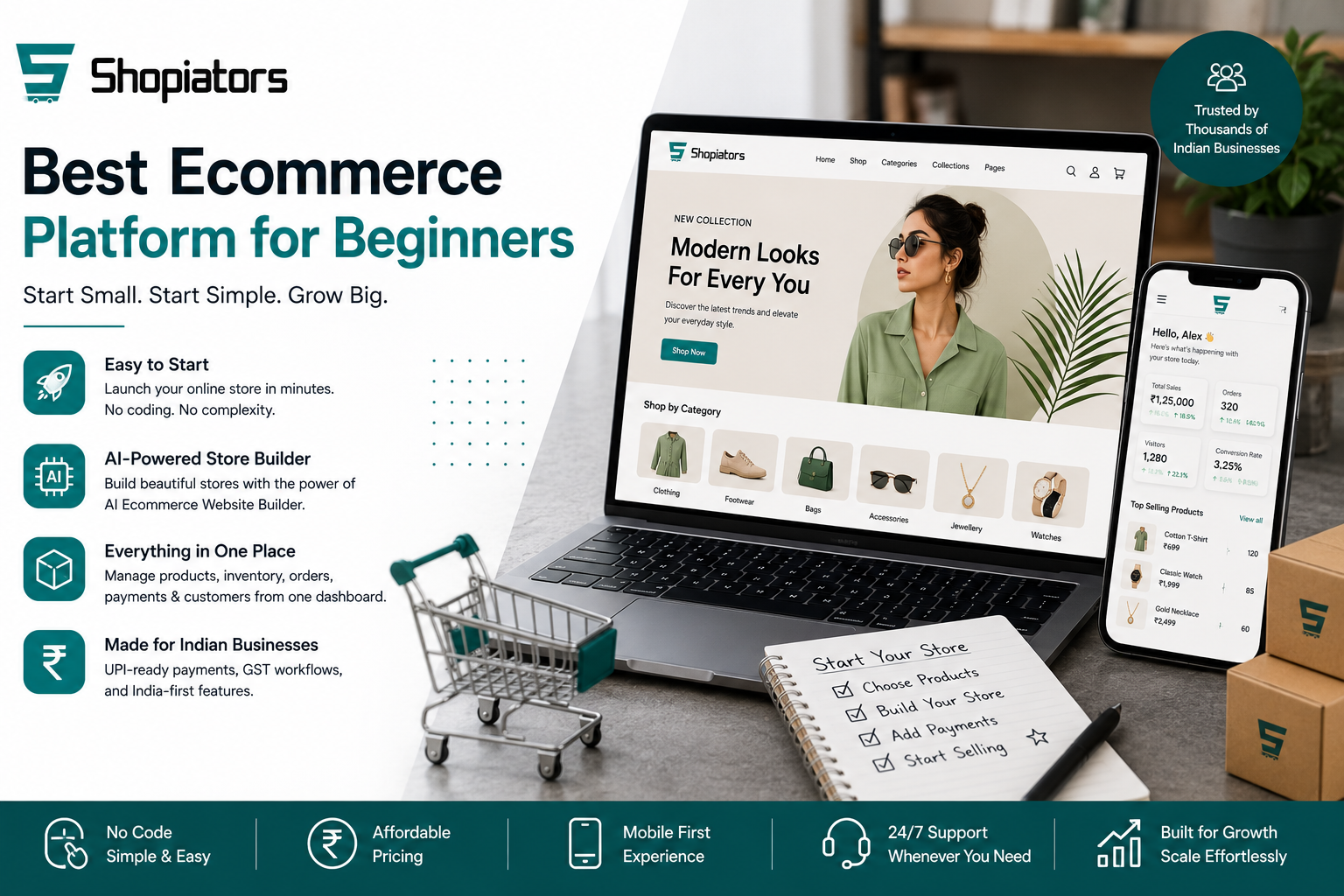
Shopiators is an India-first AI Commerce Platform that combines AI-assisted store creation with ecommerce infrastructure, helping entrepreneurs and growing businesses launch, manage, and expand online stores without complicated technical setup.