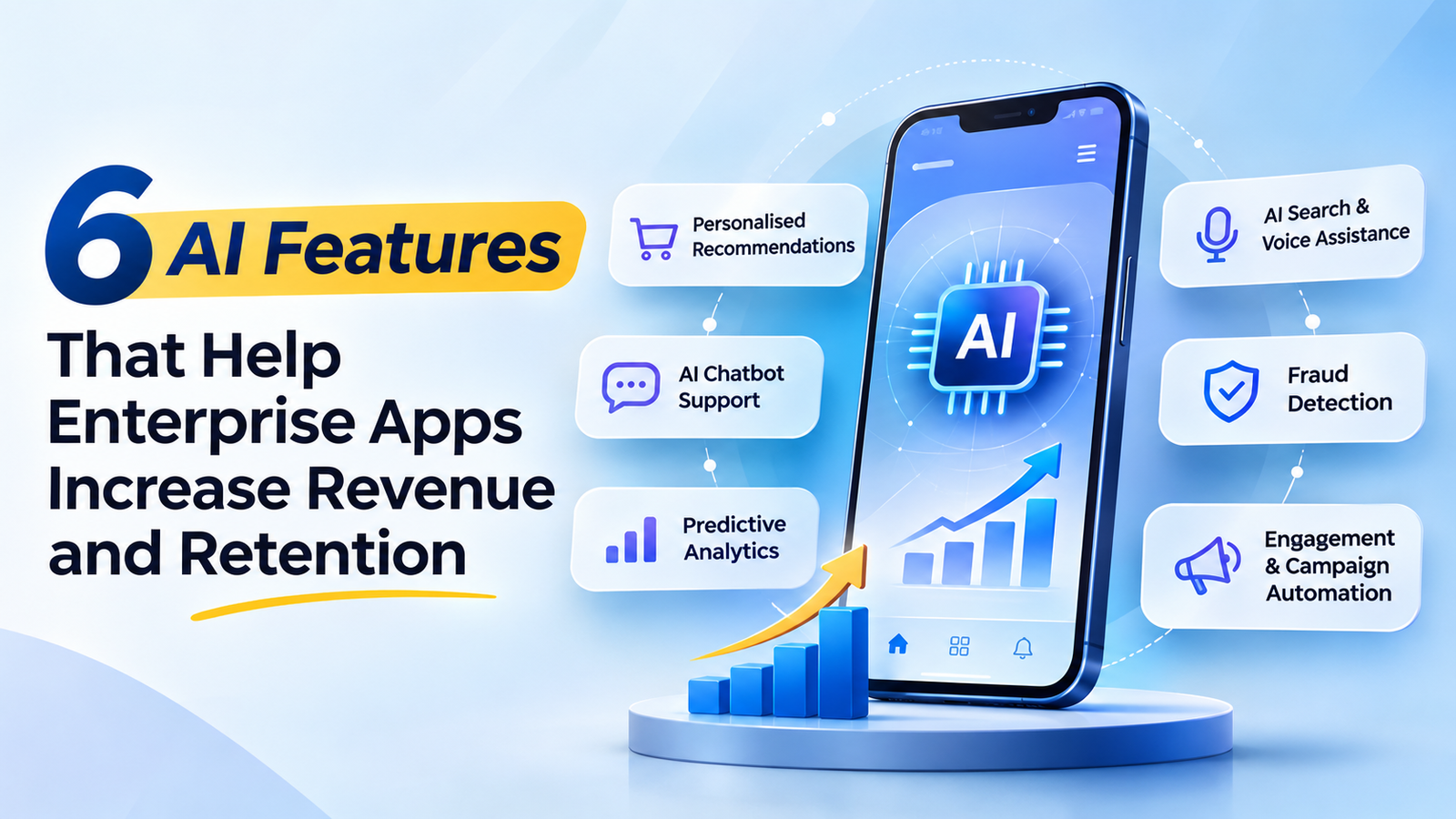
Enterprise mobile applications are becoming an important part of how businesses serve customers, manage operations, and generate revenue. Customers now expect faster responses, relevant recommendations, convenient payment options, and services that adapt to their needs. Traditional app features alone may not be enough to meet these expectations.
Artificial intelligence (AI) gives enterprise applications the ability to understand user behaviour, automate routine tasks, and deliver more relevant experiences. When these capabilities are planned around real business goals, they can support customer retention, improve operational efficiency, and create new revenue opportunities.
However, adding AI to an application should start with a clear business requirement. The right features depend on the industry, customer expectations, available data, and the application’s purpose.
Here are six AI features that can help enterprise mobile applications support revenue growth and customer retention.
Why AI Matters in Enterprise Mobile Applications
Enterprise apps often handle large volumes of customer interactions, transactions, service requests, and operational data. AI can help businesses use this information to improve how their applications work.
For example, an e-commerce company can use AI to recommend relevant products, while a banking application can identify unusual transaction patterns. A healthcare platform can use intelligent assistance to help users find services and manage appointments.
The business value comes from connecting AI capabilities to specific user needs.
Key areas where AI can contribute include:
- Customer engagement: Deliver relevant content, recommendations, and assistance.
- Revenue opportunities: Identify cross-selling and upselling opportunities.
- Customer retention: Recognise user preferences and improve the overall experience.
- Operational efficiency: Automate repetitive tasks and reduce manual effort.
- Decision-making: Use application data to understand customer behaviour and service performance.
6 AI Features That Can Support Revenue and Retention
1. AI-Powered Personalised Recommendations
Customers are more likely to engage with an application when its content and suggestions match their interests.
AI-powered recommendation systems analyse information such as browsing activity, purchase history, preferences, and previous interactions. Based on these patterns, the application can suggest products, services, content, or relevant actions.
For example, an online retail application can recommend products based on a customer’s previous purchases. A financial services app can highlight relevant products based on a user’s activity and stated preferences.
How it supports business growth:
- Encourages users to explore more products and services.
- Creates opportunities for cross-selling and upselling.
- Makes the application experience more relevant.
- Can increase repeat purchases and engagement.
Businesses should also give users control over personalisation settings and handle customer data responsibly.
2. AI Chatbots and Intelligent Customer Support
Customers expect support without having to wait for business hours or navigate complicated service processes. AI-powered chatbots can help address common questions directly within a mobile application.
These systems can understand user queries, retrieve relevant information, guide customers through processes, and direct complex requests to human support teams.
For example, an insurance application can help users understand policy information, check claim status, or find the next steps in a service request.
How it supports business growth:
- Provides support beyond standard business hours.
- Reduces pressure on customer service teams.
- Helps users find information more quickly.
- Improves the overall support experience.
A chatbot should not be expected to handle every situation. Applications should provide a clear option to connect with a human representative when a request requires additional attention.
3. Predictive Analytics for Customer Retention
Customer retention becomes difficult when businesses cannot identify why users stop engaging with an application.
Predictive analytics can examine historical interactions, usage patterns, transaction frequency, and other relevant data to identify potential changes in customer behaviour.
For example, a subscription-based business may notice that certain users are gradually reducing their application activity. An AI model can help identify patterns associated with cancellation risk, allowing the business to review the issue and respond with relevant support or offers.
How it supports business growth:
- Helps identify customers who may stop using the application.
- Supports targeted retention campaigns.
- Helps businesses understand changes in user behaviour.
- Provides insights for improving customer experience.
Predictions should be treated as indicators rather than certain outcomes. Businesses should test model accuracy and avoid unnecessary or intrusive customer targeting.
4. AI-Based Search and Voice Assistance
Search functionality plays an important role in applications that contain large product catalogues, service listings, documents, or information resources.
Traditional search often depends on exact keywords. AI-based search can interpret the meaning behind a query and help users find relevant results even when they do not use the exact wording.
Voice assistance can provide another way to interact with an application. Users may search for products, check information, or navigate selected functions through voice commands.
For example, a business application could allow employees to search internal resources using natural-language queries instead of navigating multiple screens.
How it supports business growth:
- Reduces the time required to find information.
- Improves product and service discovery.
- Makes application navigation easier.
- Supports more accessible interaction options.
The implementation should account for language differences, search accuracy, privacy, and accessibility.
5. AI-Powered Fraud Detection and Transaction Monitoring
Security directly affects customer confidence, particularly in banking, retail, insurance, and other applications that handle payments or sensitive information.
AI-based fraud detection systems can analyse transaction patterns, device information, login behaviour, and other signals to identify activity that may require investigation.
For instance, if a payment differs significantly from a customer’s usual transaction pattern, the system may flag it for additional verification.
How it supports business growth:
- Helps identify suspicious activity.
- Supports faster risk assessment.
- Strengthens transaction monitoring.
- Helps protect customer trust.
AI-based detection should work alongside established security controls, human review, and appropriate verification processes. Businesses must also consider false alerts, data protection, and regulatory requirements.
6. AI-Powered Customer Engagement and Campaign Automation
Customer engagement does not end after someone downloads an application or completes a purchase. Businesses need relevant communication to encourage users to return.
AI can help analyse customer activity and identify suitable opportunities for notifications, offers, reminders, and other engagement campaigns.
For example, a travel application may send a reminder about an unfinished booking. A retail application may notify customers about products related to their previous purchases.
How it supports business growth:
- Helps businesses deliver more relevant communication.
- Supports repeat purchases and customer engagement.
- Reduces manual campaign management.
- Helps marketing teams evaluate campaign performance.
Businesses should avoid sending excessive notifications. Communication frequency, user consent, and customer preferences should remain central to campaign planning.
What Should Businesses Consider Before Adding AI to an Enterprise App?
Selecting AI features is only one part of the development process. Businesses also need to consider how these features will work with existing systems, application architecture, and customer data.
Before development begins, decision-makers should evaluate the following areas.
Business Goals and User Requirements
Start by identifying the problem the application needs to solve. Is the objective to improve customer support, increase repeat purchases, reduce fraud, or make internal processes faster?
The selected AI feature should have a clear connection to that objective.
Data Availability and Quality
AI features depend on relevant data. Businesses should review whether their existing systems provide sufficient, accurate, and appropriately collected information.
Poor-quality or incomplete data can affect the reliability of recommendations and predictions.
Integration With Existing Systems
Enterprise applications often connect with CRM platforms, ERP systems, payment gateways, analytics tools, and internal databases.
The AI functionality should fit into this existing technology environment without creating unnecessary complexity.
Security and Privacy
Customer information must be handled carefully. Businesses should define access controls, data storage practices, encryption requirements, and consent mechanisms before introducing AI-powered features.
Performance and Scalability
AI functionality should not make an application difficult to use. Teams need to consider response times, server requirements, API usage, and expected user growth.
Testing and Continuous Improvement
AI features require ongoing evaluation. Businesses should monitor accuracy, user adoption, response quality, and their impact on business outcomes.
How to Choose the Right AI and Mobile App Development Partner
Enterprise AI development requires more than integrating an AI API into an existing application. Development partners need to understand business requirements, mobile architecture, data integration, security, and long-term maintenance.
When evaluating potential partners, businesses should consider:
- Experience with enterprise mobile application development.
- Knowledge of AI integration and application architecture.
- Expertise in Android and iOS development.
- Ability to connect applications with existing business systems.
- Understanding of data security and privacy requirements.
- A clear approach to testing, deployment, and maintenance.
- Previous projects relevant to the business’s industry.
Businesses exploring regional development options may evaluate an AI App development company in Saudi Arabia based on its experience with enterprise requirements, AI integration, and local market expectations.
Organisations in Oman can also assess AI application service partners in Oman for their ability to develop and integrate AI features into existing business applications.
For companies planning mobile application projects in Bahrain, working with a mobile app development consultant in Bahrain can help clarify technical requirements, application scope, and development priorities before committing to a solution.
Businesses seeking development expertise in India may also compare an Android and iOS App Development Company in Bangalore India based on its mobile engineering capabilities, portfolio, integration experience, and post-launch support.
The right partner should be able to explain why a particular AI feature is suitable for the project, what data it requires, and how its business impact will be evaluated.
How Can Businesses Measure the Impact of AI Features?
Adding AI features does not automatically guarantee higher revenue or customer retention. Businesses need to measure whether the features are improving the application experience and supporting their objectives.
Useful performance indicators include:
| Business objective | Metrics to monitor |
|---|---|
| Increase revenue | Average order value, conversion rate, revenue per user |
| Improve retention | Repeat purchase rate, churn rate, retention rate |
| Increase engagement | Active users, session frequency, feature adoption |
| Improve support | Resolution time, chatbot completion rate, support requests |
| Strengthen security | Fraud detection accuracy, false-positive rate |
Businesses should establish baseline performance before implementation. This makes it easier to understand whether the AI feature is contributing to an improvement after launch.
Frequently Asked Questions
1. How does AI help enterprise mobile applications increase revenue?
AI can support revenue growth through personalised recommendations, improved product discovery, targeted engagement, and predictive insights. The results depend on the quality of implementation and how well the features match customer needs.
2. Which AI features are most useful for customer retention?
Personalised recommendations, predictive analytics, intelligent customer support, and automated engagement can help businesses improve retention. The most suitable combination depends on the application and its users.
3. Is AI integration suitable for existing enterprise mobile applications?
Yes. Businesses can integrate selected AI capabilities into existing applications through APIs, cloud services, or custom-developed components. The approach depends on the application’s architecture, available data, and integration requirements.
4. Should businesses develop separate AI features for Android and iOS?
Not necessarily. Many AI services can operate through a shared backend and API layer, allowing both Android and iOS applications to use the same capabilities. However, platform-specific design and performance requirements still need to be considered.
5. How much does it cost to add AI features to an enterprise mobile app?
The cost depends on the number and complexity of features, data requirements, third-party services, integrations, security needs, and development scope. A basic chatbot integration will generally require a different level of investment than a custom predictive analytics or fraud detection system.
Conclusion
AI can give enterprise mobile applications new ways to engage customers, improve service delivery, and identify business opportunities. Features such as personalised recommendations, intelligent support, predictive analytics, AI-based search, fraud detection, and campaign automation can contribute to stronger customer relationships and better business performance.
However, businesses should select features based on actual requirements rather than adding AI simply to make an application appear more advanced. A clear development plan, reliable data, secure integration, and continuous performance monitoring are essential.
The next step is to identify the business problem that matters most, select the right AI capability, and build an application experience around it.