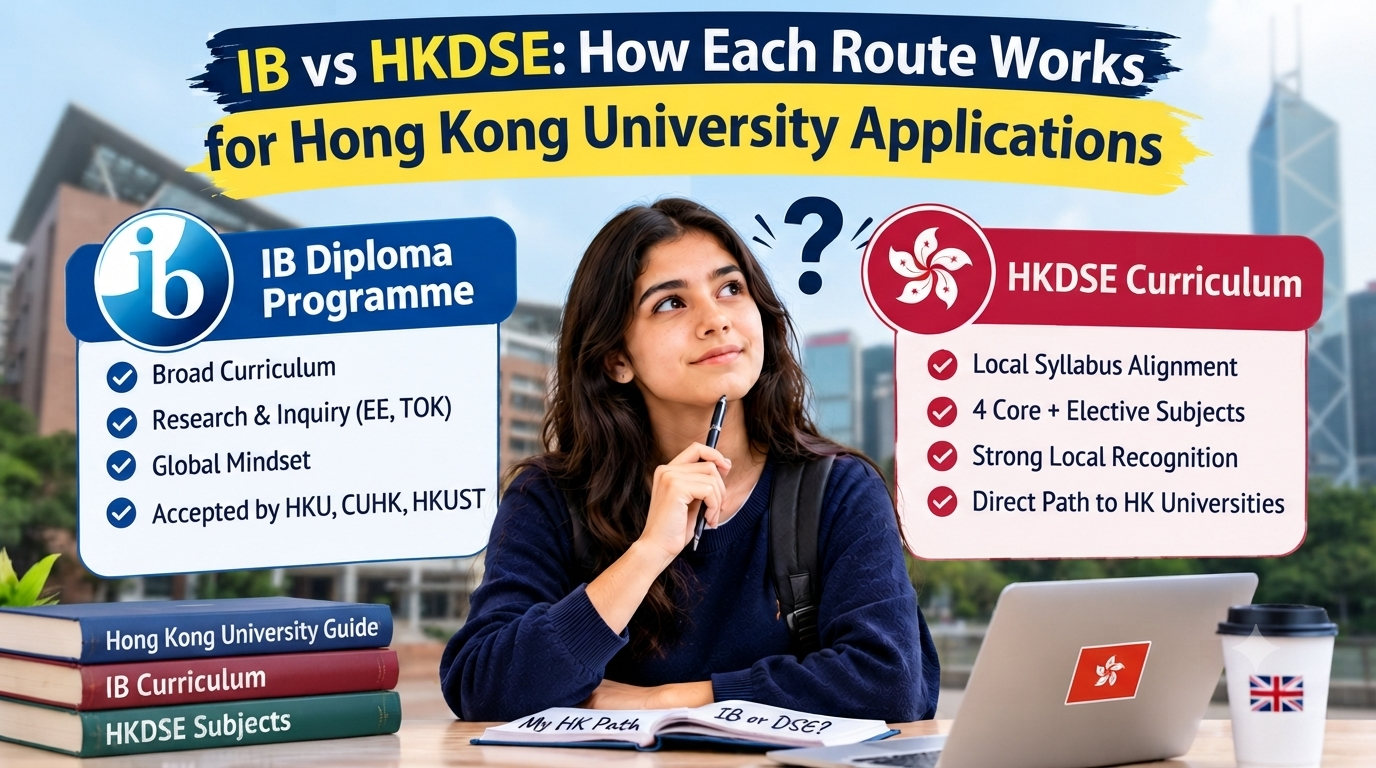
Choosing the right qualification for university admission is an important decision for high school students in Hong Kong. Two popular academic pathways are the International Baccalaureate (IB) Diploma Programme and the Hong Kong Diploma of Secondary Education (HKDSE). Both qualifications can open doors to leading universities in Hong Kong and overseas, but they differ in structure, assessment methods, subject choices and university application procedures.
For students planning to apply to universities such as the University of Hong Kong (HKU), the Chinese University of Hong Kong (CUHK) or the Hong Kong University of Science and Technology (HKUST), understanding these differences can help them make a more informed decision.
So, should you choose IB or HKDSE? The answer depends on your academic strengths, preferred learning style, university ambitions and future plans. This guide explains how both routes work and what students should consider before making their choice.
What Is the IB Diploma Programme?
The International Baccalaureate Diploma Programme is a two-year international qualification generally taken by students aged 16 to 19. It is recognised by universities around the world and is designed to develop academic knowledge, independent thinking, research skills and a broad understanding of different subjects.
The IB Diploma Programme requires students to study six subjects across different academic groups. Students normally take three subjects at Higher Level (HL) and three at Standard Level (SL), although some variations are possible under IB rules.
In addition to their six subjects, students complete three core components:
- Theory of Knowledge (TOK): Encourages students to think critically about how knowledge is developed, understood and evaluated.
- Extended Essay (EE): An independent research project in which students investigate a topic of interest and produce an academic essay.
- Creativity, Activity, Service (CAS): Encourages students to participate in creative activities, physical pursuits and community service.
IB students receive grades from 1 to 7 for each of their six subjects. The maximum subject score is 42 points, while the core components can contribute up to three additional points. This creates a maximum overall Diploma score of 45.
The IB approach places considerable emphasis on independent learning, coursework, research and applying knowledge rather than relying exclusively on final examinations.
What Is HKDSE?
The Hong Kong Diploma of Secondary Education is the main public examination qualification for secondary school students following the local Hong Kong education system. It is generally taken at the end of Secondary 6 and is a major route into local universities.
HKDSE students normally study four core subjects:
- Chinese Language
- English Language
- Mathematics
- Citizenship and Social Development
Students also select elective subjects according to their interests, academic strengths and future university plans. These may include subjects such as Biology, Chemistry, Physics, Economics, Geography, History and Information and Communication Technology.
HKDSE results are reported using a grading scale from Level 1 to Level 5, with Level 5* and Level 5** representing higher levels of achievement above Level 5.
Unlike the IB Diploma Programme, HKDSE is closely connected to Hong Kong’s local education system and university admission structure. Students applying through the local route commonly use their HKDSE results to apply through the Joint University Programmes Admissions System (JUPAS), provided they meet the relevant eligibility requirements.
IB vs HKDSE: Key Differences
Although both qualifications prepare students for higher education, their academic structures and assessment approaches are different. Understanding these differences can help students identify which programme is better suited to their learning preferences.
| Feature | IB Diploma Programme | HKDSE |
|---|---|---|
| Programme | International Baccalaureate Diploma Programme | Hong Kong Diploma of Secondary Education |
| Duration | Normally two years | Secondary school programme leading to examinations at the end of Secondary 6 |
| Subject structure | Six subjects across different subject groups | Four core subjects and elective subjects |
| Subject levels | Higher Level and Standard Level | Subjects follow the HKDSE curriculum and assessment structure |
| Assessment | External examinations and internal assessment, alongside core requirements | Public examinations and school-based assessment where applicable |
| Scoring | Maximum of 45 points | Levels 1 to 5, including 5* and 5** |
| University applications | Often through direct or non-JUPAS applications in Hong Kong | Eligible local applicants commonly apply through JUPAS |
| International recognition | Widely recognised by universities internationally | Accepted by many universities in Hong Kong and overseas |
How Do Hong Kong Universities Accept IB Students?
Hong Kong universities accept the IB Diploma as an international qualification. Students who complete the programme can apply to universities using their IB results, subject to the institution’s admission requirements.
Universities such as HKU, CUHK and HKUST consider IB applicants through their relevant non-JUPAS or international qualifications admission routes. The precise application category depends on the applicant’s residency, educational background and the university’s eligibility rules.
Universities generally assess more than the total IB score. They may also consider:
- Overall IB Diploma points
- Grades in individual subjects
- Higher Level subject choices and results
- Programme-specific subject prerequisites
- English language proficiency, where required
- Interviews, portfolios or additional selection requirements for certain programmes
For example, a student applying for an engineering programme may need strong results in Mathematics and relevant sciences. A student interested in a humanities or language-related degree may need to demonstrate appropriate subject preparation and language ability.
It is important to understand that meeting a university’s general minimum entry requirement does not guarantee admission. Competitive programmes may expect substantially stronger academic results.
How Do Hong Kong Universities Accept HKDSE Students?
HKDSE is the primary local qualification used by eligible Hong Kong students applying to universities through JUPAS. This system allows applicants to submit programme choices and be considered according to their examination results and the relevant admission criteria.
Universities publish their own subject requirements and admission score calculations. Some programmes place particular importance on specific core or elective subjects, while others may use different weighting methods.
For example, a student applying for a science degree may need strong Mathematics and science results. A student applying for a business programme may be assessed using a different combination of subjects and score weightings.
Students should review the requirements of individual university programmes before selecting their HKDSE electives. Choosing subjects without considering future admission requirements could limit available options.
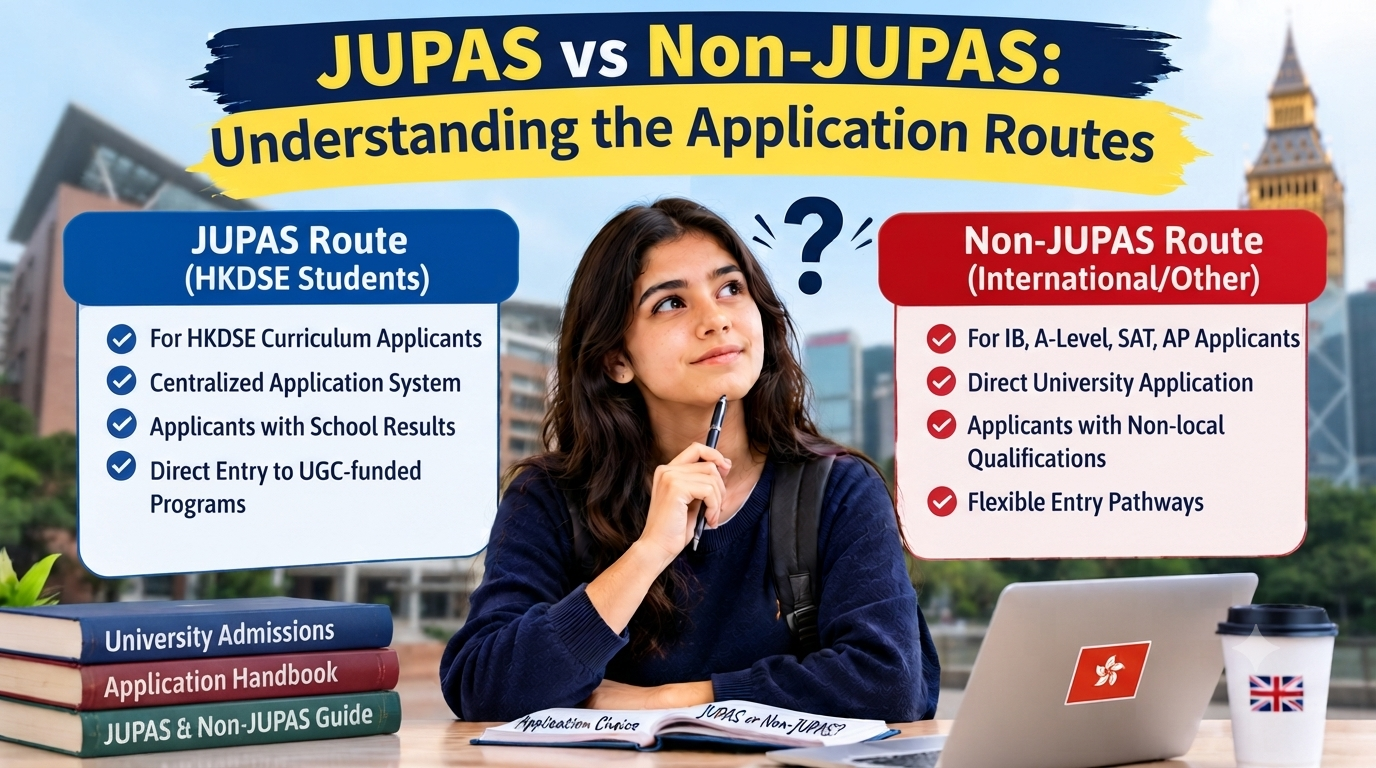
JUPAS vs Non-JUPAS: Understanding the Application Routes
One of the most important differences between IB and HKDSE applications in Hong Kong is the university admission route.
What Is JUPAS?
The Joint University Programmes Admissions System is a centralised application system for eligible local students applying to participating Hong Kong institutions using HKDSE results.
Applicants submit their programme preferences through the JUPAS system. Their applications are then assessed according to the admission requirements and selection procedures of the programmes they have chosen.
Students should carefully consider their programme preferences, subject combinations and expected examination performance when preparing their applications.
What Is Non-JUPAS?
Non-JUPAS is an alternative admission route used by universities to assess applicants with qualifications other than HKDSE through the relevant application channels.
IB Diploma students commonly apply through non-JUPAS or international qualifications admission routes, depending on their circumstances and the university’s rules.
However, it is important not to assume that every IB student automatically follows the same application route. Local and non-local status, previous education and individual university policies can affect eligibility. Applicants should confirm the correct route directly with each university.
Which Qualification Is Better for International University Applications?
If you are considering universities outside Hong Kong, the IB Diploma may offer a more internationally familiar qualification. It is accepted by universities in many countries, including the United States, the United Kingdom, Canada, Australia and several European destinations.
The IB’s broad subject structure can also help students demonstrate academic preparation across multiple disciplines. Its research and independent learning components may be useful when preparing for university-level study.
However, HKDSE is also recognised by many overseas universities. Students can apply internationally using their HKDSE results, although individual institutions may have different entry requirements and subject expectations.
The most suitable qualification depends on the universities and degree programmes a student intends to pursue. Students should check whether their preferred institutions accept the qualification and whether specific subjects or grades are required.
Subject Selection: Why It Matters for Both Routes
Subject selection is an important part of university preparation. Students should not choose subjects only because they appear interesting or seem easier to score well in. Their choices should also support their intended degree and future career direction.
Subject Selection in the IB Diploma
IB students have to select subjects across the programme’s six subject groups, with some flexibility depending on the school’s subject offerings and IB rules.
Students should consider their intended university course when deciding which subjects to take at Higher Level. Certain competitive degree programmes may require specific HL subjects or particular grades.
For example, students interested in engineering, medicine or science-related degrees may need to consider their Mathematics and science combinations carefully. Students planning to study literature, law-related disciplines or social sciences may benefit from choosing relevant language and humanities subjects.
Subject Selection in HKDSE
HKDSE students should also consider university prerequisites when selecting elective subjects. Different degree programmes may require specific subjects or give additional weighting to certain results.
Before finalising subject choices, students should compare the admission requirements of several universities. This can help them avoid selecting a combination that does not support their preferred academic pathway.
Workload and Assessment: Which Programme Is More Challenging?
Both IB and HKDSE require commitment, organisation and consistent preparation. However, the type of workload students experience can be different.
The IB Diploma combines examinations with internal assessments, research assignments, presentations and core requirements. Students need to manage several academic responsibilities throughout the programme. The Extended Essay, TOK and CAS also require time beyond regular subject lessons.
HKDSE students focus on the local curriculum and prepare for public examinations. School-based assessment may also form part of the evaluation in relevant subjects. Students need to develop strong subject knowledge, examination techniques and time management skills.
It is difficult to say that one programme is automatically easier than the other. The level of difficulty depends on a student’s academic strengths, subject choices, school environment and ability to manage the workload.
How Can Students Prepare for IB and HKDSE Successfully?
Regardless of the qualification, effective preparation should begin well before the final examination period. Students who build consistent study habits are generally better placed to manage academic pressure and identify areas that need improvement.
Some useful preparation strategies include:
- Create a realistic study schedule: Divide subjects into manageable study sessions and allow enough time for revision.
- Understand the assessment criteria: Learn how answers, coursework and examinations are evaluated in each subject.
- Practise regularly: Use past papers and sample questions to become familiar with examination formats.
- Identify weak areas early: Review difficult topics before they become larger gaps in understanding.
- Ask questions: Seek clarification from teachers or tutors when concepts are unclear.
- Maintain balance: Protect time for rest and activities outside academic work to avoid unnecessary burnout.
How Can an IB Tutor Help Students?
The IB Diploma can be demanding because students need to balance multiple subjects, internal assessments and core components. Individual academic support can help students understand difficult concepts, improve subject knowledge and develop more effective study strategies.
Working with an experienced IB tutor Hong Kong can provide students with subject-specific guidance, structured revision and support with challenging topics. Personalised lessons can also help students identify weaknesses and prepare more effectively for assessments.
For students studying language subjects, focused support in ib english language and literature can help develop analytical reading, written communication, text interpretation and essay-writing skills.
Good tutoring should complement classroom learning rather than replace independent study. Students should use tutoring sessions to clarify concepts, practise applying knowledge and receive feedback on areas where they need improvement.
Common Mistakes Students Should Avoid
When choosing between IB and HKDSE, students sometimes focus too heavily on general opinions rather than their own academic goals. A qualification that suits one student may not be the best option for another.
Here are some common mistakes to avoid:
- Choosing based only on reputation: A qualification’s international recognition does not automatically make it the right choice for every student.
- Ignoring university prerequisites: Subject combinations should be selected with future degree requirements in mind.
- Underestimating the workload: Both programmes require regular preparation and effective time management.
- Assuming all universities use the same requirements: Admission criteria can vary significantly between institutions and programmes.
- Leaving preparation too late: Consistent revision and early support are more effective than relying entirely on last-minute study.
Frequently Asked Questions
1. Is IB accepted by universities in Hong Kong?
Yes. Major Hong Kong universities, including HKU, CUHK and HKUST, accept the IB Diploma for admission consideration. Students must meet the relevant university and programme-specific requirements.
2. Can IB students apply through JUPAS?
IB students generally apply through non-JUPAS or the relevant international qualifications route rather than the standard JUPAS route. However, eligibility depends on the student’s background and the university’s admission rules.
3. Is HKDSE recognised by overseas universities?
Yes. Many overseas universities recognise HKDSE as an entry qualification. However, required grades, subject combinations and English language conditions vary by institution and degree programme.
4. Is IB more difficult than HKDSE?
There is no universal answer. IB involves a broad subject structure, internal assessments and core components, while HKDSE focuses on its local curriculum and public examination system. The more challenging option depends on the student’s strengths and learning preferences.
5. What is a good IB score for Hong Kong universities?
The score required depends on the university and degree programme. Some institutions publish general minimum requirements, but competitive programmes may expect higher scores and specific subject grades. Students should check the latest requirements for their intended year of entry.
6. Should I choose IB if I want to study overseas?
IB can be a suitable option for students considering international university applications because it is widely recognised. However, HKDSE is also accepted by many overseas institutions. Compare the entry requirements of your preferred universities before deciding.
Conclusion: IB or HKDSE – Which Route Should You Choose?
Both IB and HKDSE can provide strong pathways to university education in Hong Kong and overseas. The IB Diploma may suit students who prefer a broad international curriculum, independent research and continuous assessment. HKDSE may be a better fit for students who are comfortable with the local education system and want to follow the established JUPAS application route.
Before making a decision, consider your academic strengths, preferred subjects, university ambitions and learning style. Review the admission requirements of your target institutions and understand how each qualification supports your future plans.
Most importantly, choose the route that allows you to perform well academically while developing the skills and knowledge you will need at university. With careful planning, consistent preparation and the right academic support, both qualifications can lead to valuable opportunities.