A thermostat plays an important role in maintaining a comfortable home. It communicates with the heating and cooling equipment, lets occupants select a temperature, and helps the system respond to changing indoor conditions. When the display suddenly disappears, homeowners may be unable to adjust settings or tell whether the equipment is running. Although the problem can look serious, a dark screen does not automatically mean the thermostat needs replacing.
The right response depends on the thermostat model and the HVAC system connected to it. A few careful checks may reveal a simple power issue, while other causes require professional testing. This guide explains common causes, safe troubleshooting steps, and when to arrange service.
Begin With the Thermostat’s Power Source
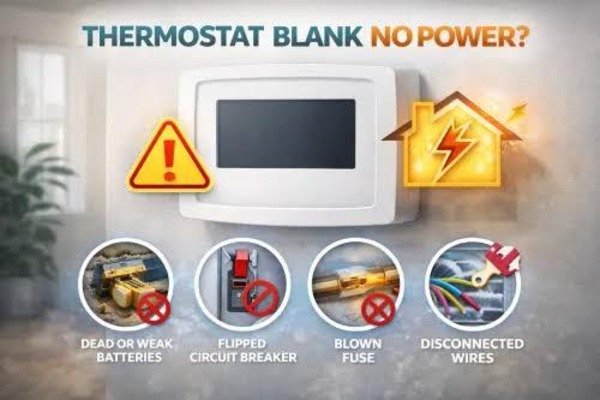
Not every thermostat receives power in the same way. Some models use replaceable batteries, some receive power through the HVAC system’s low-voltage circuit, and others use batteries as backup power. Check the model number and operating manual before troubleshooting. The manual identifies the correct power source and battery type, if applicable.
If the model uses batteries, remove the battery compartment according to the manufacturer’s instructions. Install fresh batteries of the specified type, observing the positive and negative markings. Make sure the compartment is fully closed. Do not assume every model has replaceable batteries; some designs do not.
A thermostat that relies on system power may go dark when power to the indoor HVAC equipment is interrupted. Replacing batteries will not solve that type of problem.
Check for an Interrupted Power Supply
A tripped circuit breaker can stop an HVAC system from receiving power. Look at the electrical panel for a breaker that appears out of position, but do not remove the panel cover or touch wiring. If the correct breaker is clearly identified and there are no signs of burning, moisture, or damage, follow the panel manufacturer’s instructions to reset it once.
If the breaker trips again, leave it off and contact a qualified electrician or HVAC professional. Repeatedly resetting a breaker can expose people and equipment to an unresolved electrical fault.
Some systems also have a nearby service switch that resembles a regular light switch. It may have been turned off accidentally during cleaning or other work. Check only switches that are clearly accessible and identified for the HVAC equipment. If you are unsure what a switch controls, leave it alone.
Consider HVAC Safety Switches and Drain Problems
Many air-conditioning systems include a condensate safety switch. It stops operation when water backs up in the drain system, helping prevent overflow and property damage. Depending on the system’s wiring, an interruption at the equipment can affect thermostat operation.
Look for visible signs of water around the indoor unit or near the condensate drain, but do not open equipment panels or bypass a safety switch. A technician can inspect the drain, determine whether a float switch has activated, and correct the cause. Bypassing the switch may allow water damage to occur.
Inspect the Symptoms Before Trying More
Notice whether the display is completely dark, intermittently fading, or showing partial characters. Also consider whether the heating or cooling system stopped at the same time. These details can help narrow the diagnosis.
For example, a screen that returns after fresh batteries may indicate depleted batteries. A display that goes dark whenever the HVAC equipment starts could indicate a power or wiring problem. If the screen flickers or the thermostat repeatedly restarts, record when it happens and share that information with the technician.
When a honeywell thermostat blank screen appears, resist the temptation to remove the thermostat from its wall plate or move wires around. Even low-voltage wiring can be damaged by incorrect handling, and some systems have more than one power source. Follow only the homeowner-level instructions provided for the exact model.
When Professional Diagnosis Is Necessary
If basic checks do not restore the display, the fault may involve the thermostat, transformer, control board, wiring, or another part of the HVAC system. These components should be tested by someone qualified to work on the equipment.
A technician can verify the power supply, inspect connections, test relevant safety circuits, and determine whether the thermostat has failed. This matters because replacing a thermostat without correcting a power-supply problem may leave the original symptom unresolved.
Arrange service promptly if you notice a burning smell, unusual heat near electrical equipment, visible wire damage, water around the indoor unit, or repeated breaker trips. If there is smoke or an immediate fire risk, move away and contact emergency services.
Habits That Help Prevent Future Problems
A few simple habits can reduce avoidable interruptions. Replace batteries according to the manufacturer’s recommendations, and use only the specified type. Keep the thermostat free of dust and avoid covering its air openings. Do not place lamps or other heat-producing devices directly beside it, because local heat can affect temperature readings.
Have the heating and cooling system professionally maintained at the intervals recommended for the equipment. Routine service can identify drain restrictions, deteriorating electrical components, and other developing issues. Keep the thermostat’s model number and manual available so future troubleshooting follows the correct instructions.
Choose the Right Fix, Not Just the Fastest One
A blank display can result from depleted batteries, interrupted power, an activated safety switch, or component failure. Start with the checks that the manufacturer considers safe for homeowners, then stop if the next step involves wiring, internal equipment, or uncertainty about the power source.
If a honeywell thermostat blank screen persists after basic checks, a qualified HVAC professional can determine whether the problem is at the thermostat or elsewhere in the system. Accurate diagnosis helps avoid unnecessary replacement, protects the equipment, and restores reliable temperature control.