Quick Summary
- Work at height means any task where a fall could cause injury, whatever the height.
- Safety rests on three rules: avoid the work, prevent the fall, and reduce the harm if a fall happens.
- India’s Occupational Safety, Health and Working Conditions (OSH) Code, 2020 has been in force since 21 November 2025. The Central Rules, 2026 followed on 8 May 2026.
- The right equipment, trained people and regular inspection do more than any poster on a wall.
- Y Group designs, manufactures and rents certified access equipment from Greater Noida, with branches across India.
Why This Topic Needs Your Attention
Every day, workers across India climb ladders, step onto platforms and lean over edges to finish a job. Most go home safe. Some do not. If you run a site, manage a plant or supervise a maintenance crew, you need a clear answer to one question: what is work at height safety, and how do you apply it on your own site?
This guide answers that in plain language. You will learn the meaning, the legal picture in India, the common risks and a step-by-step method you can use from tomorrow. It is written by the Y Group Team, who build and supply access equipment for industrial and commercial sites.
Work at Height Safety Meaning in Simple Words
Work at height means any task in a place where a person could fall far enough to be hurt. The UK Health and Safety Executive uses this wording and sets no minimum height. Even a low platform counts if a fall could injure someone.
Work at height safety is everything you do to stop that fall, or to limit the damage if it happens. It covers planning, equipment, training, supervision and inspection. So, what is work at height safety in daily terms? It means no one leaves the ground without a safe way up, a safe place to stand and a safe way down.
Does a Fixed Height Decide It?
Different authorities draw the line in different places. The table below shows why risk matters more than a number.
| Authority | How It Defines the Starting Point |
| OSHA (USA), general industry | 4 feet above the ground |
| OSHA (USA), construction | 6 feet above the ground |
| HSE (UK) | No minimum height; any fall risk that could injure |
| Italy (Legislative Decree 81/2008) | More than 2 metres above a stable surface |
| Poland (workplace rules) | At least 1 metre above floor or ground |
The safest approach for your team is simple. Treat any task where a fall could hurt someone as work at height.
What the Law Says in India Today
India has moved to a single, modern safety law. The OSH Code, 2020 brings 13 earlier labour laws under one roof, and it came into force on 21 November 2025. The Occupational Safety, Health and Working Conditions (Central) Rules, 2026 were notified on 8 May 2026 and apply across India. They cover factories, mines, construction work, dock work and more.
For anyone working at height, three points matter most:
- Falls are on the official radar. The new rules list fall from height and falling objects among the workplace incidents they address.
- Employers carry the main duty. Providing safe access, safe equipment and trained workers is the employer’s job.
- Rules vary by sector and state. Always check the exact requirements for your industry with your safety officer or legal adviser.
Y Group’s own figures point to more than 45,000 fall-from-height incidents reported in India each year, and most of them trace back to improvised or misused access equipment. Good law helps, but good equipment and good habits prevent the actual falls.
The Most Common Risks at Height
Knowing the risks makes them easier to control. These are the ones that show up again and again.
Improvised Access
A stack of drums, a borrowed ladder or a platform tied together on the spot may work once. It will not work every time. Equipment that is not designed for the job is a leading cause of falls.
Poor Planning
Jobs started in a rush and skipped the basic questions. Who will be at height? For how long? What could go wrong? A short plan before the work begins saves hours of trouble later.
Unprotected Edges and Fragile Surfaces
Roof edges, open floor holes, skylights and weak sheets cause serious falls. If you cannot see a safe surface, treat it as unsafe.
Misused Ladders
Overreaching, standing on the top rung and setting a ladder on soft ground are everyday mistakes. A ladder suits short, light tasks. It is not a workstation.
Falling Objects
A dropped spanner can hurt as badly as a fall. Anyone working below is at risk too, so tools need tethers, toe boards or exclusion zones.
Skipped Inspections
Equipment that was safe last year may have worn parts today. Regular inspection catches the problem before the worker does.
Untrained Workers
Even the best equipment is dangerous in untrained hands. People need to know how to build, use and check what they climb.
Electrical and Weather Hazards
Metal ladders near live lines invite disaster. Wind, rain and poor light add to the danger. FRP (fibreglass) ladders suit areas with electrical or spark risk.
The Hierarchy of Controls: Avoid, Prevent, Minimise
Safety experts follow a simple order of thinking. You start at the top and move down only when you must.
| Step | What It Means | Example |
| 1. Avoid | Do the work without going up | Prepare or assemble parts on the ground |
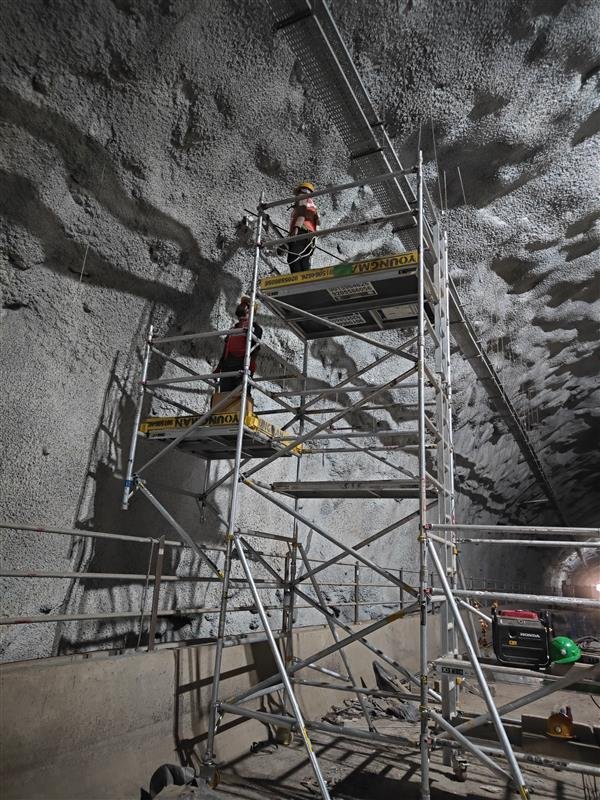
| 2. Prevent | Build protection into the workplace | Use a stable access tower with guardrails |
| 3. Minimise | Reduce harm if a fall still happens | Use a properly anchored harness or net |
Collective protection, such as guardrails and platforms, protects everyone at once. Personal protective equipment, such as harnesses, is the last line of defence, not the first. This is why Y Group builds safety into the equipment itself rather than relying on workers to make up for a weak setup.
A Practical 7-Step Method for Safe Work at Height
Use this checklist before any job above ground level.
Step 1: Ask if the work can be done from the ground. Many tasks can, with extension tools or ground-level prefabrication.
Step 2: Plan the job. Note the location, the duration, the number of workers and the surface conditions.
Step 3: Assess the risk. Look at edges, weather, nearby power lines, floor strength and rescue access.
Step 4: Pick the right equipment. Match the access product to the task, not to what is lying around.
Step 5: Check the equipment. Look at every part before use. Remove anything damaged, bent or missing.
Step 6: Brief and train the crew. Everyone should know the plan, the limits and the emergency steps.
Step 7: Supervise and review. A competent person should watch the work, and the team should talk about what went well and what did not.
Choosing the Right Access Equipment
The wrong tool for the job is a hazard in itself. Here is how common tasks line up with the product ranges Y Group provides.
| Task | Suitable Option | Why It Works |
| Indoor maintenance, painting, cleaning | Aluminium access tower | Stable platform with guardrails; light and quick to move |
| Short, light tasks | Aluminium ladder | Easy to carry and set up for brief jobs |
| Work near electrical or spark risk | FRP ladder | Non-conductive material suits sensitive areas |
| Larger structures and long projects | Scaffolding system | Wide, stable working area for several workers |
| Wide working surface at a fixed level | Work platform | Gives space to move and carry tools |
| Unusual spaces or special needs | Custom solution | Built around the site, not the other way round |
Y Group’s towers are built from 6082-T6 aluminium and made to EN1004:2020. Its ladders follow EN131, and the company works to ISO 9001:2015. Its products also align with Indian standards such as IS 3696 and IS 4014, and carry ERDA certification. These credentials matter because they show the equipment has been tested against recognised benchmarks.
Training and Inspection: The Parts People Forget
Equipment alone does not prevent falls. How it is built, used and checked matters just as much.
Training. Crews should know how to erect a tower, climb safely, carry tools and respond to an emergency. Y Group offers on-site safety certifications, scaffold erection training and compliance audits, because the right equipment used the wrong way is still dangerous.
Inspection. Check equipment before each use and keep records of formal inspections. Y Group publishes a User Guide and an Inspection Guide on its website to help teams build the habit.
Supervision. A trained person on site can stop an unsafe act before it becomes an accident.
Industries Where Height Safety Matters Most
Work at height is not limited to building sites. It shows up wherever machines, roofs, tanks and tall structures need care:
- Construction and infrastructure
- Power plants and energy facilities
- Oil and gas
- Iron and steel plants
- Railways and metro projects
- Pharma and FMCG facilities
- Mining
- Automotive and manufacturing plants
- Data centres and warehouses
- Ports and maritime sites
Each setting has its own risks. A pharma clean room needs light, non-marking equipment, while a steel plant may need a tower that handles heavy daily use. Matching the equipment to the environment is part of good planning.
How Y Group Supports Safer Sites Across India
Y Group (formerly Youngman India) was founded in 2011 and works as one connected group:
- Y-Access Manufacturing (YAM) designs and builds towers, ladders and platforms at its Greater Noida facility.
- Y Equipment Services (YES) rents light access equipment through 23+ locations across India, with same-day delivery, trained crews and 48-hour support.
- Safety Training helps teams use equipment correctly and meet compliance needs.
Clients include well-known names such as Tata Steel, Maruti Suzuki, NTPC and Reckitt. Branches serve cities including Mumbai, Chennai, Bangalore, Hyderabad, Pune, Kolkata and Ahmedabad, along with Guwahati and Goa.
Planning a Job Near Greater Noida or Anywhere in India?
Here is how to reach the Y Group team:
| Where | Details |
| 📍 Head Office | Plot No.14, Ecotech 1 Ext, Greater Noida, UP 201310, India |
| info@ygroup.co.in | |
| 📞 Call | +91-9015964626 |
| 🌐 Website | www.ygroup.co.in |
You can also ask for a free site survey, and the team will look at your site and suggest suitable access equipment.
Summary
Work at height means any task where a fall could injure someone. Safety follows a clear order: avoid the work, prevent the fall, then reduce the harm. India’s OSH Code and the 2026 Central Rules put clear duties on employers. The biggest risks are improvised access, poor planning, misused ladders, falling objects, skipped inspections and untrained workers. A simple 7-step method, the right equipment and regular training will keep your team safer.
Conclusion
Falls from height are among the most preventable workplace accidents. They happen when the setup is weak, the plan is missing or the equipment is wrong for the task. Now that you know what is work at height safety and how it works in practice, you can start with small steps. Plan each job, pick suitable equipment, train your crew and inspect before every use.
Every worker deserves to come home safe. If you want support from a team that designs, makes, rents and trains for safe access, Y Group is ready to help.
(FAQs)
- What is work at height safety?
It is the set of planning, equipment, training and habits that prevent falls from one level to another, or reduce harm if a fall happens. It applies to any task where a person could fall far enough to be hurt, not only to very tall structures.
- At what height does work become “work at height”?
The UK’s HSE sets no minimum height, because any fall that could injure counts. Other authorities use fixed starting points, such as 4 feet for OSHA general industry and 6 feet for OSHA construction. For daily use, treat any task with a real fall risk as work at height.
- Who is responsible for safety at height on a site?
Employers carry the main legal duty to plan the work, provide suitable equipment and ensure workers are trained and supervised. Workers also have a role: they should follow instructions, use equipment correctly and report faults or unsafe conditions.
- Is wearing a harness enough?
No. A harness is a last line of defence. Safety experts recommend avoiding work at height first, then using collective protection such as guardrails and stable platforms, and relying on personal protective equipment only when those are not possible.
- Should I choose a ladder or an access tower for longer jobs?
Ladders suit short, light tasks. For longer or more detailed work, an access tower is generally better because it provides a stable platform with guardrails, so workers can use both hands and move with more confidence. A site survey can help you decide.
About the Writer
Y Group Team is the in-house content and safety knowledge team at Y Group (formerly Youngman India). Backed by the company’s engineers, rental specialists and safety trainers, the team shares practical, easy-to-follow guidance on scaffolding, access towers, ladders and work-at-height safety for Indian industries. Reach them at info@ygroup.co.in or +91-9015964626.