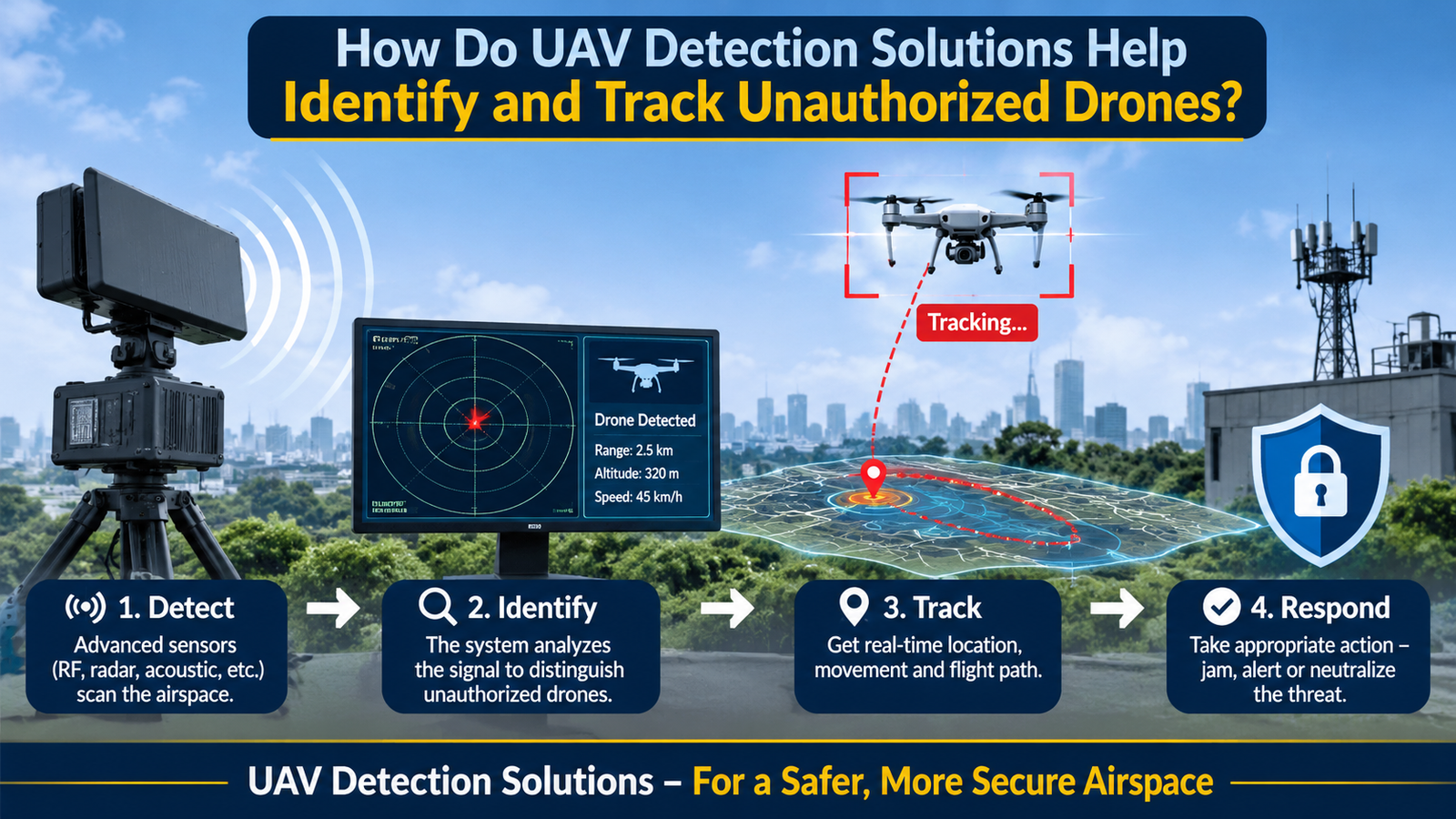
The usage of Unmanned Aerial Vehicles (UAVs), which are popularly called drones, is gaining popularity among a wide range of businesses for various purposes such as surveillance, photography, inspection of infrastructure, agriculture, logistics, and more. Although this technology has many benefits, its increasing use poses certain security risks. The usage of drones in unauthorized places like airports, military bases, government buildings, industrial sites, and other areas of this kind can raise serious security and privacy issues.
In this respect, UAV detection solutions can play a crucial role. This technology will allow security personnel to detect suspicious aerial operations, track the flight path of drones, and deal with the threat before it becomes dangerous.
UAV Detection Solutions
UAV Detection solutions or unmanned aerial vehicles (UAVs) are special tools for locating, identifying, and tracking UAVs that fly over a specified territory. Special sensors, artificial intelligence, and other means are employed to detect a drone, and differentiate between a drone and other airborne objects like birds and regular planes.
These tools constantly monitor the airspace around the site, and gather data on detected UAVs. Security staff can analyze this data and determine whether the drone is registered, unidentified, or possibly malicious.
For companies running large facilities or critical infrastructure, installation of such systems is a way to increase security awareness and enhance their security processes.
Identifying Unauthorized Drones Through Multiple Technologies
One of the key features of modern UAV detection systems is that they can be used for drone detection with various sensing technologies, each one being used for a particular task and enabling more accurate detection.
Radar-Based Detection
Radar technology relies on radio waves to detect objects in the sky, providing an indication of their approximate position, heading and speed. Some drone detection radars use tailored detection features to identify specific qualities of smaller objects in flight.
RF Detection
Radio frequency (RF) detection systems track the radio signals associated with the control and communication signals of a drone. A drone detection based on its RF footprint can also identify the drone’s location and, in some cases, the location of the drone pilot.
Electro-Optical, Infra-Red (E-O, IR) Cameras
Infrared sensors and visual cameras act as further confirmation when a drone is identified as a threat. They allow security personnel to locate and track the drone as well as differentiate it from other objects in the sky. They can also be used to monitor at night.
Acoustic Detection
Acoustic sensors detect the noise produced by drone propellers and motors. When paired with other methods of detection, acoustic sensors can be an additional method for detection in areas where visual surveillance is limited.
Real-time Tracking of the Movement of Drones
Recognizing an unidentified drone is just a beginning. It is important to know where the drone moves and whether it is threatening at all.
Modern UAV detection systems integrate data from several sensors to produce constant tracking histories. Depending on the technologies available, tracking history can involve the drone’s approximate location, altitude, heading, speed, and behavior.
All the information is presented through digital interfaces and geographic maps by centralized monitoring systems. Thus, operators can monitor the flight trajectory of drones, identify unusual movements, and track aerial activity within secured sites.
Real-time tracking plays a crucial role in airports, factories, power stations, and other infrastructures where any aerial activity might interfere with their work.
Improvement of Detection Through Intelligent Analysis to Reduce Unnecessary Alerts
All objects in the sky cannot be considered a threat. There are birds, helicopters, environmental disturbances, and other objects that can cause alerts.
Through artificial intelligence and machine learning capabilities, the technology helps to detect drone-related patterns from the data collected from sensors.
In the case where sensors collaborate with each other, they analyze data such as radar, radio frequency, acoustic signatures, and video cameras. This is referred to as sensor fusion, and it enhances decision making.
Identifying objects is important for reliable identification to save on time.
Enhancing Security at Critical Infrastructure Facilities
The use of unauthorized drones poses both operational and security risks to different industries.
- Airports: Detection technologies aid in recognizing drones flying near runways and airport flight corridors.
- Military bases: Monitoring technologies help in increasing the awareness of unauthorized aerial activity near military bases.
- Industrial facilities: The use of power plants, factories, and storage facilities can monitor the air above them.
- Government facilities: Detection technologies help security personnel recognize suspicious activities involving drones.
- Large events: Events involving lots of people can use improved aerial surveillance and increased security awareness.
Incorporating detection technologies in the current security infrastructure can help firms implement better air monitoring processes.
Conclusion
Commercial drone threats, an emerging security risk Drone threats are now an increasingly significant security issue for organizations charged with safeguarding personnel, property and key sites. For organisations seeking to mitigate drone security risks, current UAV detection solutions can help to detect rogue objects in the sky and make better security decisions.
As the technologies advance, it is essential to examine the capabilities of other detection and integrated control systems. For this reason, the approach of organizations to airspace awareness is increasingly relevant and the desire to increase security during operations.